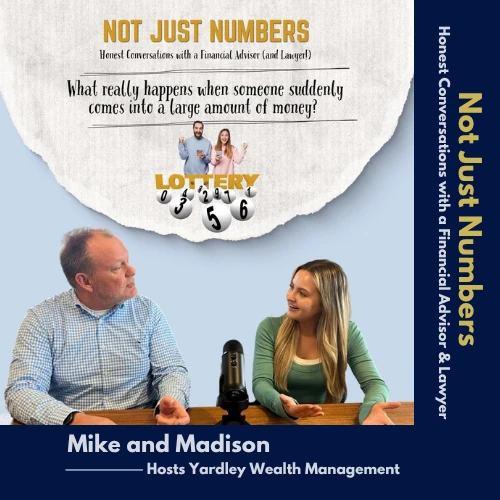
Episode 77: What Would You Do with a Windfall?

Hosts: Madison Demora and Michael Garry

Episode Overview

When a large sum of money lands in your lap, what you do in the first few months can shape your family’s finances for years. In this episode of Not Just Numbers, Mike and Madison talk through what happens after an inheritance, a bonus, or the sale of a business, and why emotion so often moves faster than strategy. They walk through five common patterns they see with clients, from big lifestyle purchases to money that sits untouched for years, and look at the enormous transfer of wealth expected over the next two decades. Then they share a simple five-step framework, including a “spending permission slip,” and explain why honest conversations with family matter. If a windfall is coming your way, or has just arrived, this episode is about slowing down and making it count.

Listen to Our Podcast On:

TIMESTAMPS

00:08 – 02:51 – Introduction

02:52 – 05:25 – The First 90 Days

05:26 – 11:49 – The Five Patterns

11:50 – 14:34 – Discussing the Great Wealth Transfer

14:35 – 17:05 – A Framework for Windfall Decisions

17:06 – 18:09 – Conversations Inside the Family

18:10 – 19:21 – Closing

Follow Us on Social Media

Stay updated with the latest episodes and news by following us on social media:
 

Episode Glossary

  • Windfall: A sudden or unexpected financial gain, such as an inheritance, business sale, bonus, or legal settlement.

Key Takeaways

  • A windfall is relative. It might be a $5 million inheritance, a $20,000 or $50,000 bonus that’s bigger than anything you’ve seen before, or the proceeds from selling a small business you spent 30 years building. The families who handle it well aren’t the ones with the biggest numbers. They’re the ones who paused, asked the right questions, and made deliberate decisions before the money got committed.
  • The first 90 days matter because emotion tends to outpace strategy. Common early missteps include lifestyle commitments made before there’s a plan, loans to family written under emotional pressure, investments based on a hot tip, and several big purchases in quick succession. The opposite can happen too. Money that feels too big to touch can sit in a checking or savings account earning nothing for years, especially with an inheritance that arrives during a time of loss, and it loses ground to inflation every day.
  • Many people don’t feel ready for a windfall. About 72% of Americans say they aren’t confident managing a large one, yet those same people often feel comfortable giving chunks of it away in the first month. Only about 20% say they would seek guidance from a financial professional. People also tend to treat money they didn’t earn like bonus money, which can lead to bigger risks and faster spending.
  • The Lifestyle Leap: a new house, upgraded cars, and a bigger vacation budget aren’t wrong on their own, but they can commit you to ongoing costs the windfall can’t support forever. In one example, a $3.5 million inheritance turned into a vacation home, a boat, private school for three children, and a major renovation. None of it was reckless alone, but together it locked up more than half the principal and created carrying costs of about $180,000 a year.
  • The Family First Impulse: the pressure to share can be intense, and generosity can be wonderful. But there’s a real difference between thoughtful gifting with proper documentation and writing checks in the first few weeks because saying no feels uncomfortable. The 2026 annual gift tax exclusion is $19,000 per person, or $38,000 for married couples giving jointly. Gifts beyond that can affect lifetime exemptions, so talk with a tax professional.
  • The DIY Investor and Sudden Wealth Syndrome: windfalls often bring a rush of investing confidence, and asking for help can feel like admitting you don’t know what you’re doing. Sudden wealth syndrome, a term coined by psychologist Stephen Goldbart in the 1990s, describes the anxiety, guilt, isolation, and difficulty trusting others that can come with unexpected money. People who navigate it well talk honestly with family, stay curious instead of embarrassed about what they don’t know, get clear on what they want the money to accomplish, give intentionally, invest strategically, and keep everyday spending from creeping up to match their new balance sheet.
  • A huge transfer of wealth is underway. Cerulli projects $124 trillion will change hands through 2048, with nearly $100 trillion moving from Baby Boomers and the Silent Generation to their heirs. About $62 trillion is expected to come from high-net-worth and ultra-high-net-worth households, and roughly $18 trillion is projected to go to charitable causes. Gen X is expected to inherit the largest amount over the next decade, around $14 trillion, while Millennials are the largest group of inheritors over the full window, at roughly $46 trillion.
  • Mike and Madison share a five-step framework: (1) secure the funds before making decisions, because the most powerful early move is often no decision at all; (2) get the right professionals working together, such as financial, tax, legal, and sometimes insurance; (3) define the purpose of the money; (4) cover the basics, including high-interest debt, your emergency fund, insurance, and your estate plan; and (5) build a spending permission slip by setting aside about 3 to 5% for guilt-free enjoyment, like a cheat day for a dieter.
  • Family conversations matter on both sides of a windfall. Think about who needs to know what, and when. Skipping these talks can lead to adult children counting on money that isn’t coming, siblings feeling blindsided, or parents hearing the news from someone else. You don’t have to share exact numbers. Sometimes it’s enough to acknowledge that something has changed and open the conversation. If you’re on the giving side, talk with your heirs and work with a lawyer to build an estate plan that reflects your values, rather than drafting it yourself.

Transcript

Not Just Numbers: Honest Conversations with a Financial Advisor and Lawyer
Episode 77 – What Would You Do with a Windfall?

Introduction & Hosts

Madison: Hello, everyone, and welcome to Not Just Numbers, Honest Conversations with a Financial Advisor and Lawyer. I am Madison Demora, and I am here with Mike Garry. Mike is a financial advisor and a CFP practitioner and the founder and the CEO of Yardley Wealth Management. He is also an estate planning lawyer, and his law firm is Yardley Estate Planning. Hey, Mike.

Mike: Hey, Madison. How are you this morning?

Madison: I’m good. How are you?

Mike: Good. Getting ready for this Memorial Day Weekend? Bright sunshine, warm temperatures. It probably is somewhere in the world, but not here.

What Happens First When a Windfall Arrives

Madison: Yeah, unfortunately. So, Mike, over the years you’ve worked with a lot of clients through major financial windfalls. Inheritances, business sales, bonuses, liquidity events. When someone suddenly comes into a large amount of money, what tends to happen first?

Mike: Well, Maddie, there’s almost always some kind of a splurge. Could be a little thing. It could be as big as a vacation home, renovations, trips that were never quite in the budget before. All kinds of things.

Madison: And honestly, I think a lot of people would hear that and say, well, of course. There’s nothing inherently wrong with enjoying some of it.

Mike: Well, exactly. People should enjoy a windfall. The issue is usually what happens in the months immediately after the money arrives. Because that window often determines whether the windfall becomes the foundation for something lasting, or whether short-term decisions quietly limit what could have been possible.

Madison: And something important to point out upfront is that a windfall can mean very different things for different people.

Mike: Oh, sure. You know, anything involving wealth and income is relative, right? I mean, for one family it could be a $5 million inheritance. For another it’s like a $20,000 or $50,000 bonus that is meaningfully larger than anything they’ve seen before. For others, the proceeds from selling a small business they spent 30 years building. You know, it really does differ.

Madison: It does. So it’s really less about the exact dollar amount and more about how significant it feels relative to that person’s life.

Mike: Yeah, that’s exactly right, Maddie. The emotional reaction and the advice we give are remarkably similar across the board. What feels like a windfall is relative to each family’s situation and what they define it as.

Madison: So whether the number on the wire transfer is six figures or eight figures, the patterns we are about to walk through tend to show up in the same way.

Mike: Yep. And the families who handle it well are not the ones with the biggest numbers. They’re the ones who paused, took a breath, asked the right questions, and made deliberate decisions before the money got committed.

The First 90 Days

Madison: One thing I’ve heard you say before is that the first 90 days after a windfall matter more than the next 10 years. That sounds kind of dramatic.

Mike: It does sound dramatic, but it’s true.

Madison: Why are those first few months so critical?

Mike: Because in those early weeks, emotion tends to outpace strategy. And we see it over and over again.

Madison: Can you walk us through what that looks like?

Mike: Sure. Lifestyle commitments made before any plan is in place. Loans to family members written under emotional pressure. Investment decisions made on a hot tip from a brother-in-law or a podcaster. Big purchases made in quick succession. A vacation, a renovation, a new car, and sometimes within the same six months.

Madison: And I imagine it’s not always overspending either.

Mike: No, sometimes it’s the exact opposite. Total paralysis. The money sits in a checking account because the number feels too big to touch. We probably have seen that one more often. You know, some inheritance often, and they come in and say, oh, yeah, it’s been sitting in a savings account earning nothing for two years. Yeah, that is quite common.

Madison: Yeah. That’s so interesting, because I think people assume everyone immediately starts spending.

Mike: Yeah. That analysis paralysis is especially real with inheritances. The money often arrives at the worst possible emotional moment, right, when someone’s just lost a parent or a loved one. And so nothing happens, sometimes for years.

Madison: There’s actually a behavioral finance concept tied to this, too. It’s called the house money effect. People tend to treat money they didn’t earn differently from money they did earn.

Mike: So, Maddie, five years ago, would you have ever thought you’d be discussing behavioral finance on a podcast? Come on, this was not in your bucket list, was it?

Madison: Maybe. Maybe.

Mike: But, you picked up the right thing. I mean, rationally, a dollar is a dollar, right? Like it doesn’t matter. But emotionally, people often treat windfall money like bonus money, which can lead to bigger risks and faster spending.

Madison: And the data supports that. Roughly 72% of Americans say they don’t feel confident managing a large financial windfall.

Mike: Right. But those same people feel confident giving chunks of it away in the first month.

Madison: Which probably leads into the patterns you’ve seen over the years.

Mike: It does. And after enough of these situations, you start recognizing the patterns very quickly.

Pattern 1: The Lifestyle Leap

Madison: Okay, let’s walk through those patterns. What’s the first one?

Mike: First one is what we call the Lifestyle Leap. The new house, upgraded cars, bigger vacation budget. None of it is inherently wrong. But we’ve seen clients commit to lifestyle expenses that require ongoing income to maintain, only to realize the windfall itself doesn’t generate enough return to support that lifestyle forever.

Madison: Can you give us an example?

Mike: Sure. A client received a three and a half million-dollar inheritance. It’s great, right? But then over the next 18 months, they committed to a vacation home, a boat, private school for three children, and a major renovation. Those kids probably aren’t going to go to cheap colleges either. None of it was reckless individually. But together it locked up more than half the principal and created annual carrying costs around $180,000 a year. Some serious money.

Madison: Yeah, I’d say so. So windfall that could have become generational wealth became more of a comfortable lifestyle.

Mike: Yep, exactly.

Madison: And to be clear, comfortable isn’t always a bad outcome.

Mike: No. Comfortable is great. But, you know, people should understand what the tradeoff is that they’re making, right?

Pattern 2: The Family First Impulse

Madison: That’s right. So what’s the second pattern?

Mike: The Family First Impulse. The pressure to share windfall can be intense. Adult children, siblings, parents, old friends. And generosity can be a beautiful thing. But there’s a real difference between strategic gifting, with proper documentation and tax awareness, and writing checks in the first few weeks because saying no feels uncomfortable.

Madison: And there are tax considerations here, too. The 2026 annual gift tax exclusion is $19,000 per person, and $38,000 for married couples giving jointly. Anything beyond that can start affecting lifetime exemptions, so it’s important to talk with a tax professional.

Mike: Exactly.

Pattern 3: The DIY Investor

Madison: So what’s the third pattern?

Mike: The DIY investor. Windfalls have a way of generating investment confidence. I don’t know why that is, but it is absolutely true. Someone receives, like, $800,000 and suddenly feels like they should manage it themselves.

Madison: Maybe because asking for help feels like admitting they don’t know what they’re doing.

Mike: Yeah, that’s probably it. And only about 20% of Americans say they would seek guidance from a financial professional after receiving a windfall.

Madison: Which is surprising considering these decisions are often much more complicated than managing regular monthly savings.

Mike: Exactly. It is really striking to think that only 20% of people who receive some sort of windfall, and most people have no real idea about how to manage something like that, wouldn’t even consider hiring a financial professional for it. It’s crazy to me.

Pattern 4: Sudden Wealth Syndrome

Madison: All right, so what’s the fourth pattern?

Mike: Sudden wealth syndrome. Term was coined by psychologist Stephen Goldbart in the 1990s. It describes the psychological and emotional distress that can come with an unexpected windfall. Anxiety, guilt, social isolation, difficulty trusting the people around you. So maybe they wouldn’t trust the financial professional either. I don’t know.

Madison: And I think inheritances make this even more emotional because the money is often tied directly to grief.

Mike: That’s right. The money arrives at the same moment someone is processing the loss of a parent or loved one. Making decisions can feel emotionally loaded, so people freeze.

Madison: But that paralysis has a cost too.

Mike: It does. Money sitting in a checking account is losing ground to inflation every single day.

The Great Wealth Transfer

Madison: Yeah, that’s true. So we mentioned windfalls show up in all sizes. But there is also a much bigger picture worth knowing about, because it’s shaping the next two decades for a lot of families.

Mike: Yeah, the whole wealth transfer has been talked about, my whole career in wealth management. But it’s out there like so Cerulli, which is a big consulting firm, is now projecting $124 trillion in assets will change hands through 2048, which is like 22 years from now. Nearly 100 trillion of that is expected to move from Baby Boomers and the Silent Generation to their heirs.

Madison: And a large portion of that is concentrated among high-net-worth households.

Mike: It sure is. Around 62 trillion is expected to come from high-net-worth and ultra-high-net-worth. Roughly $18 trillion is projected to go toward charitable causes.

Madison: And timing matters here, too. Gen X is expected to inherit the largest amount over the next decade.

Mike: Finally, Gen X gets something. Yeah, that’s around 14 trillion. And they will be receiving it at a complicated life stage. Many are already caring for aging parents while still helping adult children. You know, the oldest Gen Xers now are in their early 60s.

Madison: Millennials are the largest group of inheritors over the full 25-year window.

Mike: Yeah, millennials are a giant group, just like the baby boomers. So, yeah, I think for that Cerulli said like around 46 trillion by 2048.

Madison: So for people listening in their 50s or 60s with aging parents, this isn’t really a hypothetical conversation anymore.

Mike: Exactly. The question is not whether wealth will eventually transfer. It’s whether families are prepared for when it does.

Madison: And if someone is on the giving side of this equation, there are a different set of questions.

Mike: Right. Have you set your heirs up to receive your wealth wisely? Have you had the conversations? Have you structured your estate to reflect your values, not just your balance sheet? Have you structured your estate? We’ll make this real simple. Like, have those conversations. Talk to lawyers. Don’t try to draft it yourself. Like, take the time and spend a little bit of money that it costs to make sure things go right. Like, it’s really, really important. And you’ll be a huge, huge service for your kids and grandkids.

Madison: That’s right. And I think most families genuinely want to make life easier for their children.

Mike: They do. Right. But many haven’t done the work themselves to make sure you’re not unintentionally leaving behind confusion and conflict.

A Five-Step Framework for Windfall Decisions

Madison: Okay, let’s make this practical. If someone knows a windfall is coming, or one has just arrived, what’s the framework?

Mike: Well, we walk clients through five steps.

Madison: All right, so what’s step one?

Mike: Secure the funds before making decisions. Receive the money, park it somewhere safe, and don’t commit it to anything in the first weeks. Single most powerful financial decision you can make in those early days is no decision at all.

Madison: Basically, take a breath before reacting.

Mike: Exactly.

Madison: All right, what’s next?

Mike: Get the right professionals involved. Financial professional, tax, legal and or accounting professionals. Sometimes an estate attorney. Maybe an insurance specialist depending on the situation. Good strategy usually happens when those professionals are coordinating together. You need a team.

Madison: And I think a lot of people underestimate how many moving pieces there can be.

Mike: Yeah, they do. Many people try to handle everything through one advisor and unintentionally miss important pieces.

Madison: Right, so what’s step three?

Mike: Define the purpose. Like, what are you going to do with the money? What is this windfall actually for? Retirement? Helping your children? A legacy gift? A mix of all three? Clients who can clearly articulate the why behind the money tend to make much better decisions.

Madison: Otherwise, every opportunity starts feeling equally important.

Mike: Yep, exactly.

Madison: All right. And step four?

Mike: Cover the basics. Look at your full financial picture. Are there any high-interest debts worth paying down? Is the emergency fund where it should be? Are insurance coverages appropriate? Is the estate plan still aligned with what the family looks like today? These questions get skipped in the rush to make big moves.

Step 5: Build a Spending Permission Slip

Madison: And then the last step.

Mike: Build a spending permission slip.

Madison: Can you explain what that means?

Mike: Sure. We often encourage clients to intentionally carve out a small percentage of the windfall, you know, maybe 3 to 5% specifically for guilt free enjoyment. A trip. A renovation. Meaningful gifts. Whatever brings joy.

Madison: And why does that matter so much?

Mike: Yeah, Maddie, because if people don’t intentionally give themselves permission to enjoy part of the money, the pressure to enjoy all of it tends to build over time. That’s often when impulsive decisions happen.

Madison: So building enjoyment into that plan actually helps people stay disciplined.

Mike: Yep. It’s like, you know, it’s like a cheat day for a dieter. And it acknowledges something important. Windfall should create some joy, not just stress.

Conversations Inside the Family

Madison: All right. One piece we haven’t really talked about yet is the family conversation side of this. Because a windfall doesn’t just affect one person. It affects everyone connected to that person. And those conversations are some of the hardest to have.

Mike: They are. But, you know, we often always encourage clients to think intentionally about who needs to know what, and when. Aging parents may need to know that their adult child is now in a different financial position. Siblings may need clarity if there’s a shared family money in play.

Madison: And avoiding those conversations can create issues later.

Mike: Yep, all the time. Adult children may structure their lives assuming more money is eventually coming. Siblings who feel blindsided by gifts that went one direction. Parents who hear about a windfall through someone else.

Madison: And often these problems could have been avoided with a few intentional conversations early on.

Mike: You know, and importantly, those conversations do not have to include every exact number. Sometimes it’s simply acknowledging that something has changed and opening the dialogue.

Final Thoughts

Madison: So if someone listening today knows a windfall may be coming, or one has already arrived, the biggest takeaway is probably this: slow down.

Mike: Yep. Receive the money. Get the right professionals involved. Define the purpose of the money. Cover your basics. And give yourself permission to enjoy part of it.

Madison: Because a windfall is one of those few moments where the decisions you make in a short window can genuinely alter the trajectory of your family’s financial story. For better or worse.

Mike: Yeah, we’ve seen that play out both positively and negatively many times.

Madison: And if you want help thinking through what this could look for you and your family, that’s exactly the kind of work we do.

Mike: Reach out anytime.

Closing & Contact Information

Madison: Thanks for listening. For more information on Yardley Wealth Management or Yardley Estate Planning, you can visit our websites at yardleywealth.net and yardleyestate.net. You can also follow us on socials at Yardley Wealth Management. Don’t forget to subscribe to our YouTube channel. This podcast has been produced by Madison Demora and Mike Garry, with technical and artistic help from Poe Productions.

Request the Full Transcript as a PDF

The full transcript of this episode is available via email. Please fill out the form below to receive it: