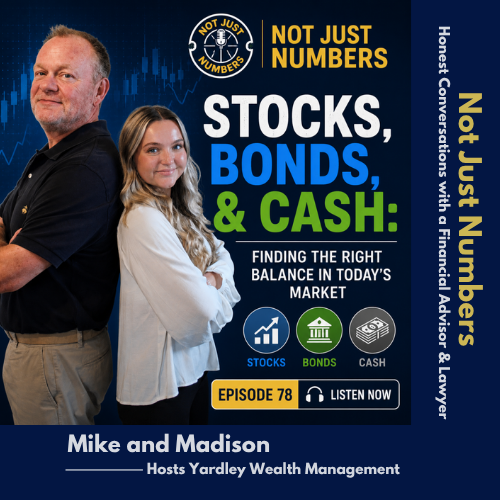
Episode 78: Stocks, Bonds, and Cash: What’s the Right Mix?

Hosts: Madison Demora and Mike Garry

Episode Overview

Are stocks too expensive? Do you own too many bonds? Are you sitting on too much cash? In this episode of Not Just Numbers, Madison and Mike unpack three recent Wall Street Journal articles that seem to point in different directions. Mike explains the equity risk premium, P/E ratios, and earnings yield in plain terms, then looks at whether the traditional 60/40 mix still makes sense and why cash can quietly lose value to inflation and taxes. They also explain how all three ideas can be true at once, and why the right balance of stocks, bonds, and cash depends on your goals, your time horizon, and your comfort with risk rather than on a rule of thumb.

Listen to Our Podcast On:

TIMESTAMPS

00:08 – 03:06 – Introduction

03:07 – 05:07 – What Is the Equity Risk Premium?

05:08 – 11:21 – Understanding P/E Ratios, Earnings Yield, and the Equity Risk Premium

11:22 – 12:26 – The AI Boom and High Valuations

12:27 – 20:09 – Why Asset Allocation Isn’t One-Size-Fits-All

20:10 – 25:42 – Are Investors Holding Too Much Cash?

25:43 – 27:11 – Reconciling the Three Articles

27:12 – 28:36 – Main Takeaways

28:37 – 29:54 – Closing

Follow Us on Social Media

Stay updated with the latest episodes and news by following us on social media:
 

Episode Glossary

  • P/E Ratio: Price-to-earnings ratio is a valuation metric that compares a company’s current stock price to its earnings per share (EPS), showing how much investors are willing to pay for each dollar of earnings.

Key Takeaways

  • Three recent Wall Street Journal articles seem to disagree, but they can all be true at once. Stocks may offer less of an edge over bonds than usual right now, stocks have still been the stronger long-term wealth builders, and holding too much cash carries a hidden cost. The real question isn’t which asset is best. It’s the right balance of stocks, bonds, and cash for you.
  • The equity risk premium is the extra return investors expect for owning stocks instead of steadier investments like U.S. Treasury bonds. Two things have narrowed that gap: Treasury yields have moved higher (Mike cited roughly 4.5% on the 10-year and over 5% on the 30-year), and stock prices have risen faster than earnings. Investors are still taking stock market risk, but they’re being paid a little less for it than in the past.
  • A stock’s share price alone doesn’t tell you whether it’s cheap or expensive. A $5 stock can be pricey for what it earns while a $2,000 stock can be a bargain. The P/E ratio shows how much investors pay for each dollar of earnings. A stock earning $1 per share and trading at $20 has a P/E of 20, and its earnings yield, the flip side of that number, is 5%. Mike notes that individual investors rarely use these measures, but money managers do when weighing stocks against bonds.
  • A narrow risk premium is a caution signal, not a sell signal. Valuation measures are useful, but they’re rarely good tools for timing the market, and people have warned that stocks are expensive for decades. Mike’s reminder: the most dangerous words in investing are “this time is different.” No one knows when a pullback will come. In 2022, stocks and bonds both fell, and hardly anyone saw it coming.
  • The AI boom is one reason investors stay optimistic despite high valuations. If artificial intelligence makes companies much more efficient and profitable, today’s prices may turn out to be justified. As Mike puts it, everyone agrees stocks are somewhat expensive. The question is whether future earnings growth can support those prices, and so far, earnings growth has been very strong.
  • Should you hold fewer bonds? One article argued for 90% stocks and 10% cash instead of a traditional 60/40 mix. Mike calls that provocative but rooted in something real: with low-cost, diversified funds and stronger rules than decades ago, the main risk of owning stocks today is short-term volatility rather than losing everything. Even so, retirees drawing income, people with shorter time horizons, and anyone who can’t handle big declines may need meaningful bond exposure. Allocation should follow your goals, time horizon, cash flow needs, and risk tolerance, not just your age or a rule of thumb.
  • Bonds didn’t protect investors in 2022, when stocks and bonds fell together as inflation and interest rates jumped. Mike says that doesn’t mean bonds no longer serve a purpose. It has rarely happened, and with yields much higher than a few years ago, bonds may offer more attractive opportunities going forward.
  • Cash feels safe, but it carries purchasing power risk. In Mike’s example, a 4% yield for someone in the 30% tax bracket is about 2.8% after taxes, which falls short of 3.8% inflation. The account balance goes up while the real value of the money goes down. A long-term study discussed in the episode found that even investors who put money into the S&P 500 at the worst possible time each year still ended up with more than those who stayed in cash.
  • Cash is a tool, not an investment strategy. Emergency funds, short-term spending, planned purchases, and liquidity reserves all belong in cash. The problem is holding far more than you need because of scary headlines or while waiting for a decline that may never come. Your cash should have a purpose.
  • Avoid making major portfolio decisions based on a single market narrative. Instead of trying to predict the next move, build a portfolio that fits your financial plan and can handle a variety of economic environments. Your allocation is a personal decision based on your goals, time horizon, income needs, and comfort with risk, and it’s worth revisiting over time rather than setting once and forgetting it.

Transcript

Not Just Numbers: Honest Conversations with a Financial Advisor and Lawyer
Episode 78 – Stocks, Bonds, and Cash: What’s the Right Mix?

Introduction & Hosts

Madison: Hello everyone and welcome to Not Just Numbers, Honest Conversations with a Financial Advisor and Lawyer. I am Madison Demora and I’m here with Mike Garry. Mike is a financial advisor and a CFP practitioner and the founder and the CEO of Yardley Wealth Management. He is also an estate planning lawyer and his law firm is Yardley Estate Planning. Hi Mike.

Mike: Hey Madison. How are you today?

Madison: I’m great. How are you?

Mike: Oh, not as good as you, but I’m all right.

Madison: Oh well, we’ll get there. Right?

Mike: Keep trying.

Today’s Topic: Three Articles, One Big Question

Madison: So today we’re discussing three recent Wall Street Journal articles that all touch on a question many investors are asking right now, how should we think about stocks, bonds, and cash in today’s market? One article argues the risk premium for owning stocks over bonds has nearly disappeared. Another suggests many investors may be overallocated to bonds. And a third makes the case that investors are holding too much cash and paying a hidden price for it through inflation and lost opportunity. At first glance, those ideas seem difficult to reconcile. If stocks look expensive, why own more of them? If bonds are offering higher yields, should investors lean into fixed income? And if cash is finally earning something again, how much is too much? Today, we’re going to unpack what these articles are really saying, discussing the trade offs between stocks, bonds, and cash, and talk how investors can think through these decisions within the context of their own financial plans. Mike, thanks for joining me.

Mike: Maddie, thanks for having me here. And do I get this straight, like your boss asked you to synthesize three articles, read them, and come up with a coherent set of questions? I hope this job is going okay for you, because that’s a little bit much to ask. But look, these articles all had a theme to them, and they’re kind of different, but they’re all kind of together, too. So, one of the things I like is they challenge some of the assumptions investors often make. We tend to think of stocks, bonds, and cash in very simple, maybe too simplistic terms, like stocks for growth, bonds for safety, cash for stability, but the reality is more nuanced. Right. And so, today’s discussion is really about understanding the role each asset class plays and how investors can make thoughtful decisions in a market environment that’s constantly evolving. And it’s not going to stop evolving, hasn’t ever stopped evolving. So, you know, it’s always a good subject to think about and think through and update during your life. You know, see where you are. It’s not like a set it and forget it when you’re 36 and you have the same portfolio forever. You know, it’s something you need to constantly think about.

What Is the Equity Risk Premium?

Madison: All right, so let’s start with the first article. It talks about the equity risk premium nearly disappearing. That’s not a term most investors use every day. What exactly is the equity risk premium?

Mike: You don’t use equity risk premium every day, Maddie? That’s not something you’re talking about? Even I don’t. So at its core, the equity risk premium is the extra return investors expect to receive for owning stocks instead of less volatile investments like U.S. treasury bonds. Stocks carry more uncertainty. Companies can miss earnings, economic conditions can deteriorate, and stock prices can decline significantly. Because of that risk, investors generally expect higher returns from stocks over time. And historically, that premium has been meaningful. But today, because bond yields have risen while stock valuations remain elevated, that gap has narrowed considerably.

Madison: So investors are taking stock market risk but aren’t necessarily being compensated as much as they have been in the past?

Mike: Right. You know, the stock returns are elevated. Right. So people are making a lot of money investing in stocks. But if you’re looking at it like from today, if you’re going to make an investment in stocks, you’re not being compensated too much more than you would by taking bonds, by buying bonds. So when the premium shrinks, future stock returns may not be as attractive relative to bonds as they have historically.

Madison: So what has caused this situation?

Mike: Two forces at work. First, treasury yields have moved higher. Investors can now earn like it’s like four and a half percent on 10 year, and the 30 year has gone over 5%. So that’s meaningful return from an asset considered virtually risk-free. And second, stock prices have risen significantly. When stock prices rise faster than earnings, valuations become more expensive and the earnings yield falls.

Understanding P/E Ratios and Earnings Yield

Madison: So let’s pause there for a moment because I think earnings yield and valuation are terms investors hear all the time but may not fully understand.

Mike: So I’m going to explain what earnings yield is and how it relates to something called P/E ratio. So like equity risk premium, nobody ever talks about that. P/E is probably the one that people have heard and talked about the most. So the P/E ratio, or price to earnings ratio, is a very common way investors value stocks. The thing is like, the individual stock price doesn’t tell you anything about the company or its earnings or if it’s a cheaper or expensive stock. A $5 per share stock could be really, really expensive for the earnings you buy, while a $2,000 stock might be cheap. So, like a $5 stock isn’t necessarily cheaper than a $2,000 stock. And so, to kind of normalize the numbers, somebody long time ago came up with a P/E ratio. So it tells us how much investors are willing to pay for each dollar of the company’s earnings. For example, if a company earns a dollar per share and a stock trades at $20.00 per share, it has a P/E ratio of 20. The earnings yield is simply the inverse of that calculation. Instead of asking how much you’re paying for a dollar of earnings, it asks how much earnings you’re getting relative to the price you’re paying. So in that same example, a stock trading at 20 times earnings has an earnings yield of 5%.

Madison: And that’s one reason investors compare earnings yield to bonds yields?

Mike: Yep. So it’s not perfect comparison because stocks and bonds are very different investments, but it gives investors a useful way to evaluate relative value. If treasury bonds are yielding 4 or 5% and the stock market’s earnings yield is around 5%, investors are only receiving a relatively small amount of additional expected return for taking on the greater risk that comes with owning stock. That’s one reason many analysts say the equity risk premium has narrowed. When you combine higher bond yields and elevated stock valuations, the gap between the two narrows. Now, I’m going to say this, Maddie, like, individual investors never do this. Right? They never do this. But you will see it in articles, and you will see, like, money managers talk about it, in terms of relative risk. The risk for a money manager is that if the earnings yield is low and, you know, and they have a choice between investing in stocks or bonds, stocks become a riskier investment for them because the likelihood of stocks vastly outperforming bonds decreases a lot when the earnings yield is that close to bonds. I hope this stuff helps.

Is a Narrow Premium a Sell Signal?

Madison: Yes, yes. Thank you, Mike. So the article also mentions inflation concerns playing a role.

Mike: Absolutely. Bond markets have become increasingly sensitive to inflation expectations. If inflation remains persistent, interest rates may stay higher for longer. That affects both stocks and bonds, but it especially influences how investors compare expected returns between the two asset classes.

Madison: So if someone hears that equity risk premium is close to zero, should they be reducing their stock exposure?

Mike: No, not necessarily. I love how there’s no, like, bright line red right answers on these things. Valuation metrics are useful tools, but they’re rarely effective market-timing tools. The article points out something important, investors have been warning about expensive stock valuations for years. I don’t know if you remember Alan Greenspan, talking about the irrational exuberance in the stock markets. Well, you couldn’t, because he said it in 1995 before you were born, and that the Dow was like 1/15 what it is now, and the S&P is like 1/20 of what it was now, what it was now. So people have been saying stocks have been expensive for a long time. A low-risk premium may suggest lower future returns than we’ve experienced recently, but it doesn’t necessarily mean a market decline is imminent. I would say in modern market history, you know, like your choice for that earnings yield to get back to… Well, it could either be that the earnings yield stays artificially low, what we think of as artificially low or like, it’s a new normal. Although that’s a really unusual thing in stock investing, there aren’t a lot of real new normals. The most dangerous words in investing are, this time is different. So that will either get back by either having lower returns over the next 5 or 10 years or having a really bad year or really bad two years. And it generally does play out, but like, nobody knows when it might happen. You know, like 2022 stocks and bonds were both down pretty good amount and nobody was predicting it. And you know, now the last couple years they’ve been great. So it’s hard to say.

Madison: So it’s more of a caution signal than a sell signal?

Mike: Yep. You know, there’s always reasons to be cautious or just accept the fact that the stock market is in the short run is highly irrational and it reacts to news in ways that we may not expect. And so it could be down quick and hard, in no time. And it’s just the way that it works. And it’s okay. It’s a feature, not a bug. But having that caution signal, I think it encourages investors to have realistic expectations and maintain appropriate diversification because things aren’t just going to go up huge amounts all the time. It’s just not going to happen.

The AI Boom and High Valuations

Madison: The article also discussed the AI boom and its potential impact. Is that part of why investors remain optimistic despite high valuations?

Mike: Very much so. I mean, many investors believe artificial intelligence could drive a major productivity revolution. If companies become significantly more efficient and profitable, today’s valuation may ultimately prove justified. The market is essentially debating whether future earnings growth will be strong enough to support current stock prices. Right now, earnings growth recently is as strong as it’s ever been. Right. And so maybe the stock prices make a lot of sense, you know, based on the earnings that companies are coming up with.

Madison: So investors aren’t necessarily ignoring risk, they’re betting that earnings growth will eventually catch up.

Mike: Yep, yep. Question isn’t whether stocks are expensive. Everybody agrees that they are somewhat expensive. The question is whether future earnings growth can justify those prices. And we’ll see, we’ll see. So far it’s not looking too bad.

The Second Article: Are Investors Overinvested in Bonds?

Madison: All right, so let’s shift to the second article. The author makes a pretty bold claim, that many investors are over invested in bonds and that a 90% stock, 10% cash allocation may be better than a traditional 60/40 portfolio. What’s your reaction to that argument?

Mike: It’s certainly provocative, but it’s based on a real observation. Historically, stocks have significantly outperformed bonds over longer periods of time. If someone has substantial assets, a long-time horizon, and doesn’t depend on their portfolio for immediate spending needs, then owning more stocks has often produced better long-term outcomes. One of the things that has changed, you know, if you went back 50 or 75 years, investing in stocks was really more of a lottery ticket than it is now, right? So like 90 years ago we had all the rules that came into place after the crazy excesses that caused the stock market crash in 29 and helped prolong the Great Depression. There are better rules in place now for stocks. So stocks are not as much of a gamble as they may have been then, and that’s individual stocks. And now what’s happened in the last 50 years is that mutual funds and exchange traded funds, and index funds, factor investing, low cost, very cheap diversification make investing a much better experience than it was not even all that long ago. So you know, it’s one thing if 50 years ago, say oh well, I have $10,000, I’m going to buy this railroad stock, you know, now you could take that $10,000 and buy a diversified portfolio with 10,000 global companies in the world and hold it at Schwab Vanguard of Fidelity, and so the money is safe and the investments are diversified and the stock part might go down, but historically it has always recovered. And so it’s not nearly as risky as was commonly thought for a really long time. The risk now is more in the short-term volatility rather than just losing all your money. Right? Like you put that $10,000 in that one railroad stock, you could lose all your money, it could be worth zero. If you put $10,000 in that globally diversified portfolio, maybe it’ll go down 30, 40, 50% and maybe it’ll stay down like that for a couple of years, you know, and I think of that as more of a worst case scenario, but then it’ll recover and then it’ll hit a new high and then it’ll hit another new high. And so like the risk is just not the same risk that like say my grandparents thought of when they thought about the risk of investing in stocks. You know, so maybe the author in this article is saying that many affluent investors are sacrificing too much growth potential in exchange for like stability they may not actually need because they’re thinking about the stock market in terms of like how their parents or grandparents thought about it. And it’s a Different world. Like investing in individual stock isn’t different, but having the custodians and funds that we have now is very different. And things are much better for investors than they would have been 25, 50, 75 years ago.

Madison: The article seems to suggest that many investors don’t need as many bonds as they currently own. Do you agree?

Mike: Yeah, I think the answer depends entirely on the investor. You know those rules of thumb that I think that we’ve talked about before, like so the 60/40 portfolio that we probably have had five podcasts on, or the idea of you should invest the amount in stocks like 100 minus your age or 120 minus your age. And we still have people come in here who have never worked with an advisor who think like at retirement they should just be invested in CDs or insured cash, because they don’t really understand how things work. So there are certainly people who need significant bond allocations, like retirees drawing income from their portfolios, where they don’t have so much that they can take a tiny amount out. Where individuals with shorter time horizons or investors who simply can’t tolerate large market declines may all benefit from having meaningful bond exposure. But there are also investors with strong cash flow, long term goals, and substantial assets who may be able to tolerate more equity exposure than traditional rules of thumb would suggest. I’m 59 and I don’t have one penny in bonds. And I’m not seeing a future of me owning bonds, but I can handle stock market volatility and manage hundreds of millions of dollars for other people and did through 2008, 2009 and a lesser amount, 2000, 2002, and it’s okay, I am hardwired to be fine when the stock market goes down. Everybody’s different.

Madison: That’s right. So it isn’t really a one-size-fits-all discussion.

Mike: Nope. Asset allocation should be driven by goals, time horizon, cash flow needs, and risk tolerance, not just age.

Bonds and the 2022 Decline

Madison: One of the more interesting points in the article was that bonds didn’t provide as much protection during the 2022 market decline as investors expected. Has that changed the way advisors think about bonds?

Mike: It has certainly sparked a lot of discussion. For decades, during times of market risk or market stress or volatility, investors became accustomed to stocks and bonds moving in opposite directions. Now, regular markets where the stock market is up 5 to 15%, bond market probably behaves normally and a lot of years both will have positive returns. Ordinarily, when stocks have negative returns, bonds do well because people get scared of the stock market, they buy bonds and it puts the price of bonds up, and you know that that means, like your existing bond holdings are worth more. So stock market goes down, your value of your bond go up. Now, the value your bonds go up doesn’t go up nearly as much as stocks may go down, but they do kind of go in different directions during times of market stress. But 2022 reminded us that both asset classes can decline simultaneously when inflation and interest rates move sharply higher. Now, that doesn’t mean bonds no longer serve any purpose. Right. If people are going to change how they invest because that one bad thing happened one time, there’s not really many times in history that stocks and bonds both declined like they did in 2022. So it can certainly happen again, but I’m not planning on that happening all the time. You know, with yields much higher than they were a few years ago, bonds may actually offer more attractive forward-looking opportunities than they did when yields were near historic lows. So like, you know, this is the world we’re in, we need to plan accordingly.

The Third Article: Are Investors Holding Too Much Cash?

Madison: Totally agree. All right, Mike, So we’ve talked about stocks and bonds, but there’s another asset class that many investors have been gravitating towards recently, and that’s cash. Mike, I’d like to introduce the third Wall Street Journal article into this discuss because it ties everything together. The article argues that many investors are holding too much cash and that, after taxes and inflation, cash returns are often close to zero. Why do you think so many investors continue to keep large amounts of money sitting in cash?

Mike: A lot of it comes down to psychology. You know, cash feels safe. When markets are volatile, investors like having money on the sidelines because it gives them a sense of control and flexibility. The challenge is that cash carries a different type of risk, what we call purchasing power risk. So, even when cash is earning interest, inflation and taxes consume a large portion of that return. So while the account balance may be stable, the real value of that money may not be growing very much. And I’m going to make a real simple example. So we got an inflation number last Friday at 3.8%. My premium yield account, I think yields like 3.5%. And that money is taxable as income. So if I’m yielding, give me the benefit of doubt and say that that premium yield account is yielding 4%, and say somebody’s in the 30% tax bracket, well, then your after-tax yield is 2.8, and if inflation was up 3.8, then the value of your money went down. Now you look at your statement and you see the interest and it looks like it’s more money, that more money is worth less than it was last month. And so while the account balance may be stable and growing, the real value is either not growing very much or in most times it is going down.

Market Timing and the Opportunity Cost of Cash

Madison: Got it. Thanks for painting the picture, Mike. That was great. The article makes an interesting point that many investors spend a lot of time worrying about market timing, trying to find the perfect moment to invest. How much does timing really matter?

Mike: Way less than most people think. Right. That article, what was like a 40 year time horizon, 45-year time horizon? It showed that even investors who consistently invested at the worst possible time each year.. So they did investments, the worst and best times of each year to invest in the S&P 500, and then versus cash, and it showed that even people who invested the worst possible time each year built significantly more cash, built more money, than those who just left in cash over long periods. And that’s an important lesson. Investors often assume they’re avoiding risk by staying in cash, but over decades they may actually be increasing the risk of falling short of their financial goals. And you know, if you have too much money in cash, your relative net worth is declining.

Madison: That’s really interesting because I feel like many people think of cash as having no risk.

Mike: Right. It has very little market volatility, but most of the time people have it in insured savings accounts, you know, like there’s no risk that the money’s going to go away, but it absolutely has the opportunity cost. You know, you keep it in there, it’s going to become worth less.

Madison: And that opportunity cost can be hard to see because it doesn’t show up as a loss on a statement.

Mike: Maddie, that, that is so true. Like investors notice a decline in the stock portfolio immediately. They don’t necessarily notice when cash quietly loses purchasing power over several years. But both can have a meaningful impact on long-term wealth accumulation. If someone has a long-time horizon and excess cash sitting on the sidelines waiting for the “perfect” investment opportunity, history suggests that waiting can be more damaging than more damaging than investing imperfectly or at the worst possible time each year. It’s still better than being in cash.

The Role of Cash in Your Allocation

Madison: And now we’re not saying people shouldn’t have emergency reserves, right?

Mike: Absolutely not. Cash serves a very important purpose. Emergency funds, short-term spending needs, planned purchases, vacations, and liquidity reserves all belong in cash or cash equivalents. The issue isn’t having cash. The issue is having significantly more cash than you need because you’re fearful of market headlines or waiting for a market decline that may never arrive.

Madison: So how should investors think about cash within their overall allocation?

Mike: Cash is a tool, not an investment strategy. Cash provides stability, flexibility and liquidity. But if your long-term goals are years or decades away, then historically the growth assets in a portfolio, stocks and, in some cases, bonds, have been responsible for creating most of the wealth. Too much cash can become a drag on long-term returns. The key is making sure your cash allocation has a purpose rather than simply being the result of uncertainty or indecision.

Reconciling the Three Articles

Madison: It almost sounds like investors are being told stocks are expensive, bonds may not deserve as much of a portfolio as they once did, and cash isn’t necessarily the answer either. So how can all three of these arguments exist all at the same time?

Mike: Well, maybe our listeners think you’re trying to confuse them, I’m not sure. But you can have these arguments all do make sense at the same time because they’re focused on different aspects of the investment landscape. The risk particle is looking at today’s valuation environment and asking whether stocks are expensive relative to bonds right now. Second article is looking at decades of historical data and arguing that stocks have generally been superior wealth building vehicles over long periods. No one’s arguing with that. And the third article reminds us that reminds investors, because we already know that while cash feels safe, holding too much of it can create a significant opportunity cost over time. So all three things can be true simultaneously. Stocks may offer less relative value today than they have in other periods. Bonds may be more attractive than they were when yields were near zero, which doesn’t seem like we’ll get the Nobel Prize in economics for that. And cash, while useful for liquidity and emergencies, may not be the best place for long-term capital. Ultimately, the discussion isn’t about choosing stocks, bonds or cash. It’s about determining the right balance for you among all three based on your goals, time horizon, and risk tolerance.

Main Takeaways

Madison: If listeners take away one message from today’s discussion, what would it be?

Mike: I’d say this, avoid making major portfolio decisions based on a single market narrative. Today’s environment is complicated. Stocks aren’t cheap. Bonds are finally offering meaningful yields again. Cash is paying more than it has in years. Inflation remains a consideration. Interest rate expectations continue to evolve. And while cash may feel comfortable, investors still need to think about inflation, taxes, and the long term opportunity cost of staying on the sidelines. Instead of trying to predict the next market move, investors should focus on building portfolios that align with their financial plans and can weather a variety of economic environments.

Madison: So the answer isn’t necessarily all stocks, all bonds are all cash.

Mike: Exactly. Successful investing isn’t about finding the perfect asset class. It’s about building the right mix of stocks, maybe bonds, and cash for your situation and staying disciplined through market cycles. Your overall asset allocation, including how much cash you hold, is a personal decision. It should be based on your goals, your time horizon, your income needs, your comfort with risk, and the role each asset plays in your financial plan. For one person, holding more cash may provide important flexibility and peace of mind. For another, too much cash may create a drag on long-term growth. The right answer depends on the individual.

Closing & Contact Information

Madison: Mike, thank you for helping us break down these three articles and what they mean for investors.

Mike: My pleasure, Maddie. And thanks for dealing with your boss who gives you three articles to put together and come up with 10 pages of questions for me.

Madison: Well, hopefully our audience appreciates it, right? And thank you to everyone listening. We hope today’s discussion provided some perspective on how to think about stocks, bonds, cash and long-term investing. Whether you’re evaluating your stock exposure, reconsidering your bond allocation, or deciding how much cash to keep on the sidelines, the key is making sure your portfolio reflects your goals, your timeline and your financial plan. not just the latest headlines. Because at the end of the day, asset allocation is personal. The right mix of stocks, bonds and cash should be designed around your life, not someone else’s rule of thumb. For more information on Yardley Wealth Management or Yardley Estate Planning, you could visit our websites at yardleywealth.net or yardleyestate.net. You can also follow us on socials at Yardley Wealth Management. Don’t forget to subscribe to our YouTube channel. This podcast has been produced by Madison Demora and Mike Garry with technical and artistic help from Poe Productions.

Request the Full Transcript as a PDF

The full transcript of this episode is available via email. Please fill out the form below to receive it: