Episode 67: From Tax Strategy to Industry Shifts: The Real Work (and World) of Financial Planning

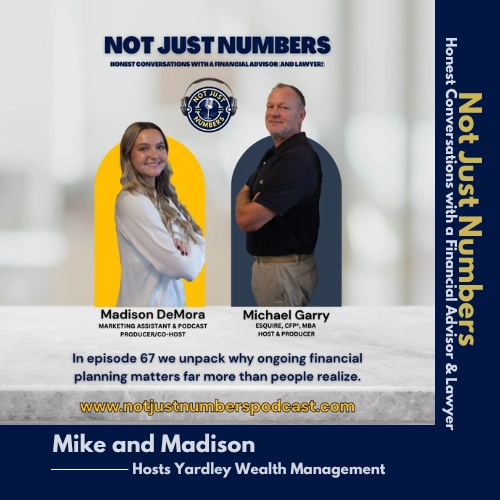
Hosts: Madison Demora and Mike Garry

Episode Overview

Most people think financial advice is something you do once — get a plan, make a few changes, and move on. In reality, that mindset can cost you tens or even hundreds of thousands of dollars over time. In this episode, Mike and Madison unpack why ongoing financial planning matters far more than people realize. They dive into the hidden tax mistakes even smart retirees make, how withdrawal and Social Security decisions can quietly drive lifetime taxes higher, and why tax planning is a year-by-year strategy — not a one-time fix. The conversation then shifts to the financial planning industry itself, including the rise of private equity, the decline of true independence, and what Bob Veres calls “the great stall.” Mike shares firsthand insight into why so many advisors sell, what actually happens after a firm is acquired, and why Yardley Wealth Management chose internal succession over private equity. If you’ve ever wondered what real financial planning looks like — or what’s happening behind the scenes in the advisory world — this episode is for you.

Listen to Our Podcast On:

TIMESTAMPS

00:08 – 01:19 – Introduction to Episode Topic

01:20 – 04: 23 – Why One-Time Advice Isn’t Enough

04:24 – 06:50 – The Real Mistake People Make (and How Costly They Are)

06:51 – 07:44 – Looking at Your Tax Return.. Every Year

07:45 – 10:32 – Industry Deep Dive: “The Great Stall”

10:33 – 16:06 – The Rise of Private Equity

16:07 – 16:50 – Will the Independence Spirit Survive?

16:51 – 18:09 – Closing

Follow Us on Social Media

Stay updated with the latest episodes and news by following us on social media:
 

Episode Glossary

  • Ongoing Financial Planning: A continuous process of building, implementing, and adjusting a financial plan over time as life events, markets, and tax laws change.
  • Fiduciary: A legal and ethical obligation requiring an advisor to always act in the client’s best interest, with a duty of loyalty and good faith.

Key Takeaways

Key Takeaways

  • Ongoing advice beats one-time plans: A single plan review is just information — ongoing execution, monitoring, tax strategy, and life changes save far more than the fees and deliver real results.
  • Tax mistakes cost thousands (even smart people): Common errors like spending from savings first instead of filling 0% tax buckets, or taking Social Security early without considering bracket impact, lead to much higher lifetime taxes.
  • Withdrawal order matters every year: Pull from the right buckets (Roth conversions, taxable gains) in low-tax years to reduce future RMDs and Social Security taxation — tax planning is a lifetime exercise, not one snapshot.
  • The “Great Stall” in financial planning: The move toward true independent fiduciary RIAs has slowed; many advisors now choose independent broker-dealers with commissions instead of full independence.
  • Private equity consolidation threatens client service: PE firms buy RIAs at high multiples, then cut staff, reduce client touchpoints, consolidate tech, and push “minimum viable” service to boost short-term profits.
  • Internal succession > PE sale: Staying independent preserves continuity, relationships, and high-touch service — selling to private equity often means fewer meetings, fewer calls, and less personalized planning for clients.

Transcript

Podcast Transcript: Ep. 65 – 401(k) Changes in 2026

Introduction

Madison: Hello everyone, and welcome to Not Just Numbers, Honest Conversations with a Financial Advisor and Lawyer. I am Madison Demora and I’m here with Mike Garry. Mike is a financial advisor and a CFP practitioner and the founder and the CEO of Yardley Wealth Management. He is also an estate planning lawyer, and his law firm is Yardley Estate Planning. Hi, Mike.

Mike: Hey, Maddie. How are you?

Madison: Great. How are you?

Mike: Good.

Madison: Good, good. All right, so today we’re diving into some important updates coming to retirement plans, specifically 401(k)s, in 2026. There are new contribution limits, expanded catch-up rules, and a few changes that could affect how much you are able to save, and how those savings are taxed.

Mike: Hey Maddie, great to be here. Before we get into it, I want to thank one of our longtime clients for giving us this idea. It’s really, really timely so you know who you are when you’re listening. Thank you so much for it. And yeah, this is one of those years where people really want to pay attention. Especially folks near retirement age or high earners who’ve been relying on catch up contributions.

Madison: Let’s start by grounding everyone. What are the contribution limits for 2025 and how are they changing in 2026?

2025 vs. 2026 Contribution Limits

Mike: For sure, Maddie. For 2025, the standard employee contribution limit to a 401(k) is $23,500. If you’re 50 or older, you can make an additional $7,500 catch-up contribution, bringing your total to $31,000. Now, there’s a special group, that I’m not yet a part of, people between the ages of 60 and 63, they get an even higher catch-up. In 2025, they can contribute $11,250 extra, meaning they could put away up to $34,750 in total. In 2026, those limits go up again. The standard limit rises to $24,500. The 50 plus catch-up increases to $8,000 for a total of $32,005. And for that special 60 to 63 group, they get a big boost, their catch-up becomes $11,005, bringing it to $36,000. So, the government is clearly encouraging folks in that pre-retirement window to sock away as much as possible.

Madison: That’s a big deal for people trying to maximize savings.

Total Employee + Employer Contributions

Madison: What about total contributions, meaning employee plus employer contributions?

Mike: Oh, that’s a good thing to remember, Maddie. I’m glad you brought that up. You know, that’s another piece that’s changing. In 2025, the combined employee and employer contribution limit is $70,000 for those under 50. In 2026, that goes to $72,000. For people 50 and over, it increases to $80,000, and for that 60 to 63 range, it can go to $83,500. So if you’re getting a strong employer match, or if you’re self-employed and contributing both as the employer and employee, these changes can make a big difference.

New Roth-Only Rule for High Earners

Madison: Now, one of the biggest changes we’re seeing is the new Roth-only rule for catch-up contributions. Can you break that down?

Mike: Absolutely. This comes from the Secure 2.0 Act, which Congress passed to quote, modernize retirement savings. Starting in 2026, if you earn more than $145,000 in the prior year, any catch-up contributions you make, whether you’re 50, 60 or 63, must go into a Roth 401(k) instead of a traditional pre-tax 401(k). That means your catch-up dollars will be made after-tax, not pre-tax. So you won’t get the immediate tax deduction now which costs about $4,000, but the money can grow and come out tax-free in retirement.

Madison: So that’s a shift in the timing of the tax benefit, pay taxes now, rather than later?

Mike: Exactly. And that could be good or bad depending on your situation. For higher earners, this change means you’ll lose some upfront tax savings, but your retirement withdrawals will be tax-free. So in the long run, it could be beneficial, especially if you expect to be in a higher tax bracket in retirement.

Shift in Tax Timing Benefit

Madison: So that’s a shift in the timing of the tax benefit, pay taxes now, rather than later?

Mike: Exactly. And that could be good or bad depending on your situation. For higher earners, this change means you’ll lose some upfront tax savings, but your retirement withdrawals will be tax-free. So in the long run, it could be beneficial, especially if you expect to be in a higher tax bracket in retirement.

Who Should Pay Closest Attention

Madison: Who should be paying closest attention to these changes?

Mike: Well, two groups stand out, right. So first, high earners over age 50, anyone making more than $145,000, because they’ll have to switch their catch-up contributions to Roth. That means talking to HR or your plan administrator to make sure your company even offers a Roth 401(k) option. And if they don’t, get on them now to offer that. And second, people between 60 and 63 because their special catch-up opportunity is temporary and age-specific. It’s a chance to really boost your retirement savings in those final working years.

Steps to Prepare for 2026 Changes

Madison: So what can people do now to prepare for these 2026 changes?

Mike: Good question. You know, first, review your 401(k) plan options now, make sure your employer offers a Roth 401(k) option before 2026. Plan for higher contributions. If you want to take advantage of the increased limits, start adjusting your budget gradually. Coordinate with your tax professional because the shift from pre-tax to after-tax contributions can change your take-home pay and your tax planning strategy. And if you’re self employed, review your solo 401(k) setup so you’re aligned with the new rules.

Madison: So bottom line, these changes are giving people more opportunities to save, but also adding some complexity with the new Roth rule?

Mike: That’s right. You know, the good news is the contribution limits are going up, that’s always positive for savers. But the Roth-only rule for high earners means you’ll need to pay more attention to how you save, not just how much. And retirement planning isn’t one-size-fits-all, so working with a financial advisor can really help you optimize based on your tax situation, income level and retirement goals.

Madison: That’s great advice, Mike. These updates are a reminder that retirement planning is always evolving, and staying informed is key to making the most of your savings opportunities. Thanks, Mike, for breaking this down.

Mike: Always a pleasure, Madison. Always.

Closing Remarks

Madison: For more information on Yardley Wealth Management or Yardley Estate Planning, you can visit our websites at yardleywealth.net and yardleyestate.net. You can also follow us on socials at Yardley Wealth Management. Don’t forget to subscribe to our YouTube channel. This podcast has been produced by Madison Demora and Mike Garry with technical and artistic help from Poe Productions.

Request the Full Transcript as a PDF

The full transcript of this episode is available via email. Please fill out the form below to receive it: