Episode 66: Market Gurus, Bold Predictions, and the Truth About Timing the Market 

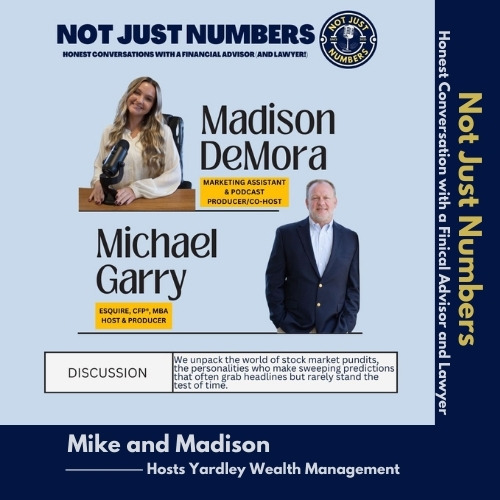
Hosts: Madison Demora and Mike Garry

Episode Overview

In this episode of Not Just Numbers, Mike and Madison sit down to unpack the world of stock market pundits, the personalities who make sweeping predictions that often grab headlines but rarely stand the test of time. From Jospeh Granville’s market-moving calls to Michael Burry’s dramatic warnings, Madison and Mike explore why bold voices attract so much attention, why even the most famous forecasters struggle to repeat their “big win,” and how relying on these predictions can lead investors astray. Mike breaks down the psychology behind overconfident gurus, the dangers of reacting emotionally to extreme forecasts, and why long-term fundamentals consistently outperform dramatic market timing attempts. Whether you’ve ever wondered if you should “sell everything” after a scary headline, or why influencers with millions of views aren’t necessarily credible, this episode offers a grounded, insightful look at what really matters for building lasting wealth: discipline, diversification, and sticking to a plan.

Listen to Our Podcast On:

TIMESTAMPS

00:08 – 01:07 – Introduction 

01:08 – 03:09 – Bold Personalities vs. Accuracy

 03:10 – 04:40 – When One Big Call Goes Wrong

04:41 – 06:36 – Michael Burry & Why Reacting to Warnings Backfires 

06:37 – 07:20 – What Investors Should Focus on Instead

Follow Us on Social Media

Stay updated with the latest episodes and news by following us on social media:
 

Episode Glossary

Pundit: A person that publicly expresses their opinions or comments on a topic on which they consider themselves an expert.

Diversification: The strategy of investing in different asset classes and asset types to reduce portfolio risk associated with price volatility.

Key Takeaways

  • Bold predictions grab attention: Confident, dramatic market calls get headlines and short-term influence, even if inaccurate, while balanced views get less notice.
  • Short-term influence ≠ long-term reliability: Pundits like Joseph Granville moved markets temporarily, but their long-term track records often failed.
  • Repeating big calls is rare: Success like Elaine Garzarelli’s 1987 crash prediction or Michael Burry’s warnings doesn’t guarantee future accuracy; markets are too complex.
  • Reacting to warnings backfires: Investing in S&P 500 after Burry’s warnings averaged 34% gains in six months — staying invested beats timing.
  • Investor amnesia is deadly: Good times lead to chasing returns and forgetting liquidity/risk, repeating past crises.
  • Focus on what you control: Build wealth with long-term goals, diversification, and discipline — time in the market beats timing the market.

Transcript

Podcast Transcript: Ep. 66 – Stock Market Pundits

Introduction

Madison: Hello everyone, and welcome to Not Just Numbers, Honest Conversations with a Financial Advisor and Lawyer. I am Madison Demora and I’m here with Mike Garry. Mike is a financial advisor and a CFP practitioner and the founder and the CEO of Yardley Wealth Management. He is also an estate planning lawyer, and his law firm is Yardley Estate Planning. Today we’re diving into an article that takes a fascinating look at stock market pundits, the people who make bold predictions about where the market is headed. Some of these calls have made headlines, even shaken the markets, and a few have made these pundits rich and famous. But here’s the real question: should everyday investors take these predictions seriously? And to help us unpack all of this, we have Mike Garry, our trusted financial advisor. Mike, thanks for joining.

Mike: Maddie, glad to be here. And I’m glad you picked this. This is one of my favorite topics.

Madison: Awesome. Excited to get started.

Why Bold Predictions Grab Attention

Madison: So, Mike, this article opens up by joking that to be a stock market pundit, you don’t really need deep financial knowledge, just confidence and the ability to keep moving after wrong predictions. Why do you think bold personalities, more than accuracy, often get attention in the financial world?

Mike: So, Maddie, that’s a good observation. And the reality is, bold predictions grab headlines. If someone says the market will be up 6% this year, nobody notices. But if someone says the market’s going to crash tomorrow, that creates drama. Financial media thrives on attention, and personalities who sound confident, even when they’re wrong over and over again, become more influential than those who quietly stick to balanced, realistic views. Unfortunately, confidence often gets mistaken for credibility. That’s why TikTok influencers or people with Instagram reels who say crazy things get millions of views. And then we have this thing where we talk rationally and talk to experts about things and we got our hundreds of views, or maybe thousands of views, but not millions for sure. And so, yeah.

Madison: Okay. Just because they have a lot of followers doesn’t mean they’re right. Right?

Mike: It’s absolutely true. Absolutely true.

Joseph Granville’s Market Influence

Madison: The article mentions Joseph Granville, who in the 1980s could literally move markets with a single call. His advice once sent the Dow down over 4% in one day. But in the long run, his predictions didn’t hold up. What does that say about following these so-called gurus?

Mike: It shows that short-term influence doesn’t equal long-term reliability. Yes, a strong voice can rattle markets temporarily, but fundamentals always win out. Following gurus can be dangerous because even if they get attention once or twice, the track record usually doesn’t hold. Investing based on someone else’s dramatic prediction often leads to emotional decisions, which is one of the biggest killers of wealth over time.

Elaine Garzarelli’s 1987 Crash Call

Madison: On the flip side, Elaine Garzarelli did famously predict the 1987 crash. For a while, she became one of the highest-paid strategists on Wall Street. But later, her mutual funds underperformed. Why do you think it’s so hard for someone to repeat a big, successful call?

Mike: So that, that’s the problem, markets are complex and unpredictable. The world is a very, very complicated place. And it’s always, it keeps spinning. Something’s always going on. So even if someone nails one big call, it could be more luck than skill. And once you’re known for a huge prediction, people expect you to keep doing it. And that pressure can lead to overconfidence or chasing headlines. You know, statistically it’s incredibly rare to consistently time the market. And one correct call doesn’t mean future calls will be accurate. I wrote a piece maybe 10 or 15 years ago, where I went into like what happened after big calls. And like when people made one thing right, I think that they made like more mistakes in later calls. And I don’t know if it’s from overconfidence or maybe people were paying more attention to the call but, you would think that predicting the market moves, even one time, would be like seen as a good thing. But I don’t think it really worked out too great. So that’s my take.

Michael Burry’s Warnings & Market Returns

Madison: The article also talks about Michael Burry, you know, the guy from The Big Short. He correctly predicted the housing crash and has made a few very public warnings since then. But according to the numbers, if you had invested in the S&P 500 index fund right after five of his warnings, you would have made an average gain of 34% in just six months. That’s wild. What are the takeaways here?

Mike: The big lesson is that reacting to bold predictions usually backfires. The market has a long history of resilience. Even after Burry’s scary warnings, staying invested in something as simple as S&P 500 index fund produced fantastic returns. That doesn’t mean risk isn’t real, it is, but long-term investors usually do far better by staying the course rather than jumping in and out based on someone else’s alarm bells. Now, I don’t know why he was so spectacularly wrong, but he just was. And I think that’s a good warning.

Why Repeating Big Calls Is Hard

Madison: That ties in perfectly with one of the closing points of the article, making sudden, extreme moves in your portfolio usually leads to regret. In fact, there was a study showing that pundits who made one amazing call are actually less likely to be right again in the future. Why do you think that is?

Mike: I think it comes down to human behavior, as so many things seem to. Right? You know, after a “big win,” people get overconfident. They start believing they’ve cracked the code. You know, my old boss was always looking for like the holy grail of investing. But markets don’t work that way. There’s too much randomness, it’s too complicated, too much stuff going on. So those pundits who double down on extreme predictions, and the odds of being consistently right actually get worse. It’s almost like the broken clock analogy, you know, even if you’re right once, it doesn’t mean you’re a good forecaster. Broken clock is right twice a day.

What Investors Should Focus On

Madison: So, to wrap this up, if investors shouldn’t rely on the market pundits and their bold predictions, what should they focus on when building their financial plan?

Mike: The most important things are to control what you can actually control. That means focusing on long-term goals, diversifying your investments, and staying disciplined through the ups and downs. Financial planning should be based on your personal situation, not the latest headline. And history shows that time in the market, not timing the market, is what builds wealth.

Madison: Love it. So, the next time we see a dramatic headline like sell everything or this will be worse than 2008, maybe the best move is to do nothing drastic and to stick to the plan.

Mike: Exactly. That’s how you win in the long run.

Closing Remarks

Madison: For more information on Yardley Wealth Management or Yardley Estate Planning, you can visit our websites at yardleywealth.net and yardleyestate.net. You can also follow us on socials at Yardley Wealth Management. Don’t forget to subscribe to our YouTube channel. This podcast has been produced by Madison Demora and Mike Garry with technical and artistic help from Poe Productions.

Request the Full Transcript as a PDF

The full transcript of this episode is available via email. Please fill out the form below to receive it: