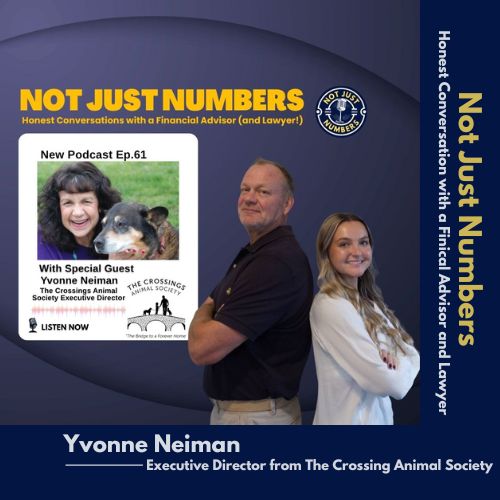
Episode 61: Should You Pay Off Your Mortgage Early? Then joined by Yvonne from The Crossing Animal Society

Hosts: Madison Demora and Mike Garry
Special Guest: Yvonne, Executive Director of The Crossings Animal Society

Episode Overview

In this episode of Not Just Numbers: Honest Conversations with a Financial Advisor and Lawyer, Mike and Madison dive into one of the most common financial questions: Should I pay off my mortgage early? They break down the advantages and disadvantages of paying down your mortgage ahead of schedule. From interest savings and peace of mind to opportunity costs and tax considerations, this conversation will help you weigh whether being mortgage-free is the right financial move for you. Later in the episode, Mike and Maddie sit down with Yvonne, Executive Director of The Crossings Animal Society, a non-profit, no-kill animal welfare organization serving Bucks and Mercer Counties since 2009. Yvonne shares her personal journey into animal advocacy, the inspiring mission behind The Crossings Animal Society, and how programs like Animal Help and Adoption Network, the Boris & Natasha’s Fund, and their Pet Rescue, Surrender & Adoption program are transforming the lives of pets and families alike. Tune in to learn how The Crossings Animal Society is building a community of compassion, and how you can make a difference, too.

Listen to Our Podcast On:

TIMESTAMPS

00:08 – 01:13 – Opening

01:14 – 01:57 – Emotional & Lifestyle Considerations

01:58 – 03:11 – The Financial Math of Paying Down a Mortgage

03:12 – 04:27 – What Else to Consider Before Paying Off

04:28 – 05:21 – The Case for Investing Instead

05:22 – 06:02 – Taxes and Mortgage Payoff

06:03 – 06:54 – Hybrid Approaches

06:55 – 07:26 – Closing

07:34 – 49:08 – Interview with Yvonne from The Crossings Animal Society 

Follow Us on Social Media

Stay updated with the latest episodes and news by following us on social media:
Connect with The Crossings Animal Society
Phone number: (215) 321-4673
Email: info@CrossingsAnimalSociety.org
Website
Facebook
Instagram
Bluesky

Episode Glossary

Opportunity cost: Any gain you pass up by deciding on one use of your resources over others.

Key Takeaways

  • No one-size-fits-all answer: Paying off a mortgage early vs. investing depends on your mortgage rate, tax situation, risk tolerance, and emotional comfort with debt.
  • Emotional payoff is real: Owning your home outright reduces fixed expenses in retirement and provides peace of mind — even if math favors investing.
  • Refinancing saves big: A $320K loan at 6.6% (30-yr) costs $415K in interest; 15-yr at 5.9% costs only $163K — saving over $250K.
  • Check priorities first: Build emergency fund, max retirement accounts, and pay off high-interest debt (credit cards, auto loans) before prepaying mortgage.
  • Low rates favor investing: If mortgage < 4.4% (July 2025 CD rate), historical stock (10.5%) or 60/40 (8%) returns often outperform.
  • Hybrid approach works: Split surplus cash — half to mortgage, half to investments — to balance security and growth.
  • Crossings Animal Society’s mission: No-kill organization focused on life-sustaining vet care (Boris & Natasha’s Fund), personalized adoptions (Fur-Ever Match), and building a sanctuary.

Transcript

Podcast Transcript: Ep. 61 – Pay Off Mortgage or Invest?

Introduction

Madison: Hello everyone, and welcome to Not Just Numbers, Honest Conversations with a Financial Advisor and Lawyer. I am Madison Demora and I’m here with Mike Garry. Mike is a financial advisor and a CFP practitioner and the founder and the CEO of Yardley Wealth Management. He is also an estate planning lawyer, and his law firm is Yardley Estate Planning. Today we’re tackling a big financial question that comes up often, should I pay off my mortgage early or invest the money instead?

Mike: Maddie, it’s a question we hear from clients all the time. Maybe they’ve received a bonus, inheritance, or their income’s gone up. On the surface, it might seem straightforward, but as we’ll explore today, the answer really depends on your circumstances. You know, your cash flow, your investment strategy, comfort with debt, and even the stage of life.

Madison: So, in this conversation, we’ll break down both sides of the decision. The emotional and financial benefits of paying off a mortgage, the potential growth from investing instead, and some hybrid approaches that balance both. Let’s start with the personal side of the decision. For many, a mortgage is the single biggest financial obligation they’ll carry in their lifetime. That can weigh heavily, especially as retirement approaches.

Emotional & Financial Benefits of Paying Off Mortgage

Mike: Yeah, exactly. You know, clients often tell us that paying off the mortgage gave them a sense of relief and security, even if the math favored investing, the emotional benefit of owning their home outright, including having no monthly payment and no lingering debt, brought them confidence and flexibility. And for retirees in particular, like lowering fixed monthly expenses can make a retirement budget more sustainable. It’s not just about dollars and cents, it’s about financial clarity and lifestyle choices, really.

Interest Savings: 30-Year vs. 15-Year Example

Madison: Of course, there are real life financial benefits to paying off debt early. Mortgages are long term loans and interest adds up over decades.

Mike: Sure. So, we’ll throw in an example here, right? If you borrow $320,000 that’s 6.6% on a 30-year loan. You’ll pay back the $320,000 in principle, but another $415,734 in interest. You know, it’s $735,000 to over the term of the loan. If you refinance to a 15-year loan at 5.9%, your monthly payment would increase, but you’d pay just $162,956 in interest, saving over a quarter million dollars compared to the 30-year loan. And that’s not a big, you know, like, it’s a big difference in how fast you’ll pay it off. Right? 15 years versus 30. But the difference between 6.6 and 5.9 is not a huge difference in interest. So, you can see it really adds up.

Making Extra Principal Payments

Madison: Even without refinancing, making extra payments directly to principal, if your lender allows it, can reduce the total interest paid and shorten your payoff timeline. But, remember, always confirm the extra amount is applied to principal.

Mike: Right. It’s a very good point, Maddie.

Check Priorities Before Prepaying

Madison: Before you rush to pay off your mortgage, it’s important to step back and look at the bigger picture.

Mike: Ask yourself, have you built up your emergency fund? Are you fully funding your retirement accounts? Do you have any higher interest debt like credit cards or auto loans? Since those typically carry higher or much higher rates than mortgages. It usually makes sense to do those things and pay those off first.

Mortgage Rate vs. CD Rate (July 2025)

Madison: Mortgage rates are another factor. As of July of 2025, the best one-year CD was paying, 4.40%. If your mortgage rate is in the same range or lower, it may change the math on whether early payoff really provides the best return.

Mike’s Personal Example: 2.375% Mortgage

Mike: And don’t forget lifestyle considerations. Some people value predictability and a debt free life. Others are comfortable carrying low-rate debt in exchange for the flexibility to invest. Maddie, I’ll tell you personally, you know, we’re maxing our retirement contributions. Don’t have any debt besides the mortgage. Our mortgage is at two and three eighth percent. I am very comfortable paying that amount. That’s lower than the rate of inflation for the few years that we have left on that. So, I’m not going to prepay that. I will be investing and doing other things rather than paying that off.

Historical Returns: S&P 500 & 60/40 Portfolio

Madison: So, what about the other side? If your mortgage rate is relatively low, investing might make more sense.

Mike: Sure. You know, historically U.S. stocks has measured by the S&P 500 have returned 10.5% annually since 1957. And a balanced 60/40 portfolio, which we talk about a lot on this podcast, has returned about 8% over the last 90 years. Those are much higher than average mortgage rates.

Power of Compounding: $100K at 8%

Madison: And the power of compounding is significant. $100,000 investment earning 8% annually grows to about $466,000 in 20 years and over 2 million in 40 years. That growth you give up if you lock those funds into your home.

Mike: Yeah, that tradeoff is what economists call an opportunity cost. The benefit you miss out on when you choose one option over another.

Tax Deductions & SALT Cap Changes

Madison: We also need to touch on taxes. Mortgage interest is deductible on up to $750,000 of eligible mortgage debt for those who itemize. Paying off early could mean losing valuable deduction.

Mike: Sure, you know, a lot of people don’t itemize anymore, but some people still do. And with the new tax law temporarily raising the state and local tax deduction cap from 10,000 to 40,000 through 2029. Homeowners in high tax dates may benefit even more. The decision to prepay your mortgage may have ripple effects, really, on your overall tax situation.

Hybrid Strategy: Split Cash Between Payoff & Invest

Madison: For many, the right answer is an all or nothing. A hybrid strategy can strike a balance.

Mike: Sure. For example, you could use half of your surplus cash to pay down the mortgage and have to invest. You could also alternate putting extra towards your loan one month and investing the next month. You know, it’s really not an all or nothing situation, and we’ll often advise that depending on, like, the rate of the mortgage and what other people’s goals are. Right. Like everything you do in financial planning, almost everything touches on something else in financial planning. And so really the idea is to look at your overall situation and figure out what’s the best approach and go from there.

Madison: This approach can give you both the sense of security that comes from lowering debt and the potential long-term growth of investing.

Mike: Right. Like, there’s no universal answer. You know, it depends on your mortgage rate, your tax situation, your investment outlook, and most importantly, in this situation, I think your personal comfort was debt. You know, our role is to help you weigh the numbers, balance the emotional considerations, and align the decision with your broader financial plan.

Madison: If you’re thinking about paying off your mortgage early or wondering if investing is the smarter move, reach out. We’d be glad to walk you through the scenarios and help you decide what’s best for your situation. Today we’re excited to welcome Yvonne, the executive director of The Crossings Animal Society, to the podcast. The Crossings Animal Society is a non-profit, no kill animal welfare organization based in Washington, Crossing, Pennsylvania that has been serving Bucks County and Mercer county since 2009. Their mission is to provide quality care and a loving home for every dog and cat. And they do this through programs like their Animal Help and Adoption Network, the Boris and Natasha’s Fund, and their Pet Rescue, Surrender and Adoption program, which includes their innovative Fur-Ever-Match program. We’ll be talking with Yvonne about the incredible work her team is doing, the impact they are having on both pets and families, and how listeners like you can get involved. Yavonne, welcome to the podcast. It’s great to have you here.

Guest Introduction: Yvonne (Crossings Animal Society)

Yvonne: Thank you so much.

Madison: All right, Yvonne, thank you for joining us. Can you start by sharing a little bit about yourself and what inspired you to get involved in animal welfare and what led you to become the executive director of The Crossings Animal Society?

Yvonne’s Backstory & Boris and Natasha’s Fund

Yvonne: Sure. My family has always been great animal lovers. I was raised first primarily with dogs. But I guess the real story starts in 1985. I had just come back from graduate school, and I got a call from my mom. And she said, she explained she was going to the protest for the deer hunt, at Tyler Park. And she asked me if she were arrested, if I would come and bail her out. And I assured her, yes, I would absolutely do that. And while she was there, she met two other women, named Hope and Terita. And they got to talking and together the three of them formed an organization called Hope for the Animals, which was a dog and cat rescue. In its time, which extended from 1985 until about 2008, give or take. They gradually became the largest dog and cat rescue in Bucks County. My mom became its president, my dad eventually its vice president. And when my dad retired in 1989, he and my mom were doing this full time. Up until that time, they stepped back, which was around 2007, 2008. So, at one point, in early 2006, my two dogs, Boris and Natasha, became ill. Natasha first and then Boris had a recurrence of cancer, and they passed away within four months of each other. And at that time, I became very well acquainted with the cost of specialty and emergency veterinary care. So, I went to my parents, and I said, look, not everybody can afford this. And there are things that happen in terms of illness and injury that are recoverable. But if people don’t have the money to pay for it, they may very well end up putting an animal down that doesn’t need to be put down at that point. So that was the beginning of Boris and Natasha’s fund. So that was sort of my entree into their organization. When I had come back in 85, I was I was about to be licensed as a psychologist. So, I started in private practice. So, my effort and energy was going there. But starting in early 2006, we created Boris and Natasha’s fund and used it to help people. We did a lot of emergency work. We also did a lot of work that wasn’t quite emergency but non-routine veterinary. And while we were with Hope for the Animals, probably saved upwards of about 50 dogs and cats. Then my parents, they were aging, their health was declining so they stepped back. And right around that time, what happened in Hope for the Animals was that the people who did the rescue work really wanted to focus on that. What we wanted to focus on was sort of, a little bit broader than that with the ultimate goal of building a no-kill sanctuary. So, several of us broke away and in 2009 created The Crossings Animal Society. So that’s sort of the backstory to it. And we’ve been going forward ever since.

Mike: That’s a really nice story. You know, I didn’t know that, you know, until our other listener recommended you. I didn’t know that that your organization existed, but you could totally see a need for it. Just a couple weeks ago, our older dog had pneumonia and was in the hospital for two nights. And you know, I remember my wife, like the bill was on the kitchen table and like we could afford it, and he was otherwise healthy. And so, we did. But she was walking by and she looked at the note and said, how do people afford that? You know, it would be really, a big thing for a lot of families. So it’s great that you have society going.

Yvonne: Thank you. I appreciate that. Yeah. For Boris and Natasha’s fund, what we do now is it’s expanded out a little bit. So, we work with pets who are living in families with limited financial resources. And we also work with homeless pets and including homeless pets that are in other rescue organizations needing help.

No-Kill Philosophy & Current Crisis

Madison: Yvonne, what does it mean to be a no-kill animal welfare organization and why is that distinction so important?

Yvonne: Thank you for asking that question because I think it’s something that people don’t clearly understand or sometimes misunderstand. The idea, behind no-kill philosophy is that what we do is to do our best to save every animal. However, there are exceptions to that. One of them is if, for example, a dog is a danger to the community. Every effort has been made to rehabilitate the dog and it’s just not working. Putting down a dog under those circumstances is still within the definition of no-kill. The other, criterion for no-kill is true euthanasia. And that is, putting down an animal who’s suffering as a result of non-recoverable illness or injury. One of the things that I feel really strongly about in terms of the whole animal welfare, excuse me, national community, is that the term euthanasia is absolutely misused. Every time that a shelter wants, just to give you an example, a shelter wants to kill an animal, they use the word euthanasia. Euthanasia has a very specific definition and the rest is killing. And right now, in this country we are facing probably the worst crisis that we have faced probably in the past 15 years in animal welfare, in terms of the shelters and the rescues being tremendously overcrowded. So, we have a real dilemma on our hands. But, partly as a result of the reverse of what happened during the pandemic and the economy, right now, the number of homeless dogs and cats it’s just overwhelming.

Pandemic Adoption Boom & Reversal

Mike: Can you go into that a little bit? So, the reverse. So, I guess during the pandemic, people rescued a lot of animals and then I guess five years later decided like, it’s not for me. And, but they’re living beings. You know, it’s not like a piece of paper or something. Right.

Yvonne: One of the challenges when you’re a shelter is, you know, in terms of vetting an adoptive family. A shelter can’t do what an organization like us are able to do.

Mike: Right.

Yvonne: And part of it is because we’re not operating at their scope with their volume. One of the things they cannot do is vet very thoroughly and particularly in terms of things like home visits, which give you an enormous amount of information. So, during the pandemic, yeah, people emptied the shelters, so dogs were being adopted, cats are being adopted left, right, and in between. But the vetting process for the shelters is not that good. And that’s not their fault. So, what happened was when Covid ended started flipping 180 degrees in the other direction. So, you know, pets started, you know, showing back up in the shelters. And then in addition to that, with certain parts of the population, socioeconomically, they’re hit harder by the economy and they’re surrendering their dogs and cats. With the rescues that we’re working with down south and in the rural areas, one of the phenomenon, unfortunately, is that people dump their animals. Which for us is like, we don’t quite understand that.

Mike: It’s hard to imagine. I really have a hard time imagining.

Yvonne: We are bringing up a boxer who we believe is a purebred boxer. For a meet and greet with a family that we vetted and approved. The dog is between a year and two years old. The shelter and the rescue down there, this is in the Huntsville, Alabama area. Know who the owner is. This owner dumped the dog. They picked the dog up as a stray. The dog is lovely. Absolutely lovely. Scared, but lovely.

Programs: Animal Help, Boris & Natasha, Fur-Ever Match

Madison: Yvonne, you have several programs like the Animal Help and Adoption Network, Pet Rescue and Surrender Adoption program, and, Boris and Natasha Fund. Can you walk us through how each of these supports animals and families?

Yvonne: Absolutely. Let me say something first in terms of what our long term is. Our long term is to build a no-kill sanctuary. And very, very briefly, the reason we use the word sanctuary as opposed to shelter has a lot to do with architecture. When you are building a no-kill sanctuary, you build it with the idea that some of the dogs and cats that go in are going to spend their lives there. And the traditional architectural model for shelter is sort of as a way station. It’s never meant to be housing dogs and cats for a length of time. So, that’s the difference. It’s in, you know, we build and we actually have plans. We’ve worked with an architect. And what we want to do is to be able to build in such a way that there is high quality of life no matter how long that dog or cat stays. So that’s it long term. Short term, we focused on more, much more direct service. The Animal Health and Adoption Network is really sort of a hotline that we run. We’re an animal welfare organization that does several things including rescue. We have an office here and so we’re brick and mortar in terms of the office space. We have a phone line, we have voicemail, we have email. So, the way that we run this is when we have a staff member present here, phone calls are answered immediately. The phone call may be about something that we can be directly involved with. If that’s the case, we jump right in. If it’s not, then our policy is to work with the caller to identify resources and then to send them on to those resources and sometimes to check back with them. There are times when we get wildlife calls, and you know, so we know that information to refer over to Mercer County or to the AARK. But there are also times where we’re getting calls for services that we just don’t provide. So, we really do our best. It’s not policy for us to say, oh, we can’t help you and hang up. We will do our best to connect with resources and times to follow through. So that’s, the Animal Health and Adoption Network. With Boris and Natasha’s fund. It is the way that we’re running it at this point is we use it for what we sort of created our own category. We don’t do Boris and Natasha’s for routine. We use our general operating fund for anything routine. We use it for what we call life sustaining veterinary. With the understanding, because we are no-kill, once we are committed to a particular situation, a particular dog or cat, we’re going to see it all the way through no matter what it takes. So, if it escalates to emergency, it escalates to emergency. Can I tell you a couple of stories?

Stripes (Cat) & Roxy (Dog) Success Stories

Mike: Sure.

Madison: I would love that.

Yvonne: Okay. So, I guess the cat story is about a cat who is now a resident cat here. Stripes is a year and a half years old and we had gotten a call from a couple who heard about us. They were feeding Stripes as a stray and Stripes came to their door, with her tail mangled. And we sent her to the bridge clinic, who did surgery, did a great job, and amputated her tail. She’s a beautiful little cat. We brought her here to the office and we thought no problem adopting this cat. Except what we didn’t know at the time was that the injury was more severe. It turns out that Stripes has what’s called a tail pull injury. So, what had mangled her tail had also pulled on her tail hard enough that it caused neurological damage. So, long story short, Stripes is incontinent and prone to, urinary tract infections and a couple of other things. Other than that, Stripes is really healthy. So, the first couple of months we were dealing with UTIs and a couple of other things to kind of learn and get the situation under control. We then reached out to Tabby’s Place, which is the no-kills cat sanctuary in Ringo’s. And they have been absolutely wonderful. They have worked with us, and they are now training us how to express Stripes bladder.

Mike: Wow.

Yvonne: So, Stripes has her bladder expressed every day. She’s a happy little cat. She’s put on some weight, probably more than she should have. And she will live here in the office for the rest of her life.

Mike: Wow.

Yvonne: She is a Boris and Natasha’s fund cat. And actually, she’s sort of a special case because we have, we not only did outreach to our supporters, you know, to help pay veterinary expenses, and they’re ongoing, she’s on medication, and that will be on an ongoing basis. And there’s going to be, every once in a while, there’s going to be something that happens with her. So, we actually created, we created a bank account for Stripes. So, she is sort of a subcategory, of Boris and Natasha’s funds, and there is a Stripes bank account. So that’s, that’s the cat story. Dog story, the most recent one. We got a call about a dog named Roxy, 6-year-old Chesapeake Bay Retriever. And over about a day and a half, suddenly couldn’t get off on her hind legs. So, we worked with the family, got her evaluated and then got her in, to see Dr. Eagleson, who is one of the internal medicine veterinarians over at Blue Pearl and is a wonderful veterinarian. So, he did a consult, told us, well, we’re looking at one of two things. It was either a herniated disc, which, if it was serious enough, would require surgery, which was quite expensive, or it was something called an FCE, which is, it’s a spinal embolism. So, we paid for the veterinary care, and we paid for an MRI. And as it turned out, Roxy, during this time, was starting to gradually improve. It did turn out to be a herniated disc, but it was, it was mild enough that she didn’t require surgery.

Mike: Oh, wow.

Yvonne: So, we are continuing to monitor, and there’s going to be a follow up in a couple of weeks. But she’s going to make a full recovery.

Mike: That’s great. You said she’s about six?

Yvonne: Yes.

Fur-Ever Match: Personalized Adoption Process

Madison: All right, Yvonne, the Fur-ever Match process is part of your Pet Rescue, Surrender and Adoption program and takes a very personalized approach. How does it work, and how is it different from a traditional adoption?

Yvonne: Okay, well, let me sort of do a compare contrast. When we do a traditional adoption, what’s happened is that we’ve posted a dog or a cat on one of the traditional adoption sites, which in our case is Pet Finder, Adopt a Pet and Rescue Me, and we get an application for that specific animal. That’s the traditional way. Fur-ever Match occurs when someone calls us, I’ll give you the story of the boxer. For example, we got a call from a couple. They have a boxer. They have lost their second dog, and they were looking for a boxer to be a companion for the boxer that they have now. This time it was a little bit more specific. But what happens is on all of our applications, we’re asking very detailed information. We are asking for, give us the range in weight, give us the range in years, give us the range in activity level, give us, tell us about the temperament that you’re looking for. We’re looking for very, very specific information. And we can use that for, if it’s a traditional adoption and there are a number of applications and someone, someone is approved, but they don’t get the dog or cat, we can then say, we’ve got your application. Let’s go looking for you. For Fur-ever Match, we do that from the very beginning. We say, okay, let’s go looking for the dog and cat, that would be a good match for what’s on your application. And what we’ve done in terms of vetting before we do that is we contact, And the references cannot be a family member. And we contact the veterinary practice. When we call the veterinary practice, we will not talk to the person who answers the phone. We talk to either the practice manager or we talk to the treated veterinarian. If we possibly can, we want to know more than, you know, this dog or cat that these people have had is up to date on all the shots. We’d like a little bit more than that. What we want to hear is, and we do hear it a lot, is if you find a dog or this particular dog or cat goes to this family, it’ll be their lucky day. That’s what you’re going to hear. So, we do that, and then we do a home visit. Home visit, depending upon distance, is either actual, you know, going to the home, and, we have a particular, you know, format to follow, or we do it virtually, which is something that we learned during COVID. So, in this particular case with the Boxer, we knew we were looking for a Boxer, but we got all of the parameters of what they were looking for. And then we went out to our rescue partners. We’ve got between shelters and large rescues; we’re probably working with about half a dozen. And we just reach out and say, this is what we’re looking for. And one of our rescue partners, they’re called Luna Farms in Huntsville, Alabama, called and said, you’re not going to believe this, but we just got a call about a Boxer who probably is purebred, who was just picked up as a stray.

Mike: Wow.

Yvonne: So, yeah, so that’s how it works.

Transport from Alabama to Bucks County

Mike: And how does the Boxer get from Huntsville, Alabama, to Bucks County?

Yvonne: We work with two different transport companies we’re pretty picky about because transport companies have variability. And we have learned to kind of, to know what to look for. So, for example, one of the transport companies, called Hoods, has this enormous van, you know, kept in great condition. The dogs and the cats are brought up in crates. And van is air conditioned and heated. And when they drive up, they drive up with two drivers so they can come straight through because they’re usually coming all the way up into New England. And they stop at various junctures, you know, to let them out, and to feed them. And then they arrive here, usually it’s usually around 17 or 18 hours from Huntsville. And then what we do is, one of the things when you’re working in rescue, you know, people are asking, you know, adoption fees can look high to people. I mean, our adoption fee for dogs is $350. We see very little of that money. We are paying what’s called a pull fee, to either the rescue or the shelter. And if that animal is being transported, we are paying the transport fees. So that’s generally how it works. And then what happens is that, when the dog or cat, well, it’s usually coming from down south, it’s a dog. When that pet arrives, we do a meet and greet because we vet it as thoroughly as we have. Our success rate at meet and greets going to immediate adoption, about 95%. So usually what happens is the dog is adopted right then and there. If not, we have a backup plan. And then after the dog is adopted, we have a program called it’s an ambassador program. And how that works is that some of our volunteers are also ambassadors. So, for example, for this boxer, hopefully this boxer is going to be adopted, and the ambassador will follow up first, you know, at relatively, frequent increments, like a couple of days a week, two weeks, and then it starts becoming less and less frequent until it’s once every six months. So, we’re staying in touch with the adoptive families as well.

Mike: When the meet and greets aren’t successful, are there, like, generally a couple reasons why or any specific, or is it just like, a random assortment of things?

Yvonne: When they’re not successful. Just I’m thinking back to a time, and this has happened a couple of times, and in some cases, it’s worked out, in some cases it hasn’t. Where we’ve got some vulnerability is where there is another dog in the family. And the dog comes to the meet and greet most of the time. We just can’t predict whether or not they’re going to get along. In the most recent case, they didn’t get along initially, but the adopter said, you know what, can we give it a couple of days? And the dogs, we had photos, like, within 72 hours of the dogs, the dogs, like, lying next to each other like their best friends.

Mike: Yeah. No, I get that.

Yvonne: Sometimes it works, sometimes it doesn’t. But that’s probably the most frequent.

Mike: And that makes sense. Right, because you can’t predict how dogs are going to like each other or not.

2025 “I’m Rescued and Extraordinary” Calendar Contest

Madison: I know The Crossings Animal Society launched the I’m rescued and gorgeous 2025 calendar, which not only features some adorable pets, but also helps raise funds for your programs. You mentioned to me that this year’s calendars contest is I’m rescued and extraordinary. Can you tell us more about the calendar contest where people can get a copy and how the proceeds support your mission?

Yvonne: Sure, let me. Actually, I grabbed one of this year’s calendars. This is I’m rescued and gorgeous. And what we do of the entries is that when the contest is over, we’ll go to the calendar production people and say take a look at the, it’s usually the dogs and the cats that have been submitted and tell us which ones you think would be good for the front cover. So, these were these were pets that were submitted.

Mike: Oh, beautiful.

Yvonne: Aren’t they? Actually, this one was my cat Baby, who unfortunately I lost this year. Baby had been my parent’s cat, particularly my mother’s cat. Baby was 21 and a half years old when she died. So, the way that it works is it is a fundraiser but we’re pretty happy with the quality of this. Just to give you an idea, that’s what an interior page looks like. What we do is we ask people when they’re submitting for the contest to give us about 300, 350 words, that are kind of consistent with the theme, you know, and then you know, how did this pet come into your life? Whatever. And there are some people who submit, they’re great writers, minor edit, we’re done. There’s some people who give us two sentences. So, part of our committee are on our writing team and they recontact an interview and they write the story. So, of the 12 winners, we’ve got 12 stories to go along with it and I think they’re pretty decent quality. So, but the way that it works is that someone goes on to, you can access through our website, it’s thecrossingsanimalsociety.org and on the home page it’ll have a link to the contest. It’s $10 to enter the contest. You send a photo, you do your write up and then you ask everybody you know to vote for your pet. And it’s a dollar a vote. It gets toward the end of the contest, it gets pretty competitive, say the least.

Mike: That’s great.

Yvonne: Last hour. We actually end, we end the contest at midnight. And the contest productions people came to me this year and said our experience has been that maybe it’s not the best to end at midnight. We said no, we’re fine. People are staying up for this, believe me and the last hour, because everybody’s jockeying for that, those 12 slots, and particularly the top three winners because there are prizes associated with that. So, it gets pretty frantic in the last hour. Then what we do is we have sponsorship for the calendar from community businesses that we have relationships with and the sponsorship pays for the production of the calendar. And then what we decided, this is the seventh one that we’re working on right now. As for the second one, we decided that we were going to add an extra couple of pages and we were going to include all of the pets that were submitted. So, anyone who submits. And that also means that we have some extra work to do in that. As the contest is going forward, if we’re getting photos, we are dealing with the calendar production people right away sending the photos and saying, are these of reasonable quality or do we have to go back to the family? So, it’s, you know, behind the scenes, there’s a fair amount of work involved in it.

Mike: Sure.

Yvonne: But we’re very happy with the end product. And the funds that we raise, it’s usually we split between our general operating fund and Boris and Natasha’s, and that’s what we’re doing this year.

Mike: Great.

Yvonne: Oh, there’s one other thing. If someone wants to reserve a calendar day for their pet, that under those circumstances, it doesn’t have to be a rescue, to enter the contest it has to be a rescue. It’s a $10 fee. They send in a photo, and they choose their calendar day, and they can do a little caption if they want, and they go into the calendar on those days as well. So, when somebody’s going through that process, either for a calendar day or to enter the contest, they can actually pre-order a calendar. And when they do that, it’s at a reduced rate. Once the calendars are available, you can order through our website, or we will also be posting on our website we work with a number of retail businesses in the area that have the calendars there. So, Puppy Scrub in Langhorn has them. Commonplace Reader has them. There are about a half a dozen places where you can pick them up.

How to Get Involved: Donate, Volunteer, Foster

Madison: Amazing. Yvonne, how can people in the community get involved? Whether through volunteering, donating, or spreading awareness?

Yvonne: There are a number of ways that people can be involved. Certainly, you know, we are an organization that operates on donations. So, to go onto our website, and hit the donate button and donate, you know, we are a 501C3 which means that any donation that you make, which is pure donation, you’re not getting something in return, is deductible, is tax deductible. So, you can certainly do it that way. We are taking a lot of physical donations and again because of what’s happening in the shelters, for the most part we don’t use them directly, but we take the donations, we track them and these days most of the time we’re taking them up to Newark Shelter, which is one of our shelter partners. And we just did a run this past Saturday, and the van was completely packed. So, you know, if anyone has any donations, any physical donations they’d like to make, we will absolutely accept them.

Mike: Okay.

Yvonne: So that’s another way that people can help. Volunteers, we always need volunteers. The thing to keep in mind is that if somebody is looking for hands on, that’s more appropriate to a shelter setting or to a rescue that does very high volume. Because we do a number of different things. We are more, the orientation is we’re here to help the animals rather than to work directly with the animals. The direct hands on happens when there’s a transport because we do go and meet the transport. So, for that, for the meet and greets, that’s a hands on, where you’re interacting with the pets. But this organization primarily is working on behalf of the animals. So, we’re doing a lot of promoting of the pets for adoption. We’re doing a lot of educational kinds of stuff. We have a writing team that’s posting about any number of things every week. And we can always use a few more really good writers. We’ve got a fundraising team, we’ve got a PR team. So, there are just a number of different things. So, if you’re looking for kind of an opportunity, to work to help the animals rather than directly working with the animals, you know, definitely were appropriate. The other thing that we are in, really hate to use the word but I’m going to use it, desperate need for are fosters. We could do so much more if we had more fosters. The important thing for people to realize about fostering is that when you foster an animal, you’re saving two lives because it’s that dog or cat’s life that you’re saving. But it’s also the room that is now created in that large rescue or shelter for another dog or cat. So, you know, generally speaking, we are operating within our catchment area, which is Mercer County, county and Bucks County. We vet our fosters the same way we vet our adoptive families. We’re picky. But that’s probably that and volunteers. It’s all three. It’s that volunteers and donations, those are the primary ways to help.

Mike: Thanks for calling the distinction on the kind of help, you know, let people know that, you know, know, it’s working to help the animals. Not necessarily with hands on the animal most of the time, because you probably get that a lot. Oh, I want to help. And like. Okay, well, here are these things, these writing things we’re working on. How can you help that? Or PR. And they’re like, no, I meant like with the dog or the cat.

Yvonne: Yeah. What we’ve learned is right off the bat is to ask.

Mike: Yeah.

Yvonne: And sometimes in what somebody sends us, usually in an email, we can tell. And we go back and say, it’s sounding like you want to work directly with animals. Let us refer you.

Mike: Sure.

Yvonne: These are the partners we work with and, you know, we’re comfortable referring to.

Mike: Yep. Yeah, there’s a lot of opportunity for that, too. Just not at your place.

Yvonne: At least not right now.

Contact & Website Info

Madison: If listeners want to learn more or support The Crossings Animal Society, where should they go?

Yvonne: Okay, I guess the first place would be to go onto our website at thecrossingsanimalsociety.org they can also give us a call. We are also out in the community on a pretty regular basis. We set up tables. We’ll probably within the next month or so, there’s going to be a Saturday where we’re at one of the McCaffreys, or Redner’s, or we’re in front of one of the wine and spirit stores. And we tend to post that on the website as well. And we usually E-blast. The other thing that I think is helpful is that if someone joins our email list because they get every E-blast that we do goes into their inbox. So that’s keeping them apprised because we regularly will talk about, this is what we’re doing with Boris and Latasha’s fund. This is where we’re going to be next weekend. This is what we’re doing with the calendar contest. And the other thing that I think that we do well, that also keeps people informed is we’re pretty good storytellers. So, you know, particularly with, I mean, Roxy’s story is going to come out, probably early next week. Stripes, you know, if you’ve been following us, you’ve been hearing about Stripes an awful lot. And we also follow up on the dogs and cats that we’ve adopted, you know, and tell stories about them six months down the road, a year down the road, sometimes longer than that. You know, just to, you know, just to tell the story of, you know, what can happen, you know, in a dog or cat’s life when they’re rescued into a forever family.

Mike: That’s so nice. I love this storytelling. You told great stories about Roxy and Stripes. I hope the listeners really enjoy them. I think they will.

Yvonne: Thank you.

Closing Remarks

Madison: For more information on Yardley Wealth Management or Yardley Estate Planning, you can visit our websites at yardleywealth.net and yardleyestate.net. You can also follow us on socials at Yardley Wealth Management. Don’t forget to subscribe to our YouTube channel. This podcast has been produced by Madison Demora and Mike Garry with technical and artistic help from Poe Productions.

Request the Full Transcript as a PDF

The full transcript of this episode is available via email. Please fill out the form below to receive it: