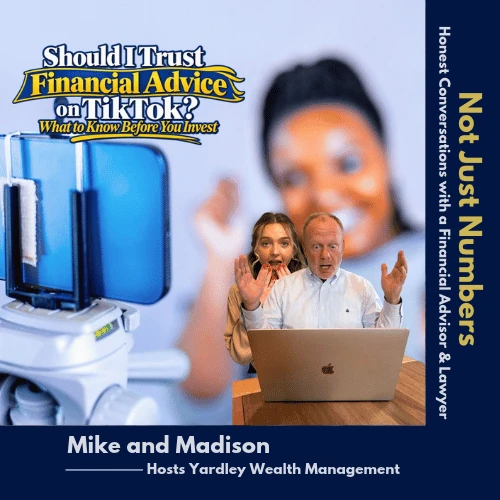
Episode 85: Should I Trust Financial Advice on TikTok? What to Know Before You Invest

Hosts: Madison Demora and Mike Garry

Episode Overview

Should you trust financial advice on TikTok? Social media has made money topics easier to find and more fun to learn, and it’s getting more young people to start saving early. In this episode of Not Just Numbers, Madison and Mike discuss a Wall Street Journal article that reviewed money advice from more than 200 TikTok accounts. They talk about why watching financial content can make people feel more confident than they should, the difference between learning about money and being told what to buy, why you usually only see the winning stock picks, and how flashy lifestyles are used as marketing. They also share five questions to ask before acting on something you saw online, and why popular advice isn’t always right for you.

Listen to Our Podcast On:

TIMESTAMPS

00:08 – 01:51 – Introduction

01:52 – 08:23 – The Upsides and Downsides of Financial Advice on Social Media

08:24 – 11:02 – Financial Education vs. Financial Advice Online

11:03 – 17:11 – Stock Picks, Social Media Hype, and What You Don’t See

17:12 – 22:26 – Evaluating Financial Advice on Social Media

22:27 – 23:58 – Main Takeaway & Closing

Follow Us on Social Media

Stay updated with the latest episodes and news by following us on social media:
 

Episode Glossary

  • Financial Influencer: A person who creates financial or investing content for an online audience, often through social media platforms. They may or may not have professional financial credentials or licenses.

Key Takeaways

  • Social media can be a great starting point. If a video gets you to open a Roth IRA or start an emergency fund in your 20s instead of your 50s, that extra time can make a huge difference. What matters is what you do next.
  • Feeling familiar with a topic isn’t the same as understanding it. FINRA found that people who use social media for investment advice rate their knowledge higher, but score worse on an objective test and are more susceptible to fraud.
  • Explaining what an ETF or a Roth IRA is counts as education. Telling you to buy a stock today because it’s going to double is something very different, and nobody consistently knows what a stock will do.
  • You usually only see the winners. A screenshot of a big gain doesn’t show the losing picks, when someone bought or sold, or how much of their portfolio it was.
  • The best financial advice is rarely dramatic: save consistently, diversify, keep costs reasonable, keep an emergency fund, and stick with your plan. Platforms reward attention, and that doesn’t always line up with what investors need.
  • An expensive car or vacation doesn’t tell you someone’s financial situation, and some creators earn more from selling courses than from investing. Always ask how the person giving advice benefits.
  • Before you act, ask: Are they promising quick or guaranteed returns? What’s their background? How are they paid? Are they explaining the downside? And does this advice actually apply to you?

Transcript

Not Just Numbers: Honest Conversations with a Financial Advisor and Lawyer
Episode 85 – Should I Trust Financial Advice on TikTok? What to Know Before You Invest

Introduction

Madison: Hello everyone and welcome to Not Just Numbers, Honest Conversations with a Financial Advisor and Lawyer, the official podcast of Yardley Wealth Management. I am Madison Demora and I am here with Mike Garry. Mike is a financial advisor and a CFP practitioner and the founder and the CEO of Yardley Wealth Management. He is also an estate planning lawyer and his law firm is Yardley Estate Planning. Hey Mike.

Mike: Hey Madison, how are you?

Madison: I’m good. How are you doing today?

Mike: I’m good. Hey, remember last time when we talked for 10 minutes and then recorded and said, oh, maybe we should have included that in the recording?

Madison: Yes.

Mike: Yeah, we had nothing good going on today, so I guess we just go right to the podcast.

Madison: Yep, September 1st. It is September 1st, so.

Mike: Yeah, somebody’s birthday month. I’m not naming names though.

Madison: Yes, it’s a great month to have a birthday.

Mike: I think it’s the month with the most birthdays too.

Madison: Yeah, yeah.

Mike: It’s like September 16th or 15th, the one with the most births, something like that.

Madison: Yep, all the cool people. That’s all you have to say.

Mike: Is it?

The Upsides and Downsides of Financial Advice on Social Media

Madison: All right, Mike. So today I want to talk about something that I think almost everyone who spends time on social media has probably encountered: financial advice on TikTok. The Wall Street Journal recently published an article called “A Breakdown of the Financial Advice That’s Flying All Over TikTok.” The article starts with some pretty familiar examples: open a Roth IRA, buy a certain stock before it takes off, or start a side hustle that supposedly makes an enormous amount of money. And this kind of financial content is everywhere. Mike, when you see how much financial advice is being shared on TikTok, Instagram, YouTube, and other platforms now, do you view that as a good thing or a bad thing?

Mike: So first, before we get into that, Maddie, I want to say that, you know, someone we’re big fans, I’m a big fan of anyway, Jewell Ward with Dimensional. I was talking to her about three or four days before I saw this article in the Wall Street Journal, and she suggested doing a podcast on like TikTok, you know, like maybe bad advice you’ve seen on TikTok or something like that. And then this article came out. It’s like, oh, okay, well this will be really easy for us to work with. And so, you know, advice that you see on any of the social platforms can be a good thing. You know, if somebody is 20 or 25 and they see a video that gets them interested in opening a Roth IRA, starting an emergency fund, contributing to their 401(k), or learning what an index fund is, that can be very positive. For generations, personal finance was something people often didn’t learn about until much later in life. Seriously, a lot of people that come to us are in their 50s when they’re just finding things out, and that extra 30 years can be a huge, huge difference. And social media has made that information much more accessible and enjoyable.

Madison: And the article actually points to some evidence of that. Fidelity partly credits financial influencers with the rapidly growing number of people opening Roth IRAs. Among Gen Z, contributions to Roth IRAs increased 73% year over year in the second quarter of 2026. So if TikTok gets someone to start saving for retirement at 22 instead of waiting until 42, that seems like a pretty meaningful benefit.

Mike: It can be. And let me just say too, I’m glad you work here instead of just being an influencer somewhere. So thanks for that. And it is good. It is a big benefit somebody starts saving for retirement 20 years earlier because starting early is incredibly valuable. And the concern isn’t necessarily that somebody learned about a Roth IRA on TikTok. The concern is what happens next. Did that video encourage you to learn more and understand how a Roth IRA fits into your financial situation? Or did you simply do exactly what somebody in a 30-second video told you to do? And those are two very different things.

Madison: So social media may be a good starting point, but maybe not necessarily the place where the decision-making ends.

Mike: Exactly.

Madison: One of the statistics in the article really stood out to me. FINRA found that people who use social media for investment advice actually rate their investment knowledge higher than people who don’t use social media for advice. But when they were given an objective financial knowledge test, they performed worse. They were also more susceptible to investment fraud. Why do you think watching financial content can make us feel more knowledgeable than we actually are?

Mike: Well, this is, I don’t know, it’s a scary little subject or test that they did there and showing that, right, they’re more confident but then actually do worse on the test. It’s not really that great. But you know I think it’s because like being familiar with something and then actually understanding it aren’t the same thing. You know if you hear people talk about Roth IRAs, ETFs, the S&P 500, AI, options, crypto, you know eventually when you hear those enough, you know they start to sound very familiar. And familiarity can create confidence. But understanding how something works, understanding the risks, taxes and knowing whether it makes sense for your situation requires another level of knowledge and understanding.

Madison: I also think social media can make complicated topics look incredibly simple. It might be, “Here are three funds you need,” or “Do this one thing and you’ll become a millionaire.”

Mike: Right. And simple explanations can be helpful. I’m always trying to make my overly complicated, my very overly complicated answers to people more simple and understandable, right? It’s a good thing. Because a lot of these subjects are really complicated and it would be much better if I did a better job of explaining them simply and that’s part of the reason we do this podcast. But you know the problem here is when like simplifying something crosses over into pretending that a complicated financial decision has one universally correct answer. And personal finance is, as we say here all the time, it’s personal. You know, what makes sense for a 25-year-old earning $60,000 could be completely different from what makes sense for a 55-year-old preparing to retire. We talk about this all the time, right? Like you and I work at the same place, but we’re in very different stages of our lives, right? And so, the financial advice that is right for me is probably not the financial advice that’s right for you. And if you just see something on TikTok that says “Oh you should go buy this stock” like, well that’s probably not right for anybody, but it definitely needs to be personal.

Madison: Yes. And even if, you know… Like I can’t compare myself to another 26-year-old because both of our financial situations could be completely different.

Mike: Right.

Madison: So even the familiarity of seeing, “Oh, he’s 26 and I’m 26, it must work for me.” That’s not necessarily the case all the time.

Mike: That’s right, right. So we have a lot of friends that are in our age group, but a lot of them still have kids in college. You know, one of our daughters is married, and so like the things that we do are very different. And so one of the things that that’s so dangerous is people compare their situations to others and they really have no idea what other people are going through positively or negatively. Right. No idea what resources someone might have. And so yeah you really have to think about your situation and do what you think is best for you and get help in your situation. You know we can’t state that enough. Every other week or so, we’ll keep blasting that message out.

Financial Education vs. Financial Advice Online

Madison: Yes, we will. All right. So the Wall Street Journal reviewed nearly 50 hours of TikTok content from 212 accounts that were offering some type of money advice. And the majority of those accounts appeared to be run by people without a financial license or professional financial certification. As someone who works in a heavily regulated industry, how different is that from the environment you operate in?

Mike: Well, how different can it be? You know, we have rules about what we can say, how investments can be presented, how performance is discussed, and what disclosures need to accompany certain information. There is accountability attached to professional financial advice. Someone making content online may not operate under those same standards. And that doesn’t automatically mean their advice is bad. There are knowledgeable people creating excellent financial content who aren’t financial advisors. But the viewer has to understand the distinction and what could come from that distinction.

Madison: So credentials aren’t the only thing someone should look at, but they should at least ask, “Why should I trust this person?”

Mike: Exactly. What is their experience? What are their qualifications? How are they making money? Are they educating you, or just trying to sell you something? And maybe most importantly, are they explaining the risks along with the potential rewards?

Madison: The article highlights influencer Humphrey Yang, who actually was a financial advisor before becoming a full-time content creator. A lot of his content focuses on fairly basic financial concepts, like opening a high-yield savings account, investing in index funds, ETFs, and Roth IRAs. And he specifically warns people about accounts promising large returns over a very short period of time. Is there a difference in your mind between someone using TikTok to teach people about finance and someone telling followers exactly what they should buy?

Mike: A huge difference. You know, teaching someone what an ETF is education. Explaining how a Roth IRA works is education. Talking about diversification and compound growth is education. Saying “Buy this stock today because it’s going to double,” is something very different. And you know that’s where people need to be especially cautious.

Madison: Because once someone moves from explaining financial concepts to predicting exactly what an investment is going to do, there’s really no way they could know that.

Mike: Correct. Nobody consistently knows what a stock or the market will do tomorrow, next month, or next year.

Stock Picks, Social Media Hype, and What You Don’t See

Madison: And that brings us to another part of the article. Of the 212 TikTok accounts the Wall Street Journal reviewed, nearly one-third recommended individual stocks or discussed stocks in their own portfolios. Some were talking about long-term investments, while others were essentially telling viewers to buy a stock before it “popped.” Why is that type of content so appealing?

Mike: Because it’s exciting and people think they’d be able you know like it’s a lottery ticket or playing craps. But you know “Own a diversified portfolio for the next 30 years” probably isn’t going to get the same attention as “This stock could explode next week.” People naturally want to find the next big winner. And social media is designed around attention. So the most exciting message can spread much faster than the most responsible message.

Madison: And you might see someone post about the stock they picked that went up 50%, but you may never see the other five stocks they picked that lost money.

Mike: That’s right. And you know when people come in here, new prospective clients come in here, it’s the same thing. They talk about like the big, big winners they have, and you look through the statements like yeah there’s other things in here too. You know, you don’t know the full record. You don’t know when they bought. You don’t know when they sold. You don’t know that if anything they’re saying is true or not. You don’t know how much money they invested. You don’t know what percentage of their total portfolio that investment represented. A screenshot… You could make something that looks like a screenshot of anything. You know and doesn’t tell you someone’s financial story and certainly doesn’t say you should try to do the same thing.

Madison: The article actually gives a pretty good example of that. One creator discussed a couple of stocks that subsequently went up, but he also acknowledged that eventually he would pick a loser. The Wall Street Journal noted another energy stock he held was down 54% in his portfolio.

Mike: And that’s reality. Every investor is going to be wrong sometimes, especially if you’re trying to pick individual stocks. The danger comes when viewers only see the winners and start believing that successful investing means constantly finding the next stock that’s about to take off. We talked about the folly of trying to do that a couple episodes back, right? You don’t know what’s going to happen, and the world is a complicated place. It’s always changing.

Madison: There’s another interesting part of the article that same creator talks about deliberately using rage-baiting language because he knows it attracts viewers. He said he tries to qualify his actual predictions using phrases like “high probability” or “odds are,” but he understands that dramatic content gets attention. Does that create a fundamental conflict when we’re talking about financial advice?

Mike: It sure can. Because the best financial advice is usually not very dramatic. You know, save consistently. Diversify. Keep your costs reasonable. Have an emergency fund. Don’t panic when the markets decline. Build a plan and stick with it. Those aren’t necessarily messages that are going to go viral.

Madison: “Stay diversified and be patient” probably isn’t getting 10 million views.

Mike: Probably not, but it should. That’s part of the issue. The social media platform wants engagement. The creator wants attention. And the investor needs good information. Those goals don’t always line up.

Madison: The article also talks about influencers who show their investment account balances, expensive cars, vacations, or other parts of their lifestyle. One creator featured in the article openly described showing her hundred thousand dollar-plus Mercedes as a marketing tactic. She said the idea was essentially to show viewers what their lives could look like if they followed what she had done. Why do you think that is so persuasive?

Mike: Because we’re visual, right? If somebody appears successful, it’s easy to connect their lifestyle with whatever advice they’re giving you. You think, “They’re driving that car, they’re taking those vacations, they have this investment account, so they must know what they’re doing.” But you don’t actually know their financial situation. Maybe they can comfortably afford that lifestyle. Maybe they can’t. You don’t know their debt. You don’t know their taxes. You don’t know their income. And you don’t necessarily know where their income is coming from. I know people in my personal life that put on a show with like cars they drive or the things that they do, and I also know that there’s no way they can actually afford that. And you know we often talk about how like friends or neighbors are doing things or looks like that, and I always have the conversation with Rachel, like you don’t know what financial shape someone is in, just because of the things that they’re doing. You just really don’t know. We’ve seen too many examples of people who have many many more millions than they need who are very comfortable living very frugally and there are people that buy these you know that G wagon or some Range Rover that there’s no way they can afford because they want to look like they can afford it. You know most people are in the middle ground there where they do things pretty reasonably but again reasonable doesn’t make headlines and doesn’t get content. You know they’re not showing like somebody with like the latest Camry or a Civic on TikTok, right? You know they want to show that the car that costs what people’s first houses used to cost. Yeah, I could go on about this forever. It is a curious thing though.

Madison: Yeah, yeah, and I think all of that is an important point because someone could appear to have become wealthy from investing when their actual business is selling courses about how to become wealthy.

Mike: Exactly. And whenever you’re receiving financial advice, it’s fair to ask how the person giving that information benefits financially. That’s true online and offline.

Evaluating Financial Advice on Social Media

Madison: The article also talks about how relatable these creators can be. One 21-year-old creator basically said that financial advice coming from another 21-year-old sitting there in a hoodie may feel much more approachable than hearing the same information from someone wearing a suit in a traditional financial office. And I understand that. Financial services can feel intimidating. Do you think traditional financial professionals have something to learn from the popularity of these creators?

Mike: Definitely. Now I do have a hoodie, it’s a Brooks Brothers hoodie of all things, and I’ve had it for probably 25 years. I can’t wear it in here though, right? Like if somebody’s coming in, that wouldn’t go over. You know, people don’t want financial information delivered in a way that makes them feel stupid or intimidated. They probably also, though, don’t want their financial advisor to look like, you know, he hasn’t showered or or he’s just got done playing sports for a half hour, you know. Financial professionals need to do a better job of explaining concepts clearly. And that is something I struggle with all the time. As someone, you know, I don’t know if it’s the law school background on why I feel the need to like explain things so comprehensively. But I really do try to do a better job of making it clear in plain English and short. And you know, I think younger people especially want to understand why they’re doing something. Instead of simply being told what to do, and that really is a positive change, Maddie.

Madison: Yes, it is. So maybe the answer isn’t, “Don’t learn about money on TikTok.” It’s teaching people how to separate useful education from questionable advice.

Mike: That’s exactly it.

Madison: So let’s make this practical. I’m scrolling through TikTok tonight and somebody gives me a piece of financial advice. What question should I ask myself before I act on it?

Mike: First, ask yourself, why am I scrolling TikTok when I could be living in the real world? No. You know, first, like if you’re if someone’s giving you advice, you know, first, exactly are they promising anything? If someone is promising quick or guaranteed investment returns, that should immediately make you cautious. Second, what’s the person’s background? Do they have relevant education, professional experience, or credentials? Third, how are they getting paid? Are they selling a course? Are they promoting a product? Are they being compensated to mention something? Fourth, are they explaining the downside? Everything has downsides. If someone spends five minutes explaining how much money you can make and zero seconds explaining how much you could lose, you’re not getting the complete picture. And finally, does this advice actually apply to you?

Madison: And I think that last one may be the easiest to forget. Something can be perfectly reasonable financial advice and still be wrong for me.

Mike: Absolutely. That’s probably one of the biggest lessons, right? There’s a lot of financial advice. If people didn’t know you, they would say, “Oh, well, you need to like max out your Roth IRA. You need to do this or that.” But I know, and from talking to you, I know you have different goals than that, right? And so, like, you need to do what is best for you. Not like the generic advice that some other Gen Z person would see on TikTok. You know, there’s a massive difference between, “This is generally a good financial concept,” and “This is what you personally should do.”

Madison: Let’s talk about that. If I see a video saying, “Everyone should open a Roth IRA,” what information could be missing from that 30-second recommendation?

Mike: A lot. What’s your income? What’s your tax situation? Do you have an employer retirement plan? Are you receiving an employer match? Do you have high-interest debt? Do you have an emergency fund? What other assets do you have? What are you saving for? What’s your time horizon? All those things matter. And that’s why financial planning involves looking at the entire picture, not just saying, “Ooh, everyone should have a Roth.”

Madison: The algorithm also doesn’t know whether I’m 23 and saving for retirement or 63 and retiring next year.

Mike: Correct. And those two people could see the exact same video even though the appropriate financial strategy for each of them could be completely different.

Madison: I also think about parents listening to this who have teenagers or kids in their 20s. Their kids may be learning more about money from TikTok than they are from school or even from their parents. Should parents be worried about that?

Mike: Well, maybe. I wouldn’t approach it as like, “Everything you’re seeing online is wrong.” Because it isn’t. Instead, use it as an opportunity to teach them how to evaluate information. Ask them what they’re watching. If you’re about an investment strategy, talk about it. Ask what the risks are. Ask where the creator’s information came from. Those conversations are probably much more valuable than simply telling them not to listen. You know, it’s a great start to a what could be a really good dialogue with you and your child.

Madison: Yeah. And if a video encourages a 19-year-old to start investing, that’s great. We just also want that 19-year-old to understand what they’re investing in.

Mike: Exactly, we want people to become investors, but more importantly, we want them to become informed investors.

Main Takeaway & Closing

Madison: So, Mike, if someone listening gets a lot of their financial information from TikTok, Instagram, YouTube, podcasts, or anywhere else online, what’s the main thing you want them to remember?

Mike: So, use social media to learn. Use it to discover financial concepts. Use it to ask better questions. But don’t confuse a person sounding confident with that person being correct. And don’t confuse a popular piece of advice with advice that’s appropriate for your particular financial situation. Before you make a significant financial decision, understand what you’re doing, understand the risks, and make sure it fits into your overall plan.

Madison: And I think that’s the important distinction. TikTok might introduce you to a Roth IRA. It might introduce you to index funds. It might even be the reason you start paying attention to your finances in the first place. All of those things can be positive. But a 30-second video can’t know your income, taxes, goals, family situation, risk tolerance, or what the rest of your financial life looks like.

Mike: Exactly.

Madison: All right, Mike. I think that’s a great place to leave it. Thank you so much.

Mike: Thank you. I agree.

Madison: For more information on Yardley Wealth Management or Yardley Estate Planning, you can visit our websites at yardleywealth.net and yardleyestate.net. You can also follow us on socials at Yardley Wealth Management. Don’t forget to subscribe to our YouTube channel. This podcast has been produced by Madison Demora and Mike Garry with technical and artistic help from Poe Productions.

Request the Full Transcript as a PDF

The full transcript of this episode is available via email. Please fill out the form below to receive it: