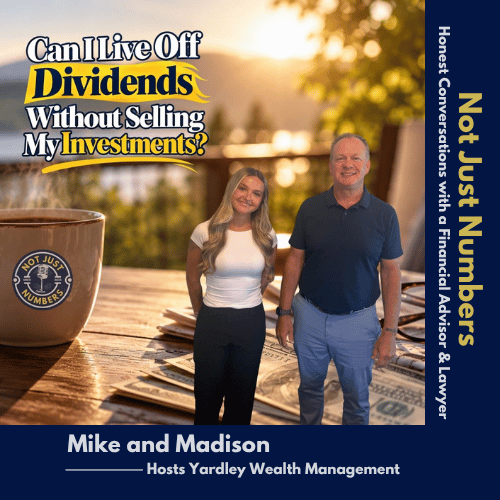
Episode 84: Can I Live Off Dividends Without Selling My Investments?

Hosts: Madison Demora and Mike Garry

Episode Overview

Can you live off dividends without ever selling your investments? For many retirees, dividend income feels safer than selling shares. In this episode of Not Just Numbers, Madison and Mike discuss a Wall Street Journal article on why retirees love dividends and why the stock market’s surge has some of them thinking again. They explain why dividend yields are so low, the difference between income and total return, why a dividend isn’t free money, and how chasing yield can hurt diversification and taxes. They also cover asset location, how to get comfortable selling investments in retirement, and where dividends can still play a useful role.

Listen to Our Podcast On:

TIMESTAMPS

00:08 – 01:06 – Introduction

01:07 – 02:38 – Why Dividends Feel Appealing in Retirement

02:39 – 05:41 – Dividends versus Total Return

05:42 – 07:57 – The “Free Dividend” Fallacy

07:58 – 10:32 – Should Retirees Build Their Portfolio Around Dividend Stocks?

10:33 – 12:59 – Higher Yield Does Not Necessarily Mean a Better Investment

13:00 – 16:37 – Dividends, Taxes, and Asset Location

16:38 – 17:38 – Getting Comfortable Selling Investments in Retirement

17:39 – 18:44 – Dividends Can Still Play an Important Role

18:45 – 19:37 – What Can Retirees Focus on Instead?

19:38 – 21:14 – Main Takeaway & Closing

Follow Us on Social Media

Stay updated with the latest episodes and news by following us on social media:
 

Episode Glossary

  • Dividends: Payments made to shareholders from corporate profits.

Key Takeaways

  • Dividends feel comforting because you receive cash without deciding to sell, so it seems like you’re living off income and leaving your principal untouched. That’s powerful psychologically, even when the economics are similar. Dividend-paying companies can belong in a diversified portfolio. The problem starts when the dividend itself becomes the main goal.
  • Yield isn’t the number that matters most; total return is. The S&P 500’s dividend yield is now just over 1%, partly because stock prices have risen. A $2 dividend on a $50 stock is a 4% yield, but if the price doubles to $100, the yield falls to 2% even though the dividend didn’t change. A stock that gains 8% and pays 2% beats one that gains 3% and pays 5%.
  • A dividend isn’t free money. When a company pays one, that cash leaves the company, and the share price drops by about that amount. Receiving a dividend versus selling a few shares is similar economically, but with a dividend, the company decides when you have a taxable event.
  • Building a portfolio around dividends can concentrate you in certain sectors and leave out companies that reinvest profits, like Berkshire Hathaway and many tech companies. Start with your financial plan and work backwards (how much you need, when, from which accounts, with what taxes) rather than shopping for a 5% yield.
  • A very high yield can be a warning sign. A $5 dividend on a $100 stock is a 5% yield, but if the stock falls to $50, it’s 10%, and that may mean the market doesn’t think the dividend is sustainable. Companies aren’t required to keep paying dividends and can cut or suspend them, so don’t treat dividend income as guaranteed.
  • Taxes and account location matter. Qualified dividends are generally taxed at long-term capital gains rates, but you don’t control when they’re paid, which can affect how much of your Social Security is taxed, your Medicare premiums, and Roth conversion opportunities. Which investments you hold in which account (asset location) is part of the strategy too.
  • Selling investments in retirement is part of the strategy, not a failure of it. Dividends still have a role as one source of cash flow, but look at your whole plan: spending, guaranteed income, withdrawal rate, diversification, cash reserves, and taxes over the next 20 to 30 years.

Transcript

Not Just Numbers: Honest Conversations with a Financial Advisor and Lawyer
Episode 84 – Can I Live Off Dividends Without Selling My Investments?

Introduction & Hosts

Madison: Hello everyone and welcome to Not Just Numbers, Honest Conversations with a Financial Advisor and Lawyer, the official podcast of Yardley Wealth Management. I am Madison Demora and I am here with Mike Garry. Mike is a financial advisor and a CFP practitioner and the founder and the CEO of Yardley Wealth Management. He is also an estate planning lawyer and his law firm is Yardley Estate Planning. Hey Mike.

Mike: Hey Madison, how are you today?

Madison: I’m good. How are you?

Mike: I’m good.

Why Dividends Feel Appealing in Retirement

Madison: Awesome. Awesome. All right. So today I want to talk about an article from the Wall Street Journal titled, “Retirees Love Dividends, but the Stock Market Surge is Making Them Think Again.” And I thought this was interesting because dividends seem to have a really strong appeal for retirees in particular. You own the investment, it produces income, and theoretically you can use that income without having to sell your shares. So let’s start there. Why are dividends so attractive to retirees?

Mike: I think a big part of it is psychological. When you’ve spent 30 or 40 years accumulating money, retirement requires you to completely change your mindset. Instead of putting money into your investment accounts every month, now you might have to take money out. And that can be uncomfortable. If you own a stock that pays a dividend, you receive cash without actually having to make the decision to sell the stock. So it feels like you’re living off the income while leaving the principal untouched.

Madison: And I would imagine that feels very different than logging into your account every month and selling shares to pay your bills.

Mike: Absolutely. Even if the economics are similar, emotionally they don’t necessarily feel similar. So if I receive a $5,000 dividend, I might think, “Great, my investments just produced $5,000 for me.” If I have to sell $5,000 worth of investments, it can feel like I’m slowly depleting my portfolio. That distinction is very powerful psychologically.

Madison: The article actually talks about that. One financial planner described the comfort some investors get from receiving periodic cash payments rather than deciding when to sell investments or trigger capital gains. So is that comfort necessarily a bad thing?

Mike: No. There’s nothing inherently wrong with dividends. Dividend-paying companies can absolutely be part of a diversified portfolio. The problem comes when someone starts making the dividend itself the primary investment objective. That’s when you can start making decisions that may not be in your best long-term interests.

Dividend Yield vs. Total Return

Madison: One of the big points in the article is that dividends aren’t producing as much income relative to stock prices as they once did. The trailing 12-month dividend yield on the S&P 500 is now over 1%, which the article describes as a generational low. Why has that yield gotten so low?

Mike: Yeah, so it’s now just over 1%, right? A generation ago, people were decrying the fact that it was just over 2%. But it’s gotten lower over that time. Part of the answer is simply that stock prices have gone up significantly. Dividend yield is calculated by taking the annual dividend and dividing it by the stock price. So if a company pays a $2 dividend and a stock is trading at $50, that’s a 4% dividend yield. If the stock rises to $100 and the dividend stays at $2, the yield is now 2%. Nothing happened to the dividend. The price of the stock just went up.

Madison: So ironically, lower dividend yields can partly be the result of something investors generally want, which is rising stock prices.

Mike: Exactly. It’s an important point. The article makes that distinction. The low yield is partly a side effect of how much stock prices have appreciated. And if you’re a shareholder, appreciation is still the return. It just doesn’t arrive in your checking account as cash.

Madison: Which brings us to something I think investors sometimes lose sight of. If my stock goes up 10%, but only 1% of that comes from dividends, I still had a good year.

Mike: Right. So you know if you get 1% from dividends and it appreciates 9%, so your total return is 10%. That’s still a good year. And that’s why we have to talk about total return. And that’s more important than just dividend yield.

Madison: Can you explain total return? Because I think that’s really the heart of this article.

Mike: Yeah. Total return is essentially everything you earn from the investment. You have the appreciation in the price, plus the income it produced through dividends or interest. So if you own a stock that appreciates 8% and pays a 2% dividend, your total return is roughly 10%, ignoring some of the details around timing. If another stock appreciates 3% and pays a 5% dividend, that’s roughly an 8% return. The second investment paid more income, but it didn’t necessarily make you wealthier.

Madison: So if I’m choosing the second stock just because I like seeing that 5% dividend, I could actually be focusing on the wrong number.

Mike: Exactly. You want to know the investment is doing for your overall financial plan. The dividends are one component of return. They aren’t the only component. And particularly over long periods of time, growth can be very important. The article gives a good example of this. One retiree had roughly half of his taxable stock portfolio in dividend-focused ETFs and half in broad-market index funds. Looking back, he said most of the growth in his portfolio actually came from the broad index funds. That doesn’t mean that dividend funds are bad. It illustrates that income and growth can serve different purposes.

The “Free Dividend” Fallacy

Madison: There was another concept in the article that caught my attention. It was called “the free dividend fallacy.” What does that mean?

Mike: Basically, some investors mentally treat a dividend as free money. They own the stock, the company sends them cash, and they still own the same number of shares afterwards. So it feels like the dividend appeared out of nowhere. But economically, that’s not really what happened. When a company distributes cash to shareholders, that cash is leaving the company. All else being equal, the value of the company is lower by the amount it distributed. Funds and stocks go ex-dividend two days before the dividend comes out, and the value, the net asset value, of the fund or the the price of the stock goes lower by the amount that is distributed.

Madison: So if a company pays me a dollar-per-share dividend, I shouldn’t think “I just got an extra dollar and nothing else changed.”

Mike: Right. You received part of the value of your investment in cash. That doesn’t mean dividends are bad. It just means they aren’t magic.

Madison: And I think that’s an important distinction because selling a small number of shares can feel completely different to somebody, even though economically you’re also converting part of your investment into cash.

Mike: Exactly. Suppose you… And a big point here is, that by receiving a dividend instead of selling stock, you’re letting the company decide when you’re going to have that taxable event. Right, so when they pay that dividend, that’s a taxable event to you, and so, and your economic value is going to be the same either way. The difference though is if you don’t receive the dividend, you’ll have less than taxes to pay, right? You know, when you’re not the one making the decision when to sell that money or take that money out, and that you’re leaving that decision up to the company, you know it’s not magic as we said. So, like, suppose you have two investments worth $100,000. One pays you $4,000 in dividends. The other doesn’t pay dividend, but you sell $4,000 worth of shares. People perceive those situations very differently. But from the standpoint of funding your retirement, the more important question is what happens to the portfolio’s value over time. There’s no difference.

Should Retirees Build Their Portfolio Around Dividend Stocks?

Madison: So let’s say somebody comes to you and says, “Mike, I’m retiring and I want my portfolio to produce enough dividends that I never have to sell anything.” Is that a strategy you would recommend?

Mike: You almost said the right word: tragedy. No, I wouldn’t make that goal. Yeah, I mean, the goal should be creating sustainable retirement income while appropriately managing risk, taxes, and the longevity of the portfolio. If dividends help that accomplishment… If dividends help accomplish that, wonderful. But I wouldn’t constrain the entire investment strategy around avoiding the sale of shares. Because once you do that, you may end up with a portfolio that’s very different from the overall market.

Madison: How so?

Mike: Well, certain types of companies tend to pay larger dividends. You can end up heavily concentrated in particular sectors or types of companies simply because you’re chasing yield. Meanwhile, you may own much less of companies that reinvest profits into growing their businesses. Now you’ve allowed your desire for income to dictate your diversification. Like the easiest example of this are, the two types of stocks that tend to not pay dividends or pay dividends only after they’ve been in business for a long time. Berkshire Hathaway, which doesn’t pay dividend and which has had tremendous stock market returns since the 1960s, and tech companies. And who are the companies that have been leading in returns for the last 25 30 years. Tech companies. So if you are deciding that you only want to invest in dividend paying stocks or you want to overweight your portfolio in dividend-paying stocks, you are making the active choice to reduce the amount of like tech stocks and the Berkshire type companies in your portfolio. And is that really a good thing you think? I’d say no. I’d say that’s not a good thing.

Madison: And the article makes the point that investors who make yield their primary goal can end up with poorer diversification, potentially higher tax burdens, and even overpaying for dividend-paying companies.

Mike: Right. That’s why I think investors should start with the financial plan and work backwards. How much do you need from your portfolio? When do you need it? What accounts are you taking it from? What are the tax consequences? How much risk can the portfolio reasonably take? Then you build the investment and withdrawal strategy around those answers. You don’t start by saying, “I need a 5% dividend yield,” and then go shopping for investments that happen to produce 5%.

Higher Yield Does Not Necessarily Mean a Better Investment

Madison: All right. So let’s talk about that idea of chasing yield because I think investors naturally assume that if 3% is good, 5% must be better, and 8% must be even better. How does that work?

Mike: Yeah, so it doesn’t work that 3% is good, 5% is better, and 8% is the best. A very high yield can actually be a warning sign. Remember, dividend yield is partly based on stock price. If a company pays a $5 annual dividend when a stock is worth $100, that’s a 5% yield. If investors become concerned about the company and the stock falls to $50, suddenly the exact same dividend represents a 10% yield. That doesn’t necessarily mean the investment became twice as attractive. It might mean the market believes that $5 dividend isn’t sustainable. And that is often what happens, Maddie. So if you are a company that’s really struggling, you’ve always paid a high dividend, and then your stock price goes down, and the dividend is like even higher. I don’t know how many times in my career, especially earlier on, people say, “Oh, that’s paying 8% dividend,” and you just have to talk to people like, “Yeah, that’s not going to last.” Like they’re either paying that 8% dividend because everybody thinks the stock is not worth as much, and so they’ve sold it, or they might be inflating the dividend to try to get people like because nothing’s working for them, and so it’s like putting on a special blend of lipstick or something like, “Ooh, we’re gonna pay this high dividend, try to attract investors because our stock price is cratering,” and it will fool some people, but it’s not going to fool the market. Right? And so, if you see a high dividend, that generally is not sustainable. Companies don’t pay a high dividend unless they feel, pay that high of a dividend, unless they feel like they have to, or because the stock price cratered. Neither of those are good reasons to buy something.

Madison: Right. So sometimes the yield goes up because the investment has gotten riskier.

Mike: Yeah, I’d say ordinarily that’s the case. I mean, that’s generally why. And you know, companies aren’t required to keep paying dividends. They can reduce or suspend or eliminate them completely. That Wall Street Journal article provides recent examples of companies suspending their dividends. So I wouldn’t treat dividend income as guaranteed income because it is not.

Dividends and Taxes

Madison: There’s also a tax component here. One reason people like dividends is that qualified dividends can receive more favorable tax treatment than ordinary income. Does that make dividend-paying stocks particularly attractive in taxable accounts?

Mike: You know, it can be helpful, but you still have to look at the whole situation. You know, yes, qualified dividends are generally taxed at long-term capital-gains rates rather than ordinary-income rates, which can be favorable. But there’s another issue. You don’t decide when the dividend gets paid. If the company distributes it, you receive taxable income whether you need the cash or not. And you know, like, on the one hand, like sure, it’s not the worst thing to get a dividend, but on the other hand, like don’t make that the ultimate part of your strategy, to have income forced on you whether you want it or not.

Madison: So whereas if I own an investment that’s appreciating but isn’t paying out as much income, I have more control over when I sell it.

Mike: Yeah, and that greater control is really important, right? That helps when you know so you decide when capital gains are realized. And tax planning retirement is often about controlling when and where income shows up. For example, taxable income can affect how much of your Social Security is taxable. It can affect your Medicare premiums. It can affect capital-gains rates. You know, is it zero? Is it 15%? Is it 23.9%? It can affect Roth conversion opportunities. There are a lot of moving pieces. And if you’re getting that income that you have no control over, that could mess up some or all of these different things. You really have ne on a rant today, Maddie. I like it.

Madison: All right, the article gives an example of a retiree whose dividends were threatening to push his income above the threshold for Medicare’s higher-income surcharges. That’s something I think people might not expect. You’re receiving more investment income, which sounds positive, but it can potentially create another expense.

Mike: Exactly, that’s why we come back to, we always try to come back to after-tax income. We’re not trying to maximize one number on a statement. We’re trying to maximize what the portfolio can sustainably provide after taxes and expenses while still supporting the long-term plan.

Asset Location: Which Account Holds What

Madison: So does that mean it also matters where you’re holding these investments? For example, whether they are in an IRA versus a taxable brokerage account?

Mike: Very much so. That’s called asset location. Different investments have different tax characteristics. You might hold relatively tax-efficient growth-oriented investments in a taxable account, while investments generating more ordinary income may make more sense inside certain tax-deferred accounts. Obviously, the right structure depends on the individual. But you don’t just look at which investments you own. You also look at which account owns them.

Madison: So somebody could theoretically have a well-diversified portfolio overall, but still be intentional about which investments sit in which account.

Mike: Right. That’s the best thing to be well-diversified and be intentional about which investments sit in which accounts. You know, it becomes especially important in retirement because you might have taxable brokerage accounts, traditional IRAs, Roth IRAs, 401(k)s, and cash reserves. Those accounts aren’t interchangeable from a tax perspective. The investment strategy and the withdrawal strategy really need to work together.

Getting Comfortable Selling Investments in Retirement

Madison: All right, Mike. So I want to go back to something you said earlier because I think this is probably the hardest mental hurdle. If you’re retired and living from your investments, selling shares feels like you’re spending your principal. How do you help somebody get comfortable with that?

Mike: Well, you know, first we remind them what the portfolio is there for. You saved this money so someday it could support your life. And retirement is that someday. That doesn’t mean we recklessly liquidate the portfolio. We have a withdrawal plan. We manage risk. We maintain appropriate reserves. We rebalance. But selling investments isn’t a failure of the strategy. It’s part of the strategy.

Madison: Especially if the portfolio has appreciated.

Mike: Sure, if you invested a million dollars and now it’s two million dollars, selling fifty thousand dollars for your income that year doesn’t mean you’ve somehow destroyed your original investment strategy. You built wealth so that that wealth could eventually support your goals. We just want to make sure the withdrawals are sustainable.

Dividends Can Still Play an Important Role

Madison: We’ve talked about a lot of reasons not to become overly focused on dividends. But I don’t want somebody listening to leave this thinking we’re saying dividends are bad. Where can they still be useful?

Mike: They can absolutely be useful. They’re one source of cash flow. They can reduce the amount of investments we need to sell at certain times. And having regular cash flow can be comforting for retirees. The article also makes an interesting point about people approaching retirement. If someone loses a job unexpectedly in their late 50s or early 60s, investment income could potentially provide some cash flow before they have to begin taking distributions from retirement accounts. So dividends can be valuable. I just wouldn’t elevate them above every other consideration.

Madison: So this isn’t really a dividend-versus-no-dividend conversation.

Mike: No. It’s really about using all the tools available to create a retirement income strategy. Dividends. Interests. Cash reserves. Portfolio withdrawals. Social Security. Pensions if you have them. Eventually required minimum distributions. They’re all pieces of the same puzzle.

What Can Retirees Focus on Instead?

Madison: So if dividend yield isn’t the number retirees should obsess over, what should they be paying attention to?

Mike: Focus on the entire retirement plan. How much are you spending? How much guaranteed income do you have? How much needs to come from your investment portfolio? What percentage of the portfolio are you withdrawing each year? How diversified are you? How much cash or short-term reserves you have? What taxes are those withdrawals generating? And how does that look not just this year, but over the next 20 or 30 years? That’s much more meaningful than simply asking whether your portfolio yields 2, 3, or 4%.

Madison: Because ultimately the question isn’t “How much dividend income did I receive this year?” It’s, “Can this portfolio support the life I’m trying to live?”

Mike: Exactly right. And ideally, it can do that through many different market environments.

Main Takeaway

Madison: So what’s the main takeaway from this article for somebody who is retired or getting close to retirement?

Mike: Okay, so don’t confuse income with return. Dividends can be an important part of a portfolio, and there’s nothing wrong with appreciating the steady cash flow they provide. But a dividend isn’t free money, and a higher dividend yield doesn’t automatically make an investment better. What ultimately matters is total return, diversification, taxes, and whether your withdrawal strategy can support your retirement over time.

Madison: And maybe also getting comfortable with the idea that your investments don’t have to generate every dollar you need through dividends.

Mike: Right. A well-designed retirement strategy can use dividends when they’re available and sell investments when appropriate. The objective isn’t to avoid ever touching principal. The objective is to use resources thoughtfully so they’ll support you throughout retirement.

Madison: I think that’s a really important distinction because dividends can feel safer simply because the cash shows up automatically. But as we talked about today, how the cash gets to you is only one part of the equation. Mike, thank you so much.

Mike: Maddie, thank you.

Closing & Contact Information

Madison: Awesome. And thank you everyone for listening. For more information on Yardley Wealth Management or Yardley Estate Planning, you can visit our websites at yardleywealth.net and yardleyestate.net. You can also follow us on socials at Yardley Wealth Management. Don’t forget to subscribe to our YouTube channel. This podcast has been produced by Madison Demora and Mike Garry with technical and artistic help from Poe Productions.

Request the Full Transcript as a PDF

The full transcript of this episode is available via email. Please fill out the form below to receive it: