Episode 59:Millennials and Money: Why Financial Anxiety Still Lingers Then Joined by Anne Lester

Hosts: Madison Demora and Mike Garry
Special Guest: Anne Lester, Author of Your Best Financial Life: Save Smart Now for the Future You Want and former Head of Retirement Solutions at J.P. Morgan Asset Management.

Episode Overview

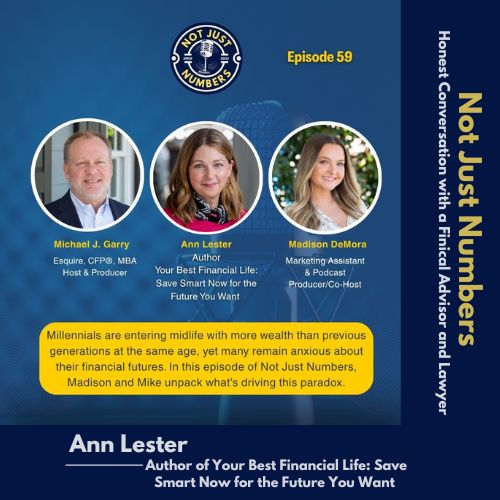
Millennials are entering midlife with more wealth than previous generations at the same age, yet many remain anxious about their financial futures. In this episode of Not Just Numbers: Honest Conversations with a Financial Advisor and Lawyer, Madison and Mike sit down with Maureen to unpack what’s driving this paradox. They explore how economic challenges shaped millennials’ money habits, what today’s numbers really reveal, and what it all means for financial planning moving forward. Later in the episode, Mike and Maddie sit down with Anne Lester, author of Your Best Financial Life: Save Smart Now for the Future You Want and former Head of Retirement Solutions at J.P. Morgan Asset Management. With more than 20 years of experience shaping how millions of Americans approach retirement savings, Anne shares her passion for helping Millennials and Gen Z overcome financial anxiety and take control of their financial futures. We dive into her journey, the common mistakes people make when it comes to saving, and practical strategies to build lasting financial security. Whether you’re just starting your career or planning ahead for retirement, this conversation offers invaluable insights into creating the future you want.
Click here for the full WSJ article in this article 

Listen to Our Podcast On:

TIMESTAMPS

00:08 – 00:49 – Introduction to episode topic

00:50 – 02:38 – Millennials Unexpected Wealth Growth

02:39 – 05:54 – Lingering Financial Anxiety & Wealth Gaps

05:55 – 10:20 – Generational Perspectives on Debt & Feeling “Missed the Window” on Homeownership 

10:21 – 12:49 – Redefining Success 

12:50 – 15:28 – Planning for the Future

15:35 – 56:06 – Interview with Anne Lester

Follow Us on Social Media

Stay updated with the latest episodes and news by following us on social media:

Connect with Ann Lester:

Anne’s book: https://annelester.com/your-best-financial-life

Anne’s website: https://annelester.com/speaking

Connect with Anne on LinkedIn: https://www.linkedin.com/in/savesmartwanne
Episode Glossary

  • Net Worth: The value of an individual’s assets minus their liabilities.
  • Emergency Fund: Money set aside to cover unexpected expenses.

Key Takeaways

  • Millennials’ wealth paradox: Despite having more wealth than previous generations at midlife, financial anxiety persists due to economic challenges shaping their money habits.
  • Economic challenges impact behavior: Economic instability has influenced Millennials’ cautious financial habits, requiring tailored strategies to address their unique planning needs.
  • Leverage current numbers: Understanding today’s financial data can guide Millennials in making informed decisions for future security, despite lingering anxieties.
  • Avoid common saving mistakes: Anne Lester highlights pitfalls like inadequate saving or poor planning, urging proactive steps to build a strong financial foundation.
  • Adopt practical strategies: Focus on saving smartly now, using Anne’s insights, to overcome anxiety and secure a retirement tailored to Millennials’ and Gen Z’s goals.
  • Take control of your future: With over 20 years of experience, Anne emphasizes actionable steps to reduce financial anxiety and create lasting security.

Transcript

Podcast Transcript: Ep. 59 – Millennials’ Wealth and Anxiety

In Episode 59 of Not Just Numbers, we explore millennial wealth anxiety, examining why Millennials have more wealth than expected yet remain anxious about the future, with insights from Mike Garry, Maureen Donahue, and Anne Lester.

Introduction

Madison: Hello everyone, and welcome to Not Just Numbers, Honest Conversations with a Financial Advisor and Lawyer. I am Madison Demora and I’m here with Mike Garry. Mike is a financial advisor and a CFP practitioner and the founder and the CEO of Yardley Wealth Management. He is also an estate planning lawyer and his law firm is Yardley Estate Planning. Today we’re diving into an article from the Wall Street Journal about how millennials are entering midlife wealthier than anyone expected, yet many are still anxious about the future. With me are financial advisors Mike and Maureen to help unpack what’s really going on behind these numbers. The article points out that after years of struggling through recessions, millennials now actually have higher net worths than previous generations did at the same age. Mike, why do you think this turnaround happened?

Millennial Wealth Turnaround

Mike: Sure. So, you know, some of them came of age during the great financial crisis and realized that they had to take control of their financial lives and they were forced to save. And now, you know, 15 years later, stock market and housing markets are at all-time highs. Right. And so, you know that rising tide has lifted those millennial boats, so to speak.

Factors Driving Wealth Catch-Up

Madison: So, Maureen, the article mentions that in 2016, older millennials wealth was one third lower than expected, but by 2022, it was 1/3 higher than expected. That’s a big swing. What factors do you think drove that kind of catch up?

Maureen: Yeah, Mike already addressed it. So first I want to say what the millennial time frame is. It’s people, born 1981 to 1996. So that’s ages in today between 2025, 29 to 44. So, if you think about it, the people that graduated, the “older millennials”, 40 to 44, they were graduating right in that Great Recession and faced it. So, you know, they graduated, they formed jobs. They’ve already been through two market cycles in that sense, so they got the advantage of whatever they were saving at the time. It’s kind of scary to graduate and you had a degree in something, and you might have to pivot, so you start getting a saving mentality. Well, now they’ve had two market cycles to grow that, and, they’re been very good market cycles. So, they’ve purchased houses and they been able to build that wealth.

Anxiety Despite Financial Progress

Madison: But even with this financial progress, the article makes clear that a lot of millennials still feel like the bottom could fall out. For example, one person keeps an emergency fund that could cover years of expenses because he doesn’t trust the stability of the market. Mike, do you see that kind of mindset with your clients?

Mike: Yeah, you know, we spoke in an earlier podcast about how, people’s experiences have shaped them. Right. And so, we have to talk to them about, like, the overall market or economic conditions or what expectations should be going forward, like, from right now. But a lot of people have in mind either the good or bad things have happened to them over the years just based on, like, the timing of when they were born or when they started jobs or when they had kids. You know, so it is something, you know, we always need to have a conversation to see, you know, like, how people feel about things and then try to figure out, like, you know, either if we need to adjust their strategies because of that or if we need to talk to them about, like, well, yeah, you had that experience and, you know, that was an unfortunate time, but, you know, things might be a little bit different now. And so, yeah, it’s always like trying to figure out how to meet people so that they’re doing what, what can be best for their future. You know, and sometimes that’s hard. I wish it was easy more often, but it’s not.

Wealth Gap and Planning Challenges

Madison: And Maureen, not everyone is sharing equally in this wealth growth. The article points out that student debt and housing affordability are still huge barriers. What does this wealth gap within the millennial generation mean for financial planning?

Maureen: Yeah, going back to just that long time horizon a generation spans. You had the millennials we talked about that graduated during the Great Recession and started investing when markets were low. Then you have the latter millennials, they graduated, you know, 5, 10 years, 15 years after the older millennials. And with college prices rising at, say, average 6.8%, you know, they are burdened with the student loan debt. And while they didn’t face the same problems as getting a job because the job market was great in the field that they desired, but they had the financial burden, which we hear this a lot. You know, they delayed buying a house. Now houses are too expensive because they wanted to pay off that student loan debt. And you get a mentality here of debt aversion, too, and a misperception, too, of what interest rates are. You know, they live during a time of saying, oh, like, I can get a 2 or 3% mortgage rate. Well, that was a unique time. And I think that’s why employing at this point, if they’re thinking of these big decisions, their first big home purchase, they might be starting their families. They don’t feel like they have the financial capacity. But having an advisor to speak to, to walk through and contextualize affordability and what a 6% loan actually is, really can help them benefit, because those decisions and where they put their money now can affect them in the future and help reshape those, you know, perceptions of debt’s bad or, you know, just because they had a lot of debt or still have it.

Interest Rate Perspective

Mike: Yeah, that’s a great point about interest rates. Right? So like, yeah, there were, available 2 and 3% interest rates for a while. But you know, I’m a Gen Xer, an old Gen Xer. And my first mortgage was at eight and three quarters. And my parents are boomers. And their mortgage on the house that my mom went up living in for 40 years was 18% in 1981. And she refinanced it twice to bring it down to 9% and eventually like paid it off. It was at 9% interest. Right. And so, I think sometimes generations look at each other as if, oh, they got all the breaks or, you know, this one only had good stuff or this one only had bad stuff. And you know, the funny thing is you hear a lot of the same, same talk, the same rhythms. Gen X, we were considered slackers. The way that they’ll talk about Gen Z now, like, and you know, like there are people that are slackers and people that are hard working in every generation. And a lot of those, a lot of those things are just kind of a little bit tired to me, a little bit overdone. You know, I had a teacher in high school, a Latin teacher say that, talked about how older generations have always said the younger generations are lazy, that they don’t have to work that hard. And he said honestly Socrates said that about Plato, who said that about Aristotle, who said that about Alexander the Great. That’s how old that that reference is. But it’s true. But anyway, great point about the interest rates.

Missed Window for Home Ownership

Madison: All right. Another interesting detail is that even a few years difference in age has made a big impact. Someone who bought a home in the 2010’s may be in much better shape than someone who waited until the 2020’s when mortgage rates and prices shot up. Mike, how do you help clients who feel like they missed their window for building wealth through home ownership?

Mike: Well, that idea of feeling you missed the window and you need to catch up, probably resonates with a lot of people, not just millennials. And you know, I think sometimes that’s a hard feeling to shake. And you know, I’ve talked with, about it with my sisters and the three of us always felt like we were trying to catch up. And you know whether that, whether that’s true or not, we have that feeling. And what I would say is, like, all you can do is take a look at your situation as it is now and do the best that you can with it. Right? Get good advice. Take practical steps and, you know, think about success in all kinds of terms. Like, not just like, oh, does your retirement amount meet some sort of threshold goal, or you have enough liquid savings? Look at everything, do the best you can. And then, you know what? Cut yourself some slack. The world is hard. It just is.

Maureen: And just to add to that, people love to think of real estate as, like, a great investment. And while it can be, and it can be a great source of wealth, it’s also a use asset. You need to live somewhere. So again, bringing that back to say, yeah, but you need a house. So you buy it now and are you going to move? You can keep it for a long time and it will hopefully appreciate. And if it doesn’t, it’s okay. You need to live somewhere.

Mike: Right? So, we’ve talked about this, Mo, like, so you bought your house like, five years ago. We bought our house like 20 years ago. We both have about the same amount of appreciation in our houses. And I will tell you that we’ve put a lot into our house in the last 10 or 12 years. And so, the idea of us, like, getting some huge amount of equity from our house, that’s not the case. You know, I love living there. I love our neighborhood. I love Yardley. It’s a great place to raise our kids. We’re not making a fortune off of our house one day. That’s just, is not a thing. Maybe that was a thing in the olden days before people, like, redid their kitchens and had nice bathrooms. But people spent a lot of money in their houses now and on their houses. And so, yeah, it is a use asset and use it as much as you’d like but don’t think of, like, not having that equity in your house, necessarily sets you behind.

Redefining Success and Experiences

Madison: That ties into another point in the article. Millennials are redefining success. Instead of the traditional house, spouse and kids in the suburbs, some measure wealth by experiences like travel and enjoying a good lifestyle now. Maureen, do you think this shift in mindset is healthy from a financial perspective?

Maureen: So, I first find the question to be a little insulting overall, because I think the family is just another experience. So, I like to say they might be redefining it as their experiences. So, whether it’s starting a family and having them in the city or having them in the suburbs or having a travel lifestyle. Millennials are redefining in the fact that it’s the experiences that they value, not, you know, the we just said housing or this. It’s really, what can I do with my life over the long time period? So, I like to just say that is from my conversation, while not everyone seeks a family, it’s the experience they want to give for their family. Whether it’s them and a spouse, them and a spouse and a family. But with that, I think it goes back to experiences again. When you have something taken away from you, you start to value it more. And Covid definitely did that for all of us. And, the millennial generation hit it in a lot of different ways, where all of a sudden, during the years that they would probably travel, we faced it personally. You had to delay that. You know, we took a honeymoon to Ireland about four years later than our marriage because we want to go but couldn’t go. So, you start to value those things when they’re taken away. You realize what you want to do with your time. And ultimately it does shape your goals then. So millennials, whether they necessarily prioritize retiring earlier or having flexibility in their job so they can travel more while they’re young and healthy, before kids or with kids, they actually take them on vacations. I think my family, when we were young, that was just not a thing that people did. So there’s just more of, hey, what are the things I can expose, in my life? What do I want to experience and how do I save for those goals through the flexibility of different types of jobs and work environments? I think it does. It comes from the experiences they had and Covid being a big one. You know, just like you never thought ripping off a band aid in a year, not being able to fly, people would be like, wow, I really need to.

Mike: For sure.

Planning for an Uncertain Future

Madison: Towards the end of the article, there’s a note of optimism. Some believe that in 20 to 30 years, millennials will be seen like boomers are today, sitting on wealth and property. But there’s also fear about things like artificial intelligence disrupting careers. Mike, how should millennials plan for an uncertain future?

Mike: The same way that everybody’s always planned for an uncertain future. The future is always uncertain. Like, just some perspective, right? There’s always challenges, and maybe they’re new, right? So, like, maybe AI is a new challenge for Millennials or younger generations or still baby boomers and Gen X who are still working. It’s the same thing, right? You need to make sure you have good skills in whatever line of work you have, make sure they’re current, make sure you have good contacts and a good network, you know, in case you need to rely on that network for professional help or career advice. You need to have emergency savings. You know, you need to be well diversified in your investments. And you need to always think like, long term for investing. So really, like, the challenges may change and like the news cycle flips, but they’re really like the same things. You always have to be prepared because the future is not knowable. If it was, I, you know, we would all have so much more money by betting on the stock market.

Advice for Millennials

Madison: Very true, Mike. Maureen, if you had one piece of advice for millennials right now, what would it be?

Maureen: My advice for millennials is to turn around somewhat of the pessimistic view that I will never be able to afford anything. I think I hear that more than not, you never be able to afford to retire. I’ll never have Social Security. I have to think of all these things. It might be the time horizon, Mike might be able to comment on this, but everyone feels like that when they’re in their 20s, 30s, and building it. But turn that around. The Internet, what we have access to, so you’re always there researching and doing DIY. But it might be a point in your life where these are big financial decisions and seeking professional help is very, is going to really just help them get there and get to those goals in the long run. So, you know, take away that pessimistic view and maybe get a professional opinion, and you’ll hopefully have more of an optimistic view of where you’re headed to in the future.

Mike: Sounds great, Mo.

Guest Introduction: Anne Lester

Madison: Thank you both for sharing your insights. This article really highlights how millennials are in a stronger position than many give them credit for, but also how much uncertainty and caution still shapes their financial outlook.
Today on Not Just Numbers, we’re thrilled to welcome a true leader in the world of retirement planning, Anne Lester. Anne is the author of the book Your Best Financial Life: Save Smart Now for the Future You Want, a powerful guide designed to help Millennials and Gen Zers overcome financial anxiety and take control of their futures. For over 20 years, Anne served as the head of retirement solutions at J.P. Morgan Asset Management, and her work has shaped how millions of Americans think about saving for retirement. We had the pleasure of hosting Anne for a special virtual event for our clients’ children earlier this year and the response was so incredible. So, we knew we had to bring her onto the podcast to share her insight with you all. Anne, welcome to Not Just Numbers.

Anne: Thanks for having me.

What Sparked Retirement Passion

Madison: All right, Anne, can you share what sparked your passion for helping people prepare for retirement?

Anne: Well, it’s what I did for a living for 20 years. And I confess there was a little bit of trying to fix myself and why I found it so interesting. I really am a, I’ll just say it, I’m a terrible saver. If you’ve heard of the marshmallow test, where a bunch of researchers at Stanford asked preschoolers to, they gave them all a marshmallow and said if they didn’t eat the marshmallow while the adults were out of the room and waited till the adults came back, they’d get a second marshmallow. I totally would have failed the marshmallow test. Like, 100% would have eaten the marshmallow. And so, when I was asked, as part of my role at J.P. Morgan, to look into building Target Date funds and to understand how we should be building default investments, I started learning about behavioral finance and a lot more about how people save. And had this massive insight that I was not the only person messing this up. That was such a relief to me. It really inspired me to both construct investments the way I did and build the Target Date series that J.P. Morgan ended up launching. But also, as I moved into this next chapter, really wanted to focus on helping people avoid making the same mistakes I did. And so, I’m very passionate about helping people understand their own relationship with money and why they behave the way they do and help them avoid those mistakes that I made.

Mike: Well, thanks. Thanks for the admission there. And I will admit that I am also a terrible saver. So, I need to set up systems like a little bit like you detailed in your book. But I have different goals for each month. Although it’s simpler now all the kids are out of college. And so, it’s paid like a bill. It’s not like, hey, what’s left over? It is paid first like a bill, or otherwise it wouldn’t save it.

Anne: I think that’s so important. And one of the things I’ve always said, and again, another reason I wanted to write the book, is I want to help people understand the consequences of the choices they don’t know they’re making. And when you don’t treat your own savings like a bill and put it on the priority, when you don’t, other people say, pay yourself first, right? When you don’t make it a priority, it’s got enormous consequences. And most people don’t understand that, certainly not in their 20s and 30s.

Mike: Right.

Inspiration for the Book

Madison: So, your book is titled Your Best Financial Life: Save Smart Now for the Future You Want. What inspired you to write this book specifically for Millennials and Gen Z?

Anne: You know, it’s funny, when I first, the book that you see that I wrote, that got published, I should say was my third attempt. It turns out writing a book is actually kind of hard. Who knew? It was a real process. It took about seven years from when I actually started working on it seriously to the publication date. And like I said, I went through three different drafts and the first two versions of it, I was really trying to write a book for everybody. And one of the things my agent told me and writing teacher that I work with, AJ Harper, also said was, if this book isn’t for somebody, it’s for nobody. And you have to have a very specific audience in mind. And then all the things that you say can be applicable and relevant to a much wider audience. But, in trying to talk to everybody, I was talking to nobody because the sad answer to most financial questions is it depends. It depends on how old you are. It depends on a whole bunch of factors. And also, and this is another sad truth, the advice that you can give to somebody in their 20s and 30s and even early to mid-40s is radically different than the advice you will give to somebody who’s older than that. Because I’d say below 40 or 45, your cake is not baked, right? You’ve got time. You know, time is such a powerful part of the retirement savings equation, because that’s what let’s compound returns work their magic. And when you have time, you have choices, and you can make relatively small adjustments and fix everything or fix many things. Once you’re in your late 40s and certainly in your 50s and 60s, your cake is kind of baked and then you’re talking about the frosting. And you can make a lot of changes. And I’m a firm believer that you can always make things better. But if you are starting to think about this stuff and you’re in your late 50s or early 60s, you know, the conversation is not going to be one of optimism. And hey, we can do this. It’s going to be a mm we’re going to make some tough choices here. And let me help you think through those tough choices. But all the choices involve probably sacrifice.

Mike: Right. So, by the time we get clients, it’s a triage. Like if they haven’t done this stuff right, in their 20s and 30s, it’s like, okay, so what can we do? How much longer can you work? How much less can you live on? Whereas if you meet somebody in their 20s and 30s, tiny little differences compound over a generation or two make a huge difference. But most people in their 20s and 30s aren’t really looking for a lot of like, ongoing advice and probably couldn’t pay for it. But like your book where you set them up. Like, I think it’s a great base. Like I’ve read your book, I saw you on the webinar and saw you live in Vegas last year. I think that if somebody gets your book and takes the message to heart, you know, it’s a couple hours of reading that can make a drastic difference in somebody’s life. Because if somebody is saving 5% and then they bump that up to 7 or 8% or 10% for as long as they could do that, and then a little bit more when they get comfortable with that, it makes a giant difference in somebody’s life. I love seeing the handful of clients that we got who were in their 20s or 30s when we started and make some little adjustments and see what great shape they’re in in their 40s and 50s. It’s phenomenal. But you know, it’s rare we don’t get a lot of those opportunities.

Anne: You know, by the time people know they need to worry about it, I don’t want to say it’s too late, but as you say, you’re really starting to talk about making really big changes. And the beautiful thing about starting in your 20s and 30s also is that most 20 and 30 year olds are experiencing relatively robust wage increases. Right. And so that kind of, that party kind of stops when you’re in your late 40s and 50s. Like maybe your income keeps going up, but you’re not getting the big bumps in your salary. And so the other really sneaky thing about starting this in your 20s and 30s is if you can avoid the consumption creep that happens as your income increases and take half of your income increase and shove that into savings, you can get to a 10 or 15% savings rate. I don’t want to say painlessly, but you don’t really feel the bite. But if you’re 50 years old and you’re saving 5% and you get a financial plan that says you need to be saving 20%, oh, and by the way, working another five years like that is a radical painful, like you’re moving, you’re selling cars, you’re not traveling, you are making some painful, painful adjustments.

Mike: Yeah, you’re not going to like it.

Anne: It’s really not fun. And the problem is, you know, it’s human nature, it’s tomorrow. Right. I don’t, I don’t care. It’s tomorrow. Right? So, if in writing this book back to why I did it, if I can just help, people go, oh, actually, I have to care a little more about tomorrow. You know, that’s the big consequence, right? That tomorrow will come.

Mike: Yes.

Power of Compound Returns

Madison: That was a great way to explain it, too. That’s awesome. All right. Anne, so in the book, you talk about the power of compound returns. Why do you think that concept is so underappreciated by young people?

Anne: Well, maybe I was sliding into that topic just there. I think it’s because it’s hard to appreciate the passage of time, and it happens really slowly, and then it gets really fast. So there’s that riddle about somebody being asked for a reward. I think the story is, you know, the story I heard was the emperor of China, and he offers them the room full of gold or one grain of rice that would double on every checkerboard square. And the guy goes, of course I want the gold. And actually, the rice would have been worth more money because that doubling of every square, your brain can’t wrap around after 64 doublings, how much that is. And when you’re saving, you’re starting off, you’re in your 20s, your paycheck is now huge. You’re putting in, I don’t know, a couple hundred bucks a month, a thousand bucks a month. It’s not a lot of money that’s going in. And that compound return, like, it will double every 7 to 10 years if you’re getting, call it 7 to 10% returns. So rough math, right? Rough math. If you’re getting a 10% return, your money is going to double every seven years. That’s been recent history. I think that’s not a good planning number. I would plan on 7% returns in your number, your money doubling every 10 years, most of the time, not all the time. There will be bumps. But if your money’s going to double every 10 years, you don’t see it start growing until year eight or nine. And then you go, whoa, wait a minute, look at that. And then in year 20, you’re like, wow, I’ve got half a million bucks. How did that happen? Well, it happened really slowly. And then, then your money’s working for you. And that doubling is going to be what creates wealth. So that from year 20 to year 30, it’s going to double again. And that half a million bucks turns into a million bucks. But when you’re 25, that’s in your 50s. That’s a really long. That’s unimaginably far away. That’s old people.

Mike: And I would say, Maddie, the compounding is hard to, even in your 50s, as I am, it’s hard to wrap your head around it, even knowing how it works. Right. I’ve been doing this for, you know, half my life almost. But looking ahead to like 5, 10, 20 years in the future to think like that, you know, bread will be $10 or $20 or whatever it is, or you’re going to need so many millions of dollars in your account to retire. It’s hard not to look at them as what those dollars mean, like, right now and think of it as, like, so much money. Whereas it’s just really, you know, has to keep up with inflation, it has to go above inflation. It really is hard to wrap your head around. You know, you think of someone with millions of dollars as someone who’s, like, pretty wealthy now. But, Maddie, at your age, you’re going to have many, many millions of dollars when you retire. You just are. And it is hard to wrap your head around it.

Madison: Absolutely. Definitely.

Anne: The future is hard, and statistics and probability are not the way most of us are wired to think. We don’t think in odds. I mean, I, you know, there are all these behavioral things, right? And some of those books behind me go into great depth about the science of behavioral economics and all these behavioral factors. And most of us are a jumble of contradictory and, complex behavioral interactions. One of the reasons I think I was good at managing money is I’m actually really dispassionate at calculating odds in statistics. Like, I actually have a pretty low fear of loss. Like, I’m really rational when I think about odds. And I’m like, okay, these are the odds. I’ve had cancer a couple times. And I’m like, all right, these are the odds. This is my treatment decision. Boom. Done. Don’t even worry about it, right? Future bias. Like eating the marshmallow. I’m like, way on the crazy, terrible impulse control spectrum bad side of things. On the rational statistics and odds. I’m way on the other side of that spectrum. Like, most of us are complicated people, right? And I think what makes this hard is A most of us don’t understand that we’re not rational. And for me, one of the big breakthroughs also was forgiving myself for making mistakes, because I kept thinking they were my fault, and I was being bad and lazy and stupid and greedy. And I kept labeling, like, my poor impulse control. And it’s like, it’s just the way I’m wired. And knowing that I’m wired that way actually helps me not do it, because I go, oh, I want, put a brake on. Figure out a way to make myself pause, right? Whether it’s putting stuff in the shopping cart and never letting yourself buy it, whether it’s not letting yourself buy anything on your phone, because that’s impulse buying, right? Nope. Gotta sit down at your kitchen table, at a computer, and, like, make decisions slowly. Figuring out if you’ve got impulse control problems. And I think many people do. And technology makes it worse. Like, figure out a way to slow yourself down. But once you. If you have this problem, getting it out of the moral realm of good and bad and just saying, hey, it’s the way I am. It’s just a thing. Given this thing, how can I be a little less prone to falling into that trap? How do I create breaks? How do I create habits? How do I automate? How do I create guardrails for myself? And everybody’s got slightly different things that they need to deal with. But, you know, some people actually are great savers, and they don’t struggle with impulse control at all. My husband’s one of them. He’s like, oh, I said I wasn’t going to do it. I’m not going to do it. I’m like, dude, seriously, like, wow, I want to be you.

Mike: Right. So, I’ve been listening to you. I feel like, we always, we always think of what our faults, right? And are judgy about them. But you do plenty. You’re hardwired to do plenty of good stuff too, right? And so, give yourself some grace. I think the thing is, like figuring out how to, I don’t know if control is the right way, but how to set yourself up to make good choices, you know? Like, I think there’s a lot of that in your book too, to take a lot of the decision making out to make it easier so it doesn’t occupy your brain all the time and you’re not, like, constantly worried about it. You do some things and make things easier.

Anne: The analogy I sometimes use also is for those of us who also struggle with Oreos for instance. It’s a standard piece of advice if you’re trying to manage your weight or not eat stuff. Like, don’t put them on the counter. Like, just like, I cannot walk by a package of Oreos and not eat one. And if I eat one, then I eat many. Like, I just can’t do it. I know that if they’re in the house, which now I’m just like, they’re not coming into the house because then I don’t eat them. They’re going in the back, hidden. So, yeah, I know they’re there, but I don’t see them. And if I don’t see them, I don’t go, oh, I want an Oreo. Like, it doesn’t tend to occur to me. It doesn’t float across my brain that, oh, there are Oreos there. But it’s the same way with a lot of money things, right? Don’t create them, and I talk about this for spending, like, don’t put yourself in the situation where you have to wrestle with yourself because you might lose more often than you want.

Mike: Right. Yeah, that’s great.

Common Behavioral Biases

Madison: What are some of the most common behavioral biases that hold young people back from saving?

Anne: Present bias is the big one, right? And that’s what I’ve been talking about. You know, you can call it impulse control, but basically it boils down to what is in front of me right now is far more important than what might happen in the future. And they’re saying that we have, a bird in the hand is worth two in the bush, right? That is a literal saying for a reason. Something certain is better than something uncertain. And our brains have taken that and run with it. So that what is happening right now is far more important than what is happening in the future. So much so that when you survey people and you say with 100% certainty, you can have a dollar today or $2 tomorrow, a lot of people would say, I want the dollar now, thank you. Because it’s right in front of them and they want it. Right. I’m exaggerating slightly, but not that much. Like, some people will take $100 today versus $200 next week. Now, I can promise you, if you take your $100 and invest it in a savings account in the bank, you’re not going to get $200 next week, right? That is just sure money, 100% doubling of your money. And a lot of people won’t take it because their need for money right now. Yeah, I know if I wait, I have, I have more, but I got a bill I got to pay. Okay, then I’m going to take the money. Right? So, when you’re young, that framing is compounded by not having lived enough to know all of the things that will probably happen to you that are bad. So, I was chatting with my younger son, and he’s like, I got to buy new tires, they’re a thousand dollars. I was like, yeah, and I can tell you you’re going to have to buy new tires every four to five years. Like, that’s just something that’s going to happen. If you live in Los Angeles and drive a car. Like, you need to budget for spending a thousand bucks on new tires. He’ll know that now in the future. It never happened to him before. He didn’t know. I mean, he has emergency savings, fortunately, but, like, so when you’re in your 20s, you don’t have any lived experience of the routine unpredictable things, the known unknowns. Right. To borrow. You don’t know what those known unknowns are. And so that bias towards, I can afford it because I have the money right now is way compounded by this, and I have no idea how much I’ll need to be able to manage in the future. So, to me, that future discounting is a huge one. I think a lot of people also get really overwhelmed by choice. And that’s another very common behavioral thing. There were studies shown that, you know, the more people say they always want more choice and more choice is good. Of course I want more options. But once you have more than six or seven options, you start getting progressively more and more unhappy because you start worrying that you’re going to pick the wrong thing. And then that locks you down and you become fearful, and you don’t make any choice at all. So I think that is a real challenge for people who are starting out with investing and saving, because the fear of doing it wrong becomes paralyzing, and it feels safer not to do anything at all. And, oh, by the way, we’ve all been told that money is the most important thing, and these are really important things. If you do it wrong, you’ll be in terrible trouble. And it all feels very, existentially frightening. And I don’t think it’s easy to understand how, it’s very easy to unwind financial decisions when you’re young, right? Yeah. You picked a lousy investment fund. You can change. Yeah, I’m sorry you lost 10% of your investment, but guess what? You’re 25. It’s all going to come out in the wash. Don’t worry.

Mike: Yep.

Anne: So to me, that that, that choice thing is probably something most people don’t appreciate either. And that’s one of the reasons in my book, I try to, the fewer choices you ask yourself to make, the more likely you are to be thoughtful about them. Right. And then you can put your energy to the most important thing, which is actually like saving more money.

First Financial Move for 20s

Madison: All right, if someone in their 20s is just starting out and feeling overwhelmed, what’s the first financial move you’d recommend they make?

Anne: Emergency savings fund number one. If you do nothing else, have a automatic deduction from your checking account into your bank’s savings account. It’s the easiest thing you can do. They will do it automatically. You need to get three to six months of living expenses tucked away. And when I say living expenses, excluding things like streaming services and vacations, like, this is, keep the lights on. Don’t get kicked out of your house. Don’t have your car repossessed. Like, minimum payments on credit cards when you’re underwater. Like, this is not, this is not how you should be living your life. But like, if you lose your job, cut it back to the bare bones. How much do you need to survive for six months while you look for another job? Or if you need to buy new tires for your car, ideally you’ve budgeted for that one. But like, that can come out of emergency savings as long as you pay yourself back, right? Ideally you would look around for a higher yield savings account and move that money into a high yield. But guess what? If you don’t, it’s okay. Do the easiest thing first. Get the emergency savings fund. Don’t make it a big scary thing. I got to find a good online bank. I read on Tik Tok that somebody found this great. Like, forget it. Do the easiest thing. Once you do that one easy thing, the next thing start feeling you’re like, yeah, I know how to, I got, I, I got this. I can take this next step.

Mike: I totally agree with the idea of getting those small wins and then, that it can snowball if you start doing them and it feels good and you see the progress. Right? If you’re trying to start that emergency fund and you’re setting up that savings at whatever it is per month or per check or, however you can do it, you’ll see it. It won’t take long to see that balance increase. Yeah. And then I feel like when people see that and have the feel good from that, then it leads to do the other things. Like you were just saying, oh, now I could do this, or I could do that, right? Take that first step is huge.

Anne: $100 a month will be $1200 at the end of the year. Like that’s, that’s like actually enough to manage a small emergency, like the tires. Like, a thousand bucks is meaningful. And, you know, if you’re not earning a lot of money, 100 bucks a month might be a lot to save. But think about it in other ways. And everybody goes, blah, blah, Starbucks. But maybe it’s not Starbucks. Like, look at how much you’re spending on a little tiny splurgy thing. And see, instead of doing it every day, do it every other day. Make it a ritual for Wednesdays and Fridays. Hump day on the last day, little celebration, coffee. The other three you can tuck away in your savings account. Right. I’m a big believer in not, depriving yourself because deprivation. Talking about myself here, deprivation makes me explode later, and then I regret it. But moderation is something you might be able to work on. Knock out one or two. If you’re going to Starbucks a day. Sorry. If you’re going to Starbucks twice a day, go once a day. You know, figure out ways to ask yourself. Not To sound all Marie Kondo, but like, you’re spending money that’s not actually bringing you joy that you’re not noticing. It just turned into a routine. This is what I do every morning. Like, if your cup of coffee in the morning is the thing that makes your day shiny and bright because the barista knows your name and you have this little chat and, like, you get going and it’s like, yeah, I look forward to. Don’t cut that out. Maybe if you go after lunch and the guy there is always some random dude, and you like it makes you crabby going in there because the line’s really long. Like, skip that one. But don’t cut out the one that brings you joy. Like, you can be thoughtful about finding ways to save, but it’s the routine spending that doesn’t mean anything to you. That’s where you maybe can trim a little bit if you need to help boost that initial savings habit. And then when you get your next raise, save half of it. That’s how you do it.

Mike: Excellent. Excellent.

Catching Up in 30s and 40s

Madison: All right. For someone in their 30s and 40s who feels behind, what’s your advice for catching up without panicking?

Anne: I keep front running my own answers. The best way to catch up is to be really, really rigorous about examining what I would call consumption creep. Right? How much spending are you doing? Because everybody else is doing it. How many subscriptions do you have that you forgot you really don’t need or want? Like, we started getting this great, flash frozen wild caught salmon during the pandemic. I loved it. And then I noticed we had, like, three months of salmon in the freezer. And I’m like, what the heck? We’re not eating that much salmon. And I canceled the subscription. And, you know, I buy it at the grocery store again. And, yes, it’s slightly more expensive per salmon filet, but guess what? Like, I don’t have a freezer full of fish anymore. Like, I don’t need that subscription. Am I really using it the way I need to? Am I? Am I? Does it make sense? And a lot of people, I think social media, you know, in my book, I talk about this whole keeping up with the Joneses thing. And when I was a kid, it literally meant, like, literally, your neighbors, because you could see nobody else suspending, like, you got the glossy magazine at the supermarket checkout counter. But that was crazy town, and those were weird celebrities, and that was just clearly not real life. And all you could anchor yourself on was literally the people who lived next door to you. So, I remember being full of envy because my neighbors across the street got an electric lawnmower and we still had a push mower. Let me tell you, I felt that. That was my definition of, like, oh, I envy their lifestyle. When you’re consuming evidence of other people having more fun than you are, it’s really hard not to want to emulate and slide into that lifestyle. Right? So, I do think it’s a lot harder now to avoid that consumption creep. Just because it’s so easy to spend money, it’s so easy to get credit. People want to sell you stuff. You know, marketers and salespeople have gotten so much more sophisticated about how to trigger your behavioral biases, right. And get you to say yes. And so, you really have to be on guard. But I think one very helpful thing to do in your 30s and 40s is to look back at how you were living in your 20s and go, okay, like you were spending half of what you’re spending today, probably. Did you really feel that poor? Did you really suffer? What’s two things that you found yourself doing that you actually are like, I don’t know if I really need to do that. What can you cut out? Maybe it’s a vacation. Maybe it’s a fancy car. Maybe it’s. You, know, downsizing starts getting more painful. And if you’ve got kids or schools and like that, but, you know, big ticket items like housing and cars are, and chunky expenses like vacations, right, are pretty obvious ways to mind that lifestyle creep, that consumption creep. But I think that’s what you’ve got to do. And the less you can spend now in your 30s and 40s, the more you’re re anchoring your lifestyle on something sustainable, the more money you have to save and actually the less you will need when you’re older because your lifestyle is ratcheted down to a lower level. Right. So that’s why this saving half of every raise. And maybe if you’re in your 30s and 40s and feeling behind, maybe you need to save all of your next couple raises and not let yourself spend that money. And then you get caught up again. Right? If you’re still getting raises and seeing those big income increases, that’s the easy way to catch up, is just to not let yourself spend any more. Yeah, you get a raise, great. You get a bonus, great. It goes right into savings.

Mike: Do you ever run across people that feel like they, even if they’re in good financial position, feel like that they’re behind and they need to catch up? Because I had this conversation with both of my sisters, and we all felt the same way. And objectively, we’re not behind. Like, we’re doing okay.

Anne: I feel that way like I’m behind, and I still worry about it. I think it’s because of the elephant in the room. Right? And I know I talked about that in that speech in Las Vegas. I didn’t talk about it explicitly in my book because I thought of it later, and I wish I had, because it’s kind of the core point of all this, which is there is no right answer to this whole equation. Nobody can tell you with certainty you’re going to be okay. We just can’t, because we don’t know how much you’re actually going to save throughout the course of your life. We don’t know how long you’re going to work. You have some control over both of those, but not total control. We don’t know what your investment returns will be for sure, although we can tell you probably, they’re going to be 7% over time for the long run. But, like, I can’t promise you that. I don’t know how much you’re going to want to spend or need to spend once you stop working, you’ve got a fair amount of control over that. But, like, nobody knows. And then nobody knows the big one, which is, when are you going to die? How long does that money need to last? And so, because that is literally an unsolvable mathematical equation. Right. At some level, you can never be certain. I mean, people with tens of millions of dollars still feel this level of anxiety. Oh, let’s be honest. Right. The more money you have, the more expenses you tend to carry. I think the people who feel the least anxiety are the people who have managed their consumption creep. Right. So, one of the things I did when I left my job at J.P. Morgan was ask myself, could we live on what we had if I never earned another dollar in my life? And the answer is yes, and it would be very unpleasant. I do not want to live that life. Right. But could I live that life? Could we stay in our house? Absolutely. So then once you sort of confront that, then it’s like all, right. Then we’re talking about discretion and wants and desires as opposed to needs. Okay. Then I can kind of start managing my own anxiety. But I think fundamentally, most people know there’s some uncertain element to this. And let’s be honest, as financial services professionals, we have to be careful about what we say. And so, we cannot legally give some level of certainty to our clients because that’s illegal and the regulators don’t like that. So, we’re also using language that is a little less frank and clear because we have to. And that also does not make our clients feel secure and safe. And I think that’s one of the big challenges we face.

Mike: Yeah, no, I can see that. Like, right, you have all those unknowns, and even if you take some of those out by being retired and being older, you still don’t know, like, how long you’re going to live or what if you have some tragic thing happen or some illness that’s not covered by insurance or something like.

Anne: Dementia, Alzheimer’s, needing long term care. Right. These things are, you know, my parents are in their 90s, and it’s expensive. I guess the biggest uncertainty is, will I be able to maintain this lifestyle. Right? And for many clients who have financial advisors it’s not a question of keeping a roof over your head, it’s maintaining your lifestyle. And that I think when you throw in long term care that gets trickier to predict. Even when people have millions of dollars it’s trickier to predict. And so I think the reality is it’s there no certainty. And again, given my weirdly rational brain I’m like you know what, 99% is good enough for me. I can put that in the bucket of if that happens the whole world has other things to worry about, and I’ll be coping with everybody else and I’m just going to make my peace with that. But many people are not that easy, are not that, I’m going to use air quotes “rational” about some of these things and they emotionally feel that becomes very painful emotionally for people.

Mike: Sure. Really appreciate that.

Anne: Yeah. But it’s the elephant in the room. And I think the more we call out that elephant and acknowledge it, actually, the less difficult it is to wrap your head around.

Mike: Yeah, no, we do that. Like, so if we do a simulation with Monte Carlo and it, like, it never says above 99. Right. Because you just don’t know. And that last percent could be really meaningful or troubling for some people. And it’s not troubling at all for me because, you know, life is uncertain. It’s a big, random thing. There’s 8 billion people and this thing spinning through the space. Like, I feel so grateful I have air conditioning and running water.

Anne: If we think about the level of uncertainty that we really face in life, we’d all just, like, go hunker down under our blankets and never want to, like, leave the house. I mean, you know, I think life is uncertain, and I think we like to pretend it isn’t. But I think I used a line in my book, you know, frankly, if you need to worry about some of those things, we are dealing with a zombie apocalypse. And, like, we’re going to have other fish to fry. Like, really, we’re going to have other problems to deal with.

Mike: Yeah. I think that, in different meetings, I’ve answered that different ways. Like, yeah, well, you’ll be selling pencils or apples on the corner like the other 10 guys. Like, yeah, like, yes. What if the stock market goes to zero? I’m like, okay, well, you know what? You won’t be the only one with that problem then.

Anne: Yep. Yep, it’s true.

Mike: Yeah. Do you remember the Mad Max movies? It’ll be like that.

Anne: Yeah. I mean, not to get all nihilistic and all, but like, you know, if in that 99% bracket, or even I’d say 90% bracket, like, a statistically unlikely number of things would have to go wrong to land you in that bucket. And never say never, but chances are it won’t persist for more than two or three years. Right?

Mike: Right.

Mindset Shift for Financial Life

Madison: If you could leave our audience with one mindset shift to take into their financial life, what would it be?

Anne: Well, we’ve talked about so much today, but I think, I’m going to cheat and say it’s really two things. One is automation is your friend, and automation and making sure you’re paying yourself and your future with as much diligence as you pay off your bills or pay your mortgage check is a beautiful thing. So that’s one, mindset shift. And the second one is to really forgive yourself for any mistakes you feel you’ve made, because you can always make things better. And finger wagging and blaming and shaming are really not helpful. And most people don’t feel like they’re doing everything right with their finances. Most people are walking around with a guilty thing or two or three or five or ten. And if you can stop labeling your behavior or your decisions as good or bad and just say, hey, it’s a thing. If I don’t like the thing, what can I do to change it next time? And that to me is like using that energy productively. It’s hard. I don’t want to lie to you. It’s hard to do that. But it’s just a thing, right? We don’t need to label and attribute bad motives and stupidity. It’s just like, you know what? I wish I hadn’t done that. Why did I do that? And what can I do next time to make a different decision?

Mike: Love it. Like that so much. Anne, I’m so glad I walked into that session six months ago.

Anne: Well, I am so glad we met. Yeah, it’s been great.

Closing Remarks

Madison: Thank you so much for your time today, Anne. It was wonderful.

Anne: Well, thank you. I enjoyed the conversation.

Madison: For more information on Yardley Wealth Management or Yardley Estate Planning, you can visit our websites at yardleywealth.net and yardleyestate.net. You can also follow us on socials at Yardley Wealth Management. Don’t forget to subscribe to our YouTube channel. This podcast has been produced by Madison Demora and Mike Garry with technical and artistic help from Poe Productions.

Request the Full Transcript as a PDF

The full transcript of this episode is available via email. Please fill out the form below to receive it: