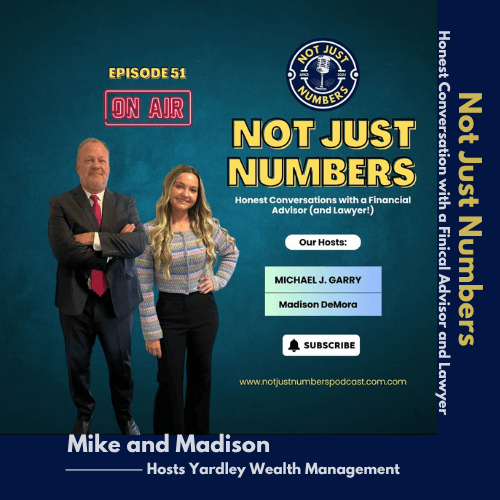
Episode 51: Beyond the Numbers: Preparing Mentally and Emotionally for a Fulfilling Retirement

Hosts: Madison Demora and Mike Garry

Episode Overview

In this episode of Not Just Numbers, hosts Madison Demora and Mike Garry discuss the mental and emotional aspects of preparing for retirement, inspired by the New York Times article “Staying Sharp After Retiring Is Its Own Job” by Mohana Ravindranath. Retirement can pose challenges to brain health, such as cognitive decline and depression, due to the loss of work-related structure and social interaction. Mike shares insights from his experience at Yardley Wealth Management, emphasizing the importance of planning beyond finances. He explores how clients can find purpose, stay socially engaged, and budget for meaningful activities to ensure a fulfilling retirement.

Listen to Our Podcast On:

TIMESTAMPS

00:08 – 02:37 – Introduction to episode topic: Beyond the Numbers: Preparing Mentally and Emotionally for a Fulfilling Retirement

02:38 – 5:00 – Preparing for Retirement Beyond Finances

05:01 – 08:25 – Planning Lifestyle vs. Just Saving

08:26 – 10:20 – Early vs. Late Retirement

10:21 – 11:51 – Budgeting for Post-Retirement Activities

11:54 – 14:10 – Underrated Non-Financial Retirement Factors

Follow Us on Social Media
Stay updated with the latest episodes and news by following us on social media:


Episode Glossary

  • Cognitive Decline: A gradual loss of thinking abilities such as memory, attention, and problem-solving.
  • Mental Stimulation: Activities that keep the brain active, important for maintaining sharpness after retiring.

Key Takeaways

  • Retirement impacts mental health: Loss of work structure can lead to cognitive decline and depression, especially for those with career-tied identities.
  • Plan for purpose, not just savings: Clients who plan post-retirement activities (e.g., volunteering, hobbies) often report greater happiness than those focused solely on financial goals.
  • Timing matters financially, not emotionally: Retiring later (e.g., at 70) eases financial concerns, but emotional well-being depends more on having a purpose than age.
  • Budget for social engagement: Include expenses for travel, hobbies, or volunteering to combat isolation, a key risk factor for depression in retirement.
  • Reconnect and schedule: Early on, reconnect with loved ones and join structured activities (e.g., golf leagues) to maintain social ties and daily purpose.

Transcript

Podcast Transcript: Preparing Mentally and Emotionally for a Fulfilling Retirement

Introduction

Madison: Hello everyone and welcome to Not Just Numbers, Honest Conversations with a Financial Advisor and Lawyer. I am Madison Demora and I am here with Mike Garry. Mike is a financial advisor and a CFP practitioner and the founder and the CEO of Yardley Wealth Management. He is also an estate planning lawyer and his law firm is Yardley Estate Planning. Hey, Mike.

Mike: Hey, Maddie. How are you?

Madison: I’m good. How are you doing today?

Mike: Good. What a beautiful day.

Madison: I know, I know. I’m so happy we’re over that winter hump and it’s finally getting warm outside.

Mike: Yeah, it’s nice. It makes the Monday not feel so Monday-ish.

Madison: That’s true.

Article Summary: Staying Sharp After Retiring

Madison: All right, so today we are going to discuss an article from the New York Times, and it is titled “Staying Sharp After Retiring Is Its Own Job”. And this is by Mohana Ravindranath. So, I will read the summary and ask Mike some questions about the article. All right. Retirement is often seen as a well-deserved break, but it can also bring unexpected challenges to brain health, including a higher risk of cognitive decline and depression. The sudden loss of daily structure mental stimulation from work and social interaction can negatively affect memory and mood, particularly for those whose identities were closely tied to their careers. Research shows that retirees, especially those who had mentally demanding jobs or retired involuntary, may experience faster declines in verbal memory and overall mental wellbeing. However, retirement can also be a time of growth and renewal if approached with intention. Experts emphasize the importance of preparing in advance, building new routines, engaging in mentally stimulating activities, and exploring meaningful pursuits before leaving the workforce. Staying socially active is crucial as maintaining deep and engaging connections can help prevent the isolation that often contributes to mental and cognitive decline. Ultimately, retirement doesn’t have to mean decline. With thoughtful planning and willingness to stay engaged, it can become rich and fulfilling chapter of your life.

Preparing Mentally and Emotionally for Retirement

Madison: All right, Mike, how do you guide clients in preparing not just financially but mentally and emotionally for retirement?

Mike: Yeah, for a lot of our clients, that’s actually the harder planning. A lot of our clients, you know, tend to, you know, be good savers, have had above average incomes and, you know, save for a long time. And so, for the most part they have a good idea where they’re at financially. We need to make some changes and usually we do some things to, you know, increase the odds of a better retirement and all that. You know, financial planning is a big part of it, but another part really is the non-financial part. And you know, what we do is from like our experience, we see people who have been successful and like happiest in their retirement, you know, and one thing is everybody’s different, right. So some people plan for years for retirement for the non-financial aspects and it works great. Sometimes people do that and then things just change, and they need to change their plan. I think the biggest things are people need to be like open to the new, to the change and be able to adapt to it. Right. Like things might be radically different. And it is funny, you see people come in and say retirement’s been great and say, well, what have you done? Like nothing, just like little things I want to do. And then other people talk about like the three organizations they volunteer for and, the various work that they do and the vacations. I think that one of the biggest things is people need to have some sort of a purpose. And so that’s where some of the volunteering comes in or helping with your grandkids or nieces or great nieces and nephews, whatever it is some sort of reason to get up. And for some it’s golf five days a week or pickleball or you know, being able to go to the gym way more often than they could while they were working. But yeah, there’s a lot to it. And it’s interesting, you know, this has definitely become like a bigger part of our jobs, you know, because we want people to have a successful retirement and that’s not just having enough money in the bank. It’s not just numbers.

Madison: That’s true.

Impact of Post-Retirement Lifestyle Planning

Madison: All right. Do you see a difference in outcomes between clients who plan in their post-retirement lifestyle versus those who just focus on hitting a savings goal?

Mike: Well, you know, it’s hard to say. I think that most people who think about what they’re going to do after retirement do tend to have, they express more feelings of happiness and success in retirement. Sometimes when people just have a savings goal in mind. Like there’s a book, “The Number” 10 years ago where it talked about like how much you need to retire. And really just in a.. Sometimes people took that in just like the, the literal number of like dollars that you needed. I think when people are thoughtful and think about it more about what they’re going to do with their purpose, they do tend to have better outcomes. At least they express them to us. We have seen instances where they really haven’t thought about it like their job is really demanding, you know, takes up all of their time during the week, even weekends. And like on, on weekends or downtime, they just need to decompress from the stress and so they don’t put in a lot of thought or effort into what they’re doing. Then, they retire, come full stop. And then like that first Monday morning, they have literally nothing to do. And we’ve seen people go back and get new jobs, you know, they stay unemployed or retired for three or six months or so and are not ready for it and they go back to work. So that’s, you know, financially that’s a successful retirement. But that’s not a great retirement for people, you know, don’t know what to do with their lives. So they take a job. You know, I think that’s part of the purpose, you know, that we spoke of earlier. And you know, in the planning aspect, sometimes it’s hard to plan and some people just need to be ready. You know, we had somebody in last week, she is above normal retirement age. I don’t think she is ready yet. And it’s not necessarily a financial thing. She has to be in a mindset where she’s not going to be doing what she’s been really good at doing for a really long time and not do that anymore. Right. And you can see why, why that might be hard and she’ll have to come to when she wants to retire on her own terms. Like she’s in a position where they’re not, nobody’s going to force her to retire. It’s fascinating to me. And reading that article, there are lots of good studies, you know, that the author found their experts. But I think they’re really just starting to get good information about that and it’s something that needs to be explored a lot more. You know, like the idea of retiring, you know, when you’re still physically productive. It’s kind of a new concept, you know, for, for most people it wasn’t an option until, you know, after World War II. Right. So humans been around for a long time and there has hasn’t been the option of like planning your retirement and really until the last couple of generations. So that’s all interesting and new stuff.

Madison: Yeah, very interesting.

Timing of Retirement and Its Impact

Madison: All right, in your experience, how does the timing of retirement, early versus later impact a client’s overall wellbeing and financial confidence?

Mike: Well, I think in our experience, you know, if you retire later, you’re likely to have less financial concerns. Right. Because if you retire at 70, it’s a lot easier to afford that than retiring at 52. But you know, they had the some of the, in the article, there was a study that showed that people that retired earlier had better outcomes. And it’s interesting because I think there was prior research in the US that said that people that retired earlier had worse outcomes. So I don’t know if that’s a difference in America versus Europe or how the studies were done, but I, I would say I don’t know that it, that necessarily makes a difference in the non-financial aspects. Right. So financially, sure, if you retire at 70, it’s going to be easier to, you know, every year you work is another year your assets don’t have to provide income for you. So financially, the longer you work, the more certain it is. But most people get to a situation where they can afford to retire and don’t have to wait any longer. So the question being whether there are non-financial outcomes that are better, younger or later. I don’t know. We don’t have a real big sample size. Right. Where we have like 70 retired clients. And when they’ve retired has been all over the place. I think more than the age, it’s whether they’ve put thought into what they’re going to be doing and if they have the purpose. Right. I think that’s more important necessarily than whether they retire earlier or later.

Madison: Yep.

Budgeting for Post-Retirement Activities

Madison: All right. How do you encourage clients to budget for meaningful post-retirement activities like travel, hobbies or volunteer work?

Mike: Yeah, so I think that the social interaction has been a big part of the various studies. Right. People who are socially isolated are more prone to depression and that is a serious risk in retirement. You know, if you’re used to going on the job site and there’s a couple of people or hundreds of people that you run into every day and then you’re not doing that, you don’t do something to take its place. It’s, it’s a lot easier to feel more isolated and that could be a real problem. So, you know, when we talk about retirement planning, we always put in budget assumptions for travel. Right. And then we always talk about, well, what are you going to do? And so some people volunteer and some people say they’re going to, you know, follow their hobbies or they’re still thinking about it or figuring out, but it’s important, you know, and I hope that anybody listening to this takes away the idea that it’s good to plan for things. You know, obviously, you know, I have a financial planning company and an estate planning company and so I like to plan things and not everybody does, but I’d say planning for the non-financial aspects of retirement is really important and I’d encourage everyone to do it.

Madison: Awesome. Great advice.

Underrated Non-Financial Factors for Retirement

Madison: If someone is planning for retirement now, what are some underrated but important non-financial factors they should be considering early on?

Mike: So I think that people should start to try to spend more time reconnecting with friends and loved ones that maybe they don’t get to see enough because they’re working. Everybody has people in their lives that, you know, if in a perfect world they’d spend more time with and maybe it’s still hard because of distance or maybe the other people are still working. But I think it’s a good idea to bring out the old contact or phone book and look to see who you’d like to spend more time with. I think it also a good idea, you know, like we talked about golf before. Like join the golf league if you’re a golfer. You know, join the bowling league if you’re a bowler. You know, do things where there’s some sort of social interaction and, and you know, an advantage of joining a league is like there’s some set schedule so you just don’t wake up and wonder how you’re going to fill your day. Right. So I think things like that or working out, if you’ve never done that, maybe hire a trainer so that you have some basics or some things that you know you need to work on. And again, a commitment to somebody else to, to go through and do it and to put some sort of balance in your schedule. You know, I think there’s all kinds of good ideas, but the whole idea of being intentional in working on that socialization and some sort of schedule and a purpose, I just can’t say that all enough.

Madison: That’s great advice, Mike. Very great advice. Everyone has their own interests and hobbies and traveling, but one thing we all have in common is planning for it is crucial for your mental being.

Mike: And I hope you remember this in 40 years when you go to retire.

Madison: I will, I will think about this moment right here.

Closing Remarks

Madison: All right, for more information on Yardley Wealth Management or Yardley Estate Planning, you could visit our websites at yardleywealth.net and yardleyestate.net. You can also follow us on socials at Yardley Wealth Management. Don’t forget to smash the like button if you enjoyed this episode. This podcast has been produced by Madison Demora and Mike Garry with technical and artistic help from Poe Productions.

Request the Full Transcript as a PDF

The full transcript of this episode is available via email. Please fill out the form below to receive it: