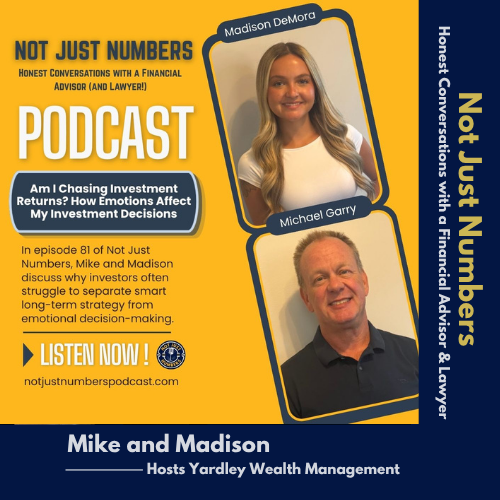
Episode 81: Am I Chasing Investment Returns? How Emotions Affect My Investment Decisions

Hosts: Madison Demora and Mike Garry

Episode Overview

Almost every investor has felt the pull of chasing investment returns, buying whatever is doing best right now. In this episode of Not Just Numbers, Madison and Mike use two articles as a starting point: Jason Zweig’s look at why investors keep buying after prices rise and selling after they fall, and Gallup’s annual survey showing that Americans have never named stocks as the best long-term investment. They explain the gap between what an investment earns and what investors actually receive, why luck can feel like skill, why real estate and famous companies feel so safe, and how a written plan and firm limits can keep emotions from turning into permanent losses. If you’ve ever wondered whether you’re chasing returns, this episode is for you.

Listen to Our Podcast On:

TIMESTAMPS

00:08 – 02:10 – Introduction

02:11 – 06:03 – The Difference Between Investment Returns and Investor Returns

06:04 – 07:46 – When Luck Starts to Feel Like Skill

07:47 – 11:26 – Familiarity Is Not the Same as Diversification

11:27 – 14:06 – Big-Name Stocks and the Late-to-the-Story Problem

14:07 – 16:08 – Investing vs. Speculating

16:09 – 21:09 – Main Takeaways & Closing

Follow Us on Social Media

Stay updated with the latest episodes and news by following us on social media:
 

Episode Glossary

  • Diversification: The strategy of investing in different asset classes and asset types to reduce portfolio risk associated with price volatility.

Key Takeaways

  • An investment’s return and an investor’s return aren’t the same. The “behavior gap” is the difference between what an investment earned and what people actually received after adding money once prices rose and selling once they fell. Investors in the original Bitcoin ETFs lost an estimated 5.8% a year, even though Bitcoin rose over that period.
  • Rising prices feel like proof, so investments feel safest right after they’ve gone up and scariest after they’ve fallen. That’s the opposite of “buy low, sell high.” Luck can also feel like skill, and one win can create overconfidence, so look at all your decisions, not just the winners.
  • Gallup’s 2026 survey found 38% of Americans chose real estate as the best long-term investment, with stocks and mutual funds a distant second at 20%. A home feels tangible and has no daily price, and it provides shelter, but stocks have historically grown faster. Owning several properties can still leave you exposed to the same risks.
  • Cash, CDs, and gold can serve a purpose, such as emergency reserves and near-term spending. The mistake is treating the choice as either-or. A thoughtful portfolio can hold different assets that do different jobs.
  • A great company isn’t automatically a great investment at every price. By the time a business is a household name, much of its extraordinary growth may already have happened. Owning a broad, diversified mix means you don’t have to pick the next winner.
  • Allocate rather than speculate. Decide in advance how much of your portfolio can go to a speculative idea (Mike’s example was 2%), keep it small enough that a big loss won’t derail your goals, and rebalance if it grows past that limit.
  • To avoid buying high and selling low, write down an investment strategy, check your portfolio less often, and pause before acting after a big market move. Automatic investing and rebalancing help too, and an advisor can give you distance from your emotions. Instead of asking what’s doing best right now, ask what role each investment plays in your plan.

Transcript

Not Just Numbers: Honest Conversations with a Financial Advisor and Lawyer
Episode 81 – Am I Chasing Investment Returns? How Emotions Affect My Investment Decisions

Introduction & Hosts

Madison: Hello, everyone, and welcome to Not Just Numbers, Honest Conversations with a Financial Advisor and Lawyer. I am Madison Demora, and I’m here with Mike Garry. Mike is a financial advisor and a CFP practitioner and the founder and the CEO of Yardley Wealth Management. He is also an estate planning lawyer, and his law firm is Yardley Estate Planning. Hey, Mike.

Mike: Hey, Maddie. How are you?

Madison: I’m good. How are you?

Mike: I’m doing pretty well. Thanks for asking.

Today’s Topic: Two Articles, One Big Idea

Madison: Of course. So today we’re talking about something that almost every investor has probably experienced, the temptation to chase whatever investments seem to be doing the best right now. We’re using two articles as the starting point for this conversation. The first is called “The Mind Game That Investors Can’t Stop Playing,” written by Jason Zweig, which looks at why investors repeatedly buy after prices rise and sell after prices fall. The second article looks at Gallup’s annual survey of what Americans consider the best long-term investment. Despite the stock market’s long-term historical returns, Americans have never selected stocks as their top choice. Mike these seem like two different topics at first, chasing performance and preferring real estate, but are they really connected?

Mike: Maddie, they’re very connected. Both articles show that people don’t make investment decisions based solely on long-term returns, financial data, or some other perfectly rational calculation. But you know, people are influenced by what feels familiar, what has performed well recently, what other people are talking about, and what makes us feel safe. Sometimes that leads people to chase a hot investment after much of the gain has already occurred. Other times it leads them to avoid an investment because it feels unpredictable, even when it may have stronger long-term growth potential. So, in both cases, emotions and perception can have a much greater influence than people realize.

The Difference Between Investment Returns and Investor Returns

Madison: All right, so the first article makes an interesting distinction between the return an investment earns and the return the investor actually receives. How can those two returns be different?

Mike: So, when you see a mutual fund, an ETF, or a stock index earned a certain return, that calculation usually assumes you invested at the beginning of the period, stayed invested the entire time, and didn’t add or withdraw money along the way. That tells you how the investment performed. But real investors don’t always behave that way. Something called the behavior gap. They add money, take money out, move between investments, and respond to headlines and market movements. If people invest more money after prices have already increased and then sell after prices decline, their personal return can be significantly lower than the return reported by the investment itself. So that, that is called the behavior gap. It’s the investor’s behavior that causes a gap between the returns that they could or should have gotten and then the returns that they actually did get.

Madison: Right. So, an investment can technically have a positive return while many of the people investing in it still lose money?

Mike: Exactly. So that was a situation the article highlighted with the Bitcoin ETFs that launched in early 2024. So, Bitcoin value increased over the measurement period, so someone who invested at the beginning and simply held on, could have made money. But investors, as a group, tended to pour money into the ETFs after Bitcoin had already experienced strong gains. Then, when the price declined, many investors withdrew their money and locked in losses. According to the analysis cited in the article, investors in the original group of Bitcoin ETFs lost an estimated 5.8% annually, even though the underlying investment had appreciated over the broader period.

Madison: That’s a pretty dramatic difference.

Mike: It is. You know, and although Bitcoin is an extreme example, because it can be so volatile, the behavior itself is not unusual. We see it with individual stocks, mutual funds, sectors, commodities, real estate markets, almost every other investment. People become interested after something has already performed well. The strong return is what gets their attention. Then they expect that recent performance to continue.

Why Is It So Hard to Resist a Hot Investment?

Madison: So why is it so difficult to resist something that has been performing well?

Mike: Because the rising price feels like confirmation, right? When we see an investment going up, it appears to validate the story surrounding it. We start thinking everyone who bought it was right and that we are missing an opportunity by not owning it. There’s also social pressure. You know, you hear people talk about how much money they made. You see stories in the news. The investment starts to feel obvious. The problem is that an investment usually becomes obvious only after the price has already risen.

Madison: So, by the time it feels safest to buy, it may actually be more expensive and potentially riskier?

Mike: That is often the case. When an investment has been rising, it feels less risky because people have recently been rewarded for owning it. But the price may now reflect extremely high expectations. When an investment declines, it feels more dangerous because people have recently experienced losses. But it may also be less expensive than it was before. So, making it less risky. Emotionally, investors are often most comfortable buying after prices rise and least comfortable buying after prices fall. That is the opposite of what most people say they want to do. Buy low and sell high.

Madison: Yep, I was going to say.. Everyone knows the phrase buy low and sell high, but emotionally, we seem to want to buy high and sell when things become uncomfortable.

Mike: Right. Buying low usually means buying when the news is bad, confidence is low, and other investors are nervous. Selling high can mean reducing investment when everyone else is enthusiastic and convinced it will continue going up. Neither one feels natural in the moment.

When Luck Starts to Feel Like Skill

Madison: The article also talks about investors confusing luck with skill. How does that affect future decisions?

Mike: So suppose someone buys a stock and it rises 50% over the next year. They may conclude that they identified a great opportunity, understood the company better than other investors, or have a special ability to pick stocks. And perhaps they did conduct good research. But the result also could have been influenced by market conditions, timing, investor enthusiasm, or simple luck. The problem is that one successful outcome can create overconfidence. The investor may put more into the next idea, take greater risks, or assume that the same strategy will continue working.

Madison: And when the next investment doesn’t work, people may explain that one differently.

Mike: Exactly. We tend to give ourselves credit when an investment succeeds. But when it fails, we may blame the market, the Federal Reserve, the media, bad timing, or someone who convinced us to sell. That makes it difficult to evaluate our decisions honestly. You have to look at all of your trades, not only the memorable winners, and compare your overall results with an appropriate benchmark.

Madison: So, it’s not enough to say, “I made money on that stock.”

Mike: No. This is something I’ve talked about with clients forever. Right. Like, you know.. You also have to ask what would have happened if you simply invest that money in diversified index fund and left it alone. Maybe you made 20% on an individual stock, but if the broader market made 30% of that same period, the decision did not add value. And so, you took a riskier decision and made less money with it. That’s not a good thing. Making money and making a good investment decision are not always the same thing.

Why Real Estate Comes Out on Top

Madison: That’s right. All right, so let’s connect this with the second article. Gallup has been asking Americans to name the best long-term investment for nearly two decades, and stocks have never finished first. In the 2026 survey, 38% of respondents chose real estate. Stocks and mutual funds were a distant second at 20%. Why do you think real estate consistently comes out on top?

Mike: Well, it feels tangible. You can see your home. You can live in it, improve it, rent it out, or pass on to your family. People understand what a house is and why someone might want to own it. Stocks can feel much more abstract. And funds are even more abstract than that. So you see prices changing every day, and when the market falls, the decline is visible immediately. A home doesn’t have a ticker showing its price every few seconds.

Madison: Even though the value of the home could also be changing.

Mike: Correct. You simply don’t receive a daily update. If an app showed homeowners that their house had fallen in value by 2% that afternoon, people might feel differently about the stability of real estate. Because homes are not priced constantly, they appear less volatile than stocks. But they really aren’t.

Madison: There’s also the fact that many more people own homes than directly own individual stocks.

Mike: That familiarity matters. Roughly two-thirds of American households own their primary residence. A much smaller percentage directly owns individual stocks in their name. People are naturally more comfortable with an asset they understand and have personally experienced. For many families, a home also acts as a form of forced savings. Every mortgage payment can gradually reduce the loan balance and build equity. That process feels steady and productive.

Madison: And a house provides a benefit beyond its investment return because you also get to live there.

Mike: Absolutely. That’s important when comparing a primary residence with an investment portfolio. Your home provides shelter, stability, and personal value. It’s not just a line on a financial statement. But that doesn’t automatically make it the strongest investment based purely on an expected return. The article noted that, over long periods, stocks have historically appreciated faster than home prices, much faster. That doesn’t mean everyone should put all their money in stocks or avoid owning a home. It means the investment that feels safest or most familiar is not necessarily the investment with the greatest long-term growth potential.

Madison: Could someone become too dependent on real estate because it feels so safe?

Mike: Yes, of course. Right. A person might have most of their net worth tied up in their primary residence, a vacation home, and one or two rental properties. They may feel diversified because they own several properties. But all of those are assets can be affected by similar risks, you know, local economic conditions, property taxes, insurance costs, interest rates, maintenance, or changes in the housing market. So real estate can be an important part of someone’s financial picture, but it still should be evaluated as part of the overall portfolio.

Gold, Savings Accounts, and CDs

Madison: The article also mentions gold, savings accounts, and CDs. Those investments often become more popular when people are nervous.

Mike: Yeah, I think they do because they provide a sense of safety. You know, cash and CDs are appropriate for emergency reserves, near-term spending needs, and money that someone cannot afford to expose to market volatility. You know, some people think gold may also provide diversification in certain circumstances. I’m not a fan. But the problem arises when investors treat the decision as either-or, either stocks or real estate, either stocks or gold, either growth or safety. A thoughtful portfolio can contain multiple types of assets serving different purposes. You don’t need every investment to do the same job.

Big-Name Stocks and the Late-to-the-Story Problem

Madison: We also see performance chasing with the biggest and most recognizable companies. People may look at the companies that have dominated the market and think, “Those are the names I need to own if I want to make serious money.” What’s the danger in thinking that way?

Mike: So, the first thing to understand is that a great company is not automatically a great investment at every price. By the time a business has become one of the largest companies in the world, much of its extraordinary growth has already happened. Early investors may have owned the company when it was small, uncertain, and not yet widely followed. They accepted a level of risk that was much more obvious at the time. But someone buying after the company becomes a household name is buying a very different investment. You know, Nvidia or Amazon or Google have had extraordinary amounts of growth over the years to be able to get to where they’re at. But if a company’s worth 3, 4, 5 trillion dollars, you know, they can’t have 10 times growth. There’s not enough money on earth. Right. So, it’s just different.

Madison: Because the expectations are already so high.

Mike: Yeah. The market already knows that the company is successful. Millions of investors and professional analysts are following it. Its growth story is not a secret. For the stock to continue delivering extraordinary returns, the company may need to perform even better than the market already expects. And that’s a bar that’s probably too high.

Madison: So, owning the biggest names today does not necessarily mean someone will experience the same gains as the investors who owned them before they became the biggest names.

Mike: That is the key point. A stock may continue to rise. The company may remain profitable and successful for decades. We’re not saying that a large or well-known company automatically becomes a bad investment. But investors should not assume that buying yesterday’s biggest winner gives them access to yesterday’s returns. The period when that stock turned a relatively small investment into an enormous fortune may already be behind it.

Madison: There’s almost a jackpot mentality: “This company made other people wealthy, so maybe it will do the same thing for me.”

Mike: Right. But the people who earned the most dramatic returns usually invested before the outcome was clear. Once everyone knows the company is a winner, the price often reflects that knowledge. The next generation of market leaders may be companies most investors are not paying attention to yet. The difficulty is that no one knows with certainty which companies those will be. This is one of the reasons diversification is so important. Instead of trying to identify the one stock that will create the next fortune, you own a broad collection of companies. Some are going to disappoint. Some will perform reasonably well. And a small number may become the major winners that drive a significant portion of the market’s return.

Investing vs. Speculating

Madison: The article makes the statement that it’s better to allocate than speculate. What does that mean in practical terms?

Mike: So, speculating usually starts with a story or a prediction. Someone believes Bitcoin will transform finance, artificial intelligence will change the economy, gold will protect them from inflation, or a particular company will dominate its industry. The investor then buys based largely on the strength of that belief. Allocating means deciding in advance how much of the portfolio should be exposed to that idea.

Madison: So, someone doesn’t necessarily have to avoid every speculative or concentrated investment.

Mike: Correct. For some investors, having a small amount of money in an individual stock, crypto, or another speculative investment can be perfectly manageable. But the amount should be small enough that a significant loss doesn’t derail the person’s retirement, education funding, emergency reserves, or other goals. You might establish a separate account or designate a small percentage of the portfolio for those ideas. The important part is deciding on the limit before the excitement takes over.

Madison: And then rebalancing if that investment grows beyond the original percentage?

Mike: Yes. You know, suppose someone decides that a speculative investment should represent no more than 2% of the portfolio. Hey, if it performs extremely well and grows to 5%, rebalancing would mean selling some and bringing back toward the target. That can be emotionally difficult because the investor may believe the investment will continue rising. But reducing it prevents one successful bet from gradually becoming a major risk to the entire financial plan.

Madison: And if it falls, the investor would have to decide whether the original belief and allocation still make sense rather than automatically panic-selling.

Mike: Exactly. A predetermined allocation creates discipline in both directions. Makes things much better. Without that structure, people often add more after an investment becomes popular, and sell after the story becomes frightening. This is how the behavior gap develops.

Practical Ways to Avoid Buying High and Selling Low

Madison: What are some practical takeaways investors can avoid repeatedly buying high and selling low?

Mike: The first step is to actually have a written investment strategy. And that strategy should explain what you own, why you own it, how much risk you’re willing and able to take, and under what circumstances the portfolio should change. When the market becomes volatile, you can refer back to the plan instead of making decision based on that day’s emotions.

Madison: What else?

Mike: Limit how often you check your portfolio, Ms. Madison. If you’re investing for a goal that’s 10, 20, or 30 years away, watching the value change throughout the day does not provide useful information. It simply gives you more opportunities to react. You know you should also be careful about making decisions immediately after a large market move. Strong gains can create fear of missing out, while sharp declines can create an urgent desire to escape. Giving yourself time to review the decision can prevent an emotional reaction from becoming a permanent financial mistake.

Madison: Would automatic investing help?

Mike: It can. You know, just like the automatic savings that you do with your forced savings with your mortgage. Regular contributions to a retirement plan or investment account reduce the pressure to decide whether this is the perfect day to invest. The money goes in according to schedule. Sometimes prices will be high, and sometimes they’ll be lower. Rebalancing can also help because it creates a systematic process for reducing assets that have grown beyond their targets and adding to areas that have fallen below their targets.

Madison: And I would imagine working with an advisor can provide some distance from the emotions involved.

Mike: That could be one of the most valuable roles of an advisor. Investment information is widely available. Difficult part is following a sensible strategy when the market gives you a powerful emotional reason to abandon it. An advisor cannot remove market volatility. But an advisor can help a client determine whether anything in the financial plan has actually changed or whether the desire to act is primarily a response to recent performance.

Main Takeaways

Madison: All right, so if listeners take one thing away from today’s conversation, what would it be?

Mike: I would want our listeners to remember that investment’s past success does not guarantee that you will personally receive the same result. The return you earn depends not only what you own, but also when you buy, when you sell, how much you invest, and whether you remain disciplined. Real estate can feel safe because it’s familiar and the price is not displayed every second. A famous stock can feel safe because the company is successful and everyone recognizes its name. A hot investment can feel safe because its recent returns appear to confirm the story. But feelings of safety are not the same as diversification, reasonable valuation, or a sound financial plan. Long-term investing is usually less about finding the one investment will hit the jackpot and more about owning a diversified portfolio, controlling how much risk you take, and avoiding decisions that turn temporary emotions into permanent losses.

Madison: So, instead of asking, “What investment is doing the best right now,?” investors may be better served by asking, “What role is this investment supposed to play in my overall plan?”

Mike: Maddie, thanks for getting this all together. You know, it’s funny, I was thinking about this whole story because we got an email from a client, and, you know, it reminded me of.. We used to have people more often, so generally the ones who ask these questions are men older than me, generally, like 10 or 15 years older than me, and have more of a mentality of, like, what’s the hot hand? Or, like, gambling with, like, playing the horses, like, what pony to follow. And it’s just so very different from what is a good strategy, that we feel like having a diversified portfolio all the time. And it’s great that Jason Zweig’s article came up because, you know, Jason can articulate those things much better than I can. You know, so your thing of asking, like, what investment is doing best right now, you know, is better served by asking, what role is this investment supposed to play in my overall plan? Maddie, that’s the exact question. You know, I love that. And so, that is much more useful and the way to really think about it. So, thanks for pulling this all together for me. You know, I’m really, really pleased with how this is turning out.

Madison: Yes, thanks for forwarding the articles. And Mike, thank you. I think this is an important reminder that even when we understand investing logically, our behavior can still work against us.

Mike: Absolutely. Thanks, Maddie.

Closing & Contact Information

Madison: And thank you everyone for listening. For more information on Yardley Wealth Management or Yardley Estate Planning, you can visit our websites at yardleywealth.net and yardleyestate.net you can also follow us on socials at Yardley Wealth Management. Don’t forget to subscribe to our YouTube channel. This podcast has been produced by Madison Demora and Mike Garry with technical and artistic help from Poe Productions.

Request the Full Transcript as a PDF

The full transcript of this episode is available via email. Please fill out the form below to receive it: