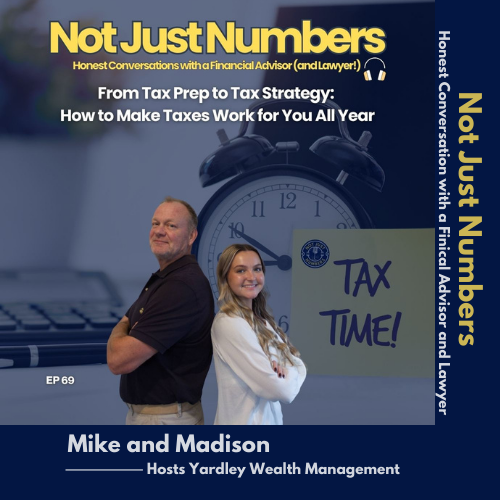
Episode 69: From Tax Prep to Tax Strategy: How to Make Taxes Work for You All Year

Hosts: Madison Demora and Mike Garry

Episode Overview

Taxes are often treated as a once-a-year obligation, but they play a much bigger role in your overall financial life. In this episode of Not Just Numbers, Mike and Madison explore the difference between tax preparation and tax strategy—and why planning ahead can make a meaningful impact over time.
They discuss how a year-round, coordinated approach to taxes can help shape future outcomes, covering topics like income timing, retirement plan contributions, Roth decisions, charitable giving, tax-loss harvesting, and estate planning. Along the way, they highlight recent rule changes and explain why working proactively with your financial and tax professionals can help reduce surprises and better align taxes with your long-term goals. Obviously, this episode is for general educational purposes only and is not tax or legal advice. Please speak to your professional for specific tax or legal advice.

Listen to Our Podcast On:

TIMESTAMPS

00:08 – 02:20 – Introduction

02:21 – 04:24 – Tax Prep vs. Tax Strategy

04:25- 05:36 – The Pillars of a Year Round Tax Strategy

05:37 – 08:01 – Income Timing

08:02 – 10:26 – Tax Advantaged Investing and SECURE 20. Changes

10:27 – 13:50 – Charitable Giving 

13:51 – 15:15 – Roth Contributions and Conversions

15:16- 17:10 – Tax Loss Harvesting 

17:11- 18:45 – Estate and Gift Taxes

18:46 – 20:58 – Common Tax Surprises and Using a Tax Calendar

20:59 – 22:16 – Closing

Follow Us on Social Media

Stay updated with the latest episodes and news by following us on social media:
 

Episode Glossary

  • Qualified Charitable Distribution (QCD): A direct transfer from an IRA to a qualified charity for individuals age 70½ or older. QCDs can satisfy required minimum distributions without being included in taxable income.
  • Tax-Loss Harvesting: Selling securities at a loss to offset the amount of capital gains tax owed on other investments.

Key Takeaways

  • Tax preparation vs tax strategy: Preparation reports history (compliance); strategy shapes the future by making proactive choices to minimize lifetime taxes.
  • Tax strategy is multi-year and ongoing: Decisions like Roth conversions or income timing can mean paying more now to pay far less later — not a one-year exercise.
  • Coordination is essential: Advisor + CPA working together throughout the year uncovers opportunities missed in siloed, filing-time reviews.
  • Core levers to pull: Income timing (bonuses, distributions), tax-advantaged accounts (401(k)/IRA limits & Roth rules), charitable giving (QCDs, DAFs, bunching), tax-loss harvesting (offset gains), estate/gift planning (exemptions, SLATs/GRATs).
  • Common surprises are avoidable: Underpayment penalties from no quarterly estimates, RMD bracket creep, wash-sale rule traps — planning prevents them.
  • Simple tax calendar helps: Spread tasks across quarters (Q1 filing/contributions, Q2 withholding review, Q3 Roth/charity, Q4 loss harvesting/max contributions) to reduce stress and improve outcomes.

Transcript

Podcast Transcript: Ep. 69 – Tax Strategy vs Tax Preparation

Introduction

Madison: Hello, everyone, and welcome to Not Just Numbers, Honest Conversations with a Financial Advisor and Lawyer. I am Madison Demora, and I’m here with Mike Garry. Mike is a financial advisor and a CFP practitioner and the founder and the CEO of Yardley Wealth Management. He is also an estate planning lawyer, and his law firm is Yardley Estate Planning.

Mike: Hey, Mike. Hey, Madison. How are you?

Madison: I’m, good. How are you doing today?

Mike: Good. That’s kind of formal. I usually say, Maddie, but I don’t know, I just felt like Madison today.

Madison: Yeah, that’s fine. Whatever works. Alright. Well, welcome, everyone, and thank you for joining us. Since many of us associate taxes with one date on the calendar, April 15, we thought this would be a great time to step back and look at taxes differently, not just as a once-a-year filing exercise, but as an ongoing part of your financial life. Mike, I know this is something you see all the time with clients. How do you think people should reframe the way they think about taxes?

Reframing Taxes: Preparation vs Strategy

Mike: Exactly. Filing your return is really about reporting what has already happened. Right? So that’s tax compliance. A tax strategy, on the other hand, is about looking forward and making choices that can change your future tax picture. The goal is not just, how do I get a bigger refund this year based on what happened last year, but how do I avoid paying more in taxes than the law requires over my lifetime.

Madison: That’s a great distinction. So today, we’re going to walk through what it really means to move from tax preparation to tax strategy, how to coordinate with your financial and tax professionals throughout the year, and some specific levers people can pull, like income timing, retirement plan contributions, charitable giving, Roth decisions, and estate and gift planning.

Mike: We’ll try to keep this conversational. Maddie, this is what we both work on with clients every day, so think of this as a guided discussion on the ideas that tend to matter most. And of course, everything we share today is for general educational purposes only. It’s not specific tax or legal advice. Before acting on anything we discuss, you should talk with your own tax, legal and financial professionals.

Tax Preparation: Necessary but Limited

Madison: Alright, thanks, Mike. Let’s get started with the basics. When most people think about taxes, they think about getting documents in the mail, sending them to their preparer, and filing a return. That’s classic tax preparation. Why is it necessary but also limited?

Mike: Because at that point, we’re working with history. We can make sure the return is accurate and we’re taking the deductions that are available, but most of the big decisions have already been made. Your income has been earned, your investment gains and losses have already happened, and your giving and retirement contributions are in the books.

What Makes Tax Strategy Different

Madison: So, tax preparation looks backward. How is tax strategy different?

Mike: A tax strategy is forward-looking and ongoing. Think of it as an ongoing approach that connects your past, present and future. You’re looking at your income, how your assets are invested, where you have unrealized gains or losses, how much you’re saving in pre-tax and after-tax accounts, and what you want to do for your family and charity, all through a tax lens.

Madison: And it’s not just about one year, is that right?

Mike: Exactly. It’s multi-year. Sometimes a good strategy means paying more in taxes this year so you could pay less over the next 10 or 20 years. Roth conversions are a classic example. You choose to recognize income now in order to enjoy tax-free withdrawals later or have those tax-free withdrawals to your kids or grandkids, or to provide more flexible assets for you and your heirs.

Why Coordination Matters Year-Round

Madison: So, for someone listening and wondering, why should I care about tax strategy, the short answer is that your tax return records what has happened, and your tax strategy shapes what happens next. That’s why we want to have this conversation now, while there’s still time to plan for 2026 and beyond, instead of only reacting next spring.

Mike: That’s also why coordination matters. Your financial advisor and your tax professional each see different parts of your picture. When we work together throughout the year, instead of just exchanging documents at filing time, we can often find opportunities that would otherwise be easy to miss.

Core Areas of Year-Round Tax Strategy

Madison: Alright, so let’s talk about the main building blocks. When you think about a year-round tax strategy, what areas are you usually looking at?

Mike: We’re typically working across a few core areas. Right? So, income timing, how and where your money is invested from a tax perspective, charitable giving, Roth contributions and conversions, tax-loss harvesting, and then estate and gift taxes for larger estates.

Madison: I like to describe it as a menu. Not every tactic applies to every person, and you’re not trying to pull every lever every year. The value comes from looking at your situation in an organized way and deciding which levers make sense now and which are better saved for later.

Mike: That’s exactly right.

Simple Tax Calendar for Ongoing Planning

Madison: This is also where having a simple tax calendar can help. Instead of thinking about taxes for a few frantic weeks in March and April, we’ll talk later about what you might want to look at in the first quarter, middle of the year, and toward the end of the year, so these things become a part of your regular planning rhythm.

Mike: And before we get to timing, maybe we start with how income timing actually works in practice, because that’s one of the few areas where a coordinated strategy can have a real impact.

Income Timing in Practice

Madison: Alright, so, let’s start there. What do we actually mean when we talk about income timing?

Mike: So, income timing is about when income shows up on your tax return and when deductions show up. You cannot move everything, your salary is typically fixed, but there are areas where you have some flexibility, especially in retirement.

Madison: Can you share some real-world examples of where people actually have flexibility with income timing?

Mike: Sure. Common examples include timing a bonus, deciding which year to take a discretionary distribution from a retirement account, or when to recognize income from things like U.S. Treasury bills or self employment work.

When to Accelerate or Defer Income

Madison: So, when people hear that, the instinct is often to push income out and pull deductions forward. Is that always the right approach?

Mike: Well, contrary to Professor Nakmius in my income tax class, back in the early 90s in law school, not necessarily. You know, back then it was a different tax environment and was always speed up deductions as much as you can or losses and push out gains or income. But it’s different. The classic move is to defer income into a future year and pull deductions into the current year to lower this year’s tax bill. But that’s not always the right answer. You know, if you know you’ll be in a higher bracket next year for some reason, it might actually make sense to accelerate some income into this year and pay at a lower rate. And, you know, and defer some of those expenses or other deductions till later.

Madison: So how do you evaluate that in practice? What helps you decide whether accelerating or deferring income makes sense?

Mike: Well, we use projections. And so projections are critical. By looking at expected income for this year and next, modeling different scenarios, and coordinating with your CPA, we can sometimes keep someone in a lower bracket over several years instead of having them bounce into higher one unexpectedly. And none of these decisions should be made in a vacuum, a move that looks good from a tax standpoint might not be ideal for cash flow or retirement planning, and might not work in your financial plan. The goal isn’t to chase every possible tax savings, but to make coordinated decisions that support broader goals. Always have to look at the big picture. You know, we’ve said in here a couple of times, we can’t let the tax tail wave the financial planning dog. It used to be the investment dog. But investments is just the part of the overall thing. It’s so much more planning focused now than it used to be.

Using Tax-Advantaged Accounts

Madison: Yeah, alright. Another core pillar is how you use tax-advantage accounts. Traditional retirement plans are still one of the most powerful tools we have for managing taxable income.

Mike: Absolutely. A traditional 401(k) or similar plan lets you defer part of your pay, which reduces your taxable income in the year you contribute. The money then grows without current taxation, and you pay income taxes later when you withdraw it in retirement.

Madison: What do the current contribution limits look like, and why is it important to revisit those regularly?

Mike: Well, for 2026 you can defer up to $24,500 into a 401(k). If you’re 50 or older, you can contribute an additional $8,000 as a catch-up. Those limits change over time, which is why reviewing them each year is an important part of a goods tax strategy.

Madison: SECURE 2.0 added some new rules around catch-up contributions. What’s one change that tends to surprise people?

Mike: Well, it’s the one that hits me square in the eyes. If you’re 50 or older and earn more than $150,000 in the prior year, your catch-up contributions must be Roth, meaning they’re after tax, even if your base contributions are pre-tax.

Madison: There’s also the “super catch-up” for certain ages. Who does that apply to, and why can it be so impactful?

Mike: So, that applies to people who are ages 60 to 63, and sometimes like they pick these ages out of the air. Like what, what is that? In 2026, they can contribute an extra $11,250 to certain plans like 401k(s), 403(b)s, and governmental 457(b) plans. That can create a powerful opportunity if you are in your final working years and want to accelerate retirement savings.

Madison: So, when you step back and look at all these moving pieces, what’s the main takeaway for someone listening?

Mike: Big takeaway is that contribution limits and rules are not static. It’s mind boggling how much they’ve changed in the 25 years I’ve been an independent advisor. Just mind boggling. A good tax strategy means staying current and making sure your savings decisions are aligned with today’s rules, not last year’s assumptions. And the more you coordinate those decisions with your long-term plan, the more strategic you can be. For example, deciding whether it makes sense for you to prioritize pretax contributions, Roth contributions, or some mix of the two.

Charitable Giving & Tax Benefits

Madison: Great. Thank you for that, Mike. Let’s talk about charitable giving. For many clients, giving is value-driven first, but with the right structure, it can also help manage taxes.

Mike: Right. So, a lot of people are really charitably inclined. You know, in this country, we’ve talked about it in the past, this country, people give out a lot, Right. People are very charitably inclined. And if you are charitably inclined, it kind of makes sense to use a tax code to amplify what you can give, either by you paying less in taxes or your charitable institution getting more money. The One Big Beautiful Bill brought a number of charitable rule changes starting in 2026. One of the headline items is the new above the line charitable deduction for people who do not itemize. Single filers can potentially deduct a thousand dollars of cash gifts to public charities and married couples can deduct $2,000, subject to the rules, even if they use a standard deduction.

Madison: And what about the people who do itemize? How have the rules changed for them?

Mike: Well, not as well. There’s a new floor for itemizers. Only the portion of your charitable giving that exceeds a half percent of your adjusted gross income will be deductible. And for very high earners, the value of itemized deductions, including charitable gifts, is capped at a 35% benefit.

Madison: Qualified charitable distributions are another important tool. Can you explain how those work and who they’re best suited for?

Mike: If you’re at least 70 and a half, you can give directly from an IRA to a qualified charity. That donation can satisfy all or part of your requirement minimum distribution and doesn’t show up as taxable income. For 2026, the QCD limit rises to $111,000.

Madison: And for high-net-worth households, donor-advised funds are another option we often discuss. How do those fit into a tax strategy?

Mike: Sure, donor-advised funds can be very effective. You can contribute cash or appreciated securities to the fund, you get a deduction in that year if you qualify, and then you can grant money out to charities over time. It separates the timing of the tax deduction from the timing of the gifts. That flexibility is especially valuable in high-income years, when you may want to bunch several years of giving into one tax year in order to itemize and get more value from your deductions, and then use a donor advised fund to support charities steadily in the following years. So, when we talk about bunching them, and so if somebody usually gives out $10,000 to charities each year, they got a nice bonus they need a deduction and they deduct $50,000 in one year, it makes it so that they’re able to itemize and it makes a lot of sense. That’s fantastic, right? And then they could give out $10,000 each year. Or if they have a taxable account that has low cost base of stock in it, you know, it’s even better. Maybe you paid $10,000 for that $50,000 of stock and you contribute that and you get the full benefit of the $50,000 that it’s worth, you know, not the $10,000 that you actually put into it. So it really can be powerful. Very powerful.

Madison: Yeah. So, as with everything we’ve discussed, the key is planning and coordination with your CPA to make sure the giving strategy aligns with both your values and your overall tax picture. Let us move to Roth accounts, because they are central to any discussion about paying tax now versus later. Can you walk us through that?

Roth Accounts & Conversions

Mike: So, with the Roth IRA, you contribute after-tax dollars, and, if certain rules are met, your earnings and withdrawals can be tax-free.

Madison: One of the bigger strategic questions is whether a Roth conversion makes sense. That means moving money from a pretax retirement account into a Roth IRA. You pay tax on the amount converted in that year, but future qualified withdrawals are not taxed.

Mike: The trap is that a full conversion in one year can push you into a much higher tax bracket. That’s why people look at, that’s why many people look at partial conversions over several years, often targeting lower income years or years before required minimum distributions begin.

Madison: And the five-year rules matter here, too. To get tax free earnings, you need to satisfy the five-year holding requirement and be at least the age 59 and a half, or meet another qualifying condition. So, conversions need to be timed with your expected retirement income needs.

Mike: When we build a tax strategy with clients, Roth decisions sit alongside everything else. We look at your projected tax brackets, your other sources of income, your charitable plans, and the legacy you want to leave. The goal is not simply to own Roth accounts, it’s to use them in a way that supports your broader plan.

Tax-Loss Harvesting Basics

Madison: Another tool that gets a lot of attention, especially in volatile markets, is tax loss harvesting. In simple terms, that is selling an investment at a loss to offset capital gains elsewhere.

Mike: Right. So, they’re not in the picture, not in Vogue since last April because the markets haven’t been too volatile. But you know, you could take losses in a position to offset gains on other investments. And if your losses exceed your gains, you can actually offset up to a limited amount of ordinary income each year and carry the rest forward. It can be a useful way to soften the tax impact of rebalancing or of concentrated stock positions. We were looking at accounts yesterday and I noticed, an ETF in somebody’s account and said, oh, it was bought in March of 2020, markets were extraordinarily volatile in March of 2020. But what we did was, you know, as painful as was to go in the stock market those days, we took losses in some positions that were down really bad, bought other positions that were similar but not the same. So kept the clients invested the same way, but then for their taxes, they could take the loss against their taxes in 2020. So, it could be really, really impactful, and really useful.

Madison: So, there are two important nuances. First, long-term losses must be used against long-term gains before you apply them to short-term gains and vice versa. Second, the wash sale rule prevents you from claiming a loss if you buy the same or substantially identical security within 30 days before or after the sale.

Mike: And from my perspective, the caution again is that the tax tail should not wag the investment dog. We never want to sell a holding that is still a strong fit for your long-term strategy just to create a loss. This is a tool that works best when your investment plan and tax plan are coordinated.

Estate & Gift Taxes in Strategy

Madison: For families with significant wealth, estate and gift taxes are another important piece of the tax strategy conversation. The OBBBA gave us more clarity here.

Mike: The law sets the federal estate and gift tax exemption at $15 million per person, or $30 million for married couples, indexed for inflation. That is a very high number, which means that more than 99% of estates will not face the federal estate tax under current law. So, of the millions of people who die in this country each year, maybe like 500 or a thousand estates are gonna have to pay tax on that. And those that do, it’s mostly because they didn’t plan. It’s an optional tax. If you don’t plan for it, you pay it. Sorry for cutting you off there, Maddie.

Madison: Oh, it’s okay. But for those who estates are over that threshold, the tax rate is 40% on the excess. And separate from federal rules, some states still have their own estate or inheritance taxes at a much lower level.

Mike: Right. That’s where techniques like lifetime giving, spousal trust, and other structures come in. You can move assets out of your taxable estate, often while still providing for a spouse or future generations, but it has to be done carefully and in coordination with your estate attorney and advisor.

Madison: Even if your estate is below the federal threshold, the same mindset applies. The earlier you start talking about what you want to happen with your assets, the more options you have to align with your tax picture, your legacy, and family dynamics. Alright, let’s talk about surprises, because many of the unpleasant tax experiences we see are avoidable with a little planning.

Common Tax Surprises & Planning Tips

Mike: Quarterly estimated taxes are a big one. If you have income that does not have withholding, like self employment income or certain investment income, you may need to make quarterly payments. If you don’t, you can face penalties even if you pay your full bill by April. The IRS has safe harbor rules that help you avoid underpayment penalties, for example, paying at least 90% of the current year tax or 100% of the prior year, subject to income levels. But you have to know where you stand during the year, not after the fact. Another surprise we see is around withdrawals from tax deferred retirement plans. People are sometimes caught off guard when they realize that every dollar they take from a traditional IRA or 401(k) is taxed as ordinary income, and that required minimum distributions can push their income, and therefore their tax bracket, higher.

Madison: This is where coordinated retirement income strategy is critical.

Mike: We can plan the sequence of withdrawals from traditional accounts, Roth accounts, taxable investment accounts, and coordinate that with Social Security timing and charitable moves, so you understand in advance what your tax picture will look like. To keep all this manageable, we often suggest a simple tax calendar. For example February and March, focus on filing returns or extensions, making final IRA contributions, reviewing last year’s return, and paying first quarter estimates. April through June, review your income withholding, make second quarter payments, and look at early tax loss harvesting opportunities if markets have moved. July through September, revisit your charitable plan, evaluate the pros and cons of Roth conversions for the year, and make third quarter payments. From October through December, finish any tax loss harvesting you and your advisor think makes sense, maximize retirement contributions, including catch-ups if appropriate, consider bundling charitable gifts, and decide on the timing of any bonuses or other discretionary income.

Madison: When you spread the work out that way, taxes become part of an ongoing planning cycle instead of a once-a-year scramble. It is the same set of decisions, but made with more time and less stress. To pull this all together, tax preparation is about accuracy and compliance. It records what has already happened. Tax strategy is about shaping what comes next, over many years, not just one.

Mike: And the most effective strategies are rarely about a single technique on its own. They come from coordinating everything we discussed today, income timing, tax advantaged savings, charitable planning, Roth decisions, investment moves, and estate and gift strategies, and doing that in a way that supports your goals.

Madison: If today’s discussion raised questions for you, a good next step is to sit down with your financial advisor and tax professional and ask, what does my tax strategy actually look like today, and what might we want to adjust in 2026.

Mike: We are here to help you move from a once-a-year filing mindset to a year round, collaborative approach. Thank you for joining us, and please reach out if you would like to explore how these ideas might apply to your own situation.

Closing Remarks

Madison: For more information on Yardley Wealth Management or Yardley Estate Planning, you can visit our websites at yardleywealth.net and yardleyestate.net. You can also follow us on socials at Yardley Wealth Management. Don’t forget to subscribe to our YouTube channel. This podcast has been produced by Madison Demora and Mike Garry with technical and artistic help from Poe Productions.

Request the Full Transcript as a PDF

The full transcript of this episode is available via email. Please fill out the form below to receive it: