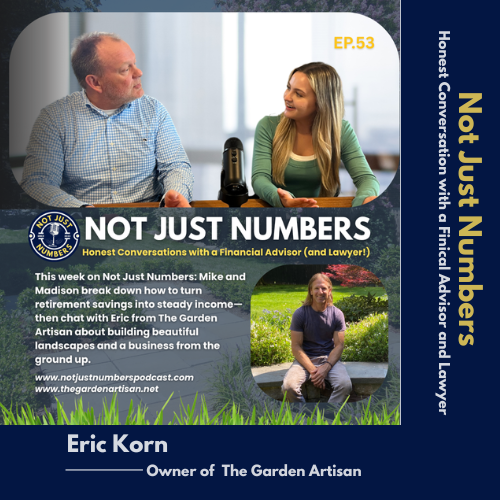
Episode 53: Turning Retirement Savings into a Steady Income Plan Then joined by Eric from The Garden Artisan

Hosts: Madison Demora and Mike Garry
Guest: Eric Korn, from The Garden Artisan

Episode Overview

In this episode of Not Just Numbers, Madison and Mike dive into one of the most common questions clients ask: How do I turn my retirement savings into reliable income? Mike explains the importance of timing Social Security benefits, strategies for minimizing lifetime taxes through smart withdrawal planning, and how to protect your portfolio against market downturns with proper asset allocation. Whether you’re approaching retirement or advising someone who is, this episode offers practical insights for creating a sustainable income plan.Then, Madison and Mike sit down with Eric, the founder of The Garden Artisan, to explore how he turns outdoor spaces into personalized works of art. Eric shares how his passion for plants and design, combined with real-world experience, led him to start his own landscaping business. He talks about how outdoor design has shifted over the years, why listening to clients is key, and how he balances creativity with practical challenges like budgets and site limitations. It’s a conversation about craftsmanship, communication, and creating spaces people love to live in.

Listen to Our Podcast On:

TIMESTAMPS
00:08 – 01:02 – Introduction to episode topic: Turning Retirement Savings into a Steady Income Plan
01:03 – 04:16 – Social Security Timing Strategy
04:17 – 06:41 – Tax-Smart Retirement Withdrawals
06:42 – 08:06 – Managing Sequence Risk During Market Downturns
08:07 – 09:47 – RMDs and Roth Conversions
09:48 – 12:31 – Planning for Heirs: Roth Conversions and Inherited IRA Taxes
12:39 – 41:15 – Interview with Eric from The Garden Artisan

Follow Us on Social Media

Stay updated with the latest episodes and news by following us on social media:

Contact with Eric Korn 
Facebook 
Instagram 
Website 


Episode Glossary


  • Required Minimum Distributions (RMDs): The minimum amount the IRS requires individuals to withdraw each year from pre-tax retirement accounts (like IRAs or 410(k)s) starting at age 73 or 75, depending on the person’s birth year.
  • Roth Conversions: The process of moving money from a traditional IRA or 401(k) to a Roth IRA. Taxes are paid now, but future growth and withdrawals may be tax-free.
  • Inherited IRA: An IRA passed on to a beneficiary after the original account holder’s death. 

Key Takeaways

  • Delay Social Security for higher benefits: Waiting until 70 increases Social Security by 8% annually (e.g., $3,000 at 62 to $5,000 at 70), adjusted for inflation, unless health or finances demand earlier claiming.
  • Plan tax-efficient withdrawals: Use a mix of pre-tax (IRA/401k), post-tax (brokerage), and tax-free (Roth) accounts to minimize lifetime taxes, planning ahead rather than year-to-year.
  • Mitigate sequence risk with bonds: Include 20-50% short-term, investment-grade bonds in portfolios to provide income during market downturns, protecting against sequence risk.
  • Consider Roth conversions early: Convert IRA funds to Roth before age 73/75 to reduce taxable RMDs and benefit heirs, especially with the SECURE Act’s 10-year withdrawal rule starting 2025.
  • Design landscapes within budget: Eric from The Garden Artisan advises phasing projects (e.g., planting first, walkways later) and scaling back (e.g., smaller plants) to fit client budgets.
  • Avoid AI for final designs: Use AI as a brainstorming tool for landscaping, but rely on experts like Eric to adjust designs for real-world feasibility and site-specific needs.

Transcript

Podcast Transcript: Ep. 53 – Turning Retirement Savings into a Steady Income Plan

Introduction

Madison: Hello everyone and welcome to Not Just Numbers, Honest Conversations with a Financial Advisor and Lawyer. I am Madison Demora and I’m here with Mike Garry. Mike is a financial advisor and a CFP practitioner and the founder and the CEO of Yardley Wealth Management. He is also an estate planning lawyer and his law firm is Yardley Estate Planning. Hey Mike.

Mike: Hey Maddie. How are you?

Madison: Great, great.

Mike: Not recording on a Monday. But it’s a beautiful day.

Madison: It’s a beautiful day. Summer is finally here.

Turning Retirement Savings into a Steady Income Plan

Madison: Today we’re diving into a question we get from clients all the time. How do I turn my retirement savings into steady, reliable income? After years of saving, investing and deferring taxes, the transition from paycheck to portfolio can feel overwhelming. But with the right strategy, it doesn’t have to be. Let’s start with one of the few sources of income retirement that most people can rely on, Social Security. While it’s rarely the main source of income for our clients, it’s an important baseline. We often tell clients to think of it as one leg of the income stool. Reliable, inflation adjusted, and lifetime based. But the decision around when to start claiming benefits really matters. How do you approach that conversation with clients?

Social Security Claiming Strategy

Mike: So, some clients get where we’re coming from. But a lot of clients like their default is to either take it as soon as they’re eligible or maybe to take it once they stop working. And our baseline default is to wait until 70 to take it because your benefit goes up 8% a year, every year you wait. So your benefit at 70 is almost 2/3 higher than your benefit at 62. That’s a big difference. Right. So if it’s going to be 3,000 at 62, it would be 5,000 at 70. Right. That is a big number. And that number will be adjusted for inflation for as long as you live. So I’m not saying we always recommend 70. It depends on the situation. If somebody really can’t afford to retire but needs to, they can’t find another job, they’re physically unable to work longer, or if they have some sort of like known life threatening illness where they might not live long enough for the claiming later strategy to work, then we will talk about taking out before 70. And when I say like live long enough for that to work, when we use our financial planning software, Moneyguide Pro, it will come up with like a break-even analysis. Whether like how long somebody would have to, live beyond claiming at 70 for it to be worthwhile not claiming earlier. Right. Because if you claim at 62 and there’s smaller benefits, you get that benefit for eight years. Right. That higher benefit’s going to have to be higher for some number of years for it to be worth it to you to wait. And generally, when we do that analysis, it comes back somewhere around 78 or 79. And well, most people that get into their 60s have a life expectancy higher than that. One thing that sometimes people forget is they think, oh, like men live to 75 or 77 and women live to 78 or 79. And that might be true at birth, but if you are 70, your life expectancy is in the 80s, right. Because you haven’t fallen illness or got hurt for some reason before that. Right. So the older you are, the older your life expectancy is. It’s just the way that math works. How’s that for a nice long answer on Social Security?

Madison: It’s perfect.

Drawing Down Assets and Tax Strategy

Madison: So once we help clients make that decision, we move to the heart of the plan, how to start drawing down assets. And this is where tax strategy becomes critical.

Mike: Yes. Right. So most people have some combination of, pre tax and post tax money. And some people have tax free money. So post tax money is money in a brokerage account or savings account or CDs where you’ve already paid income tax. And so, at that point, on CDs and savings account, you only pay tax on the interest or dividends that you get. From a brokerage account you only pay tax on the gains and at lower rates than pre tax which would be, IRA or 401k. And then when an IRA or 401k, anything you take out is fully taxable in the federal system, for federal income taxes. And then some people have Roth IRAs or 401ks so their post tax. And so what we try to figure out is how to use those for minimizing the taxes you’ll pay over your lifetime. Right. You know, we don’t just look at how do you pay the least amount of taxes this year, as you know you might do after the fact. Right. If you go to your accountant in April of 2025 and say, well, how do I pay the leasing on taxes for 2024? That’s not what we do. We look and try to plan ahead and so we see like what your income is, from the various, what it is or could be from the various buckets. And try to come up with a strategy that minimizes your taxes over that time. Because if you didn’t do that, it’s easy enough in a couple of years that very low tax years. But then it would catch up to you later and you might pay a whole lot more. We’ll talk about that later. I think you have a question in here about Roths, but we’ll talk about that. But yeah, really try to figure out, you know, based on how much you have in those different types of accounts and what the tax rules are like, what’s the best way to take your money to create that reliable income stream.

Madison: Awesome.

Mitigating Sequence Risk

Madison: All right, let’s talk about a risk most people don’t see coming. Sequence risk, which is drawing down a portfolio during a market downturn. We help clients understand that even with great average returns, the order in which those returns happen can impact how long a portfolio lasts. How do you help mitigate that from a tax and planning perspective?

Mike: Sure. So like from, from the, we do the planning in advance. Right. So we try to figure out what we’re going to do. And then when markets are down and a client needs to take money from an account. Well, one of the things is if someone’s got to take money from an account, it’s never going to be just stocks in it. There’s going to be some amount of bonds, usually 20 to 50% in bonds. And the bond fund funds that we use are short term to intermediate term and only investment grade. So no long term bonds or no junk bonds. So those bonds offer lower returns overall than the bond market regularly, but are also much less volatile. And so in a market drawdown, when the stock market is tanking, which it does from time to time, we use those bond funds to create the income stream that clients need until markets recover.

Madison: Another piece of the puzzle is required minimum distributions.

Required Minimum Distributions

Madison: We remind clients that even if they don’t need the income, the IRS will require them to start drawing down those pre tax assets at age 73 or 75. What should people keep in mind?

Mike: Yeah, one of the things that we’ve been doing a lot of recently is Roth conversions, before age 70 and possibly before age 73 or 75. You know, it goes back to that whole tax thing where if you have enough money in your like savings and brokerage and Social Security, you may not need to take anything from your, from your IRA or your 401k before required minimum distributions come due. But that, what that might mean though is that the balance in that 401k and IRA, which is all fully taxable when it comes out, might be much higher than if you include it in your planning three, five, ten years earlier. Right. So if somebody retires and there’s enough time between when they retire and when their required minimum distributions are due, we will often look to see if it makes sense to do Roth conversions. Right. And so, you know, that’s, that’s where you would take money out of your IRA, pay tax on the distribution, but roll it into a Roth and have it grow tax free. Now, it’s not for everybody, it doesn’t work in every situation, but it’s one of the things that we look at to see if, you know, paying a little bit of tax now saves paying a lot of tax later or for your beneficiaries.

Madison: Let’s touch briefly on inherited IRAs.

Inherited IRAs and Roth Conversions

Madison: There’s been a lot of change since the SECURE Act. And starting in 2025, many non-spouse beneficiaries now have to take annual RMDs and still empty the account within 10 years.

Mike: Right. So part of the Roth conversion strategy is trying to save your beneficiaries from what could be really high taxes. You know, if you die at your life expectancy in the 70s or 80s and you have kids and they’re working, they’re often in their peak earning years, right? And so if you’re in your peak earning years and then you get this wonderful, IRA, you know, as you’re a beneficiary from your mom or your dad, the downside of it could be that, you know, you have to take out all of it over in a 10 year period and you know, it could all be in a high or real or, you know, the highest tax bracket, and that, that could struggle, you know. So just, just for example, say somebody has $1 million IRA and you’re the beneficiary of that, and your first year’s distribution is going to be 100,000. So whatever your income is, you add that 100,000 to it. All of a sudden you’re going to be, you’re going to be in a high bracket and if you make a good amount of money, you might be in the highest bracket, right? And that’s a lot of money that comes out. If your mom or dad did some Roth conversions so that there’s less money in there, in your IRA and more in their IRA, but more in their Roth. Well, maybe then you’ll have the same amount distributions. But 70,000 is taxable and 30,000 is from the Roth and it’s not taxed. Right. It could make a big difference, you know, and any kind of chunk of tax free income when you’re already earning a lot and paying a lot of tax might really help your situation. Right. So it’s, you know, I mean, it sounds like it could be a little bit out there, right? Like you’re planning for your future, and then maybe planning for, like, your kids to inherit. But yeah, like, it could save a lot of money. It could make a really big difference. And it’s not that hard to plan around the whole thing is like knowing to do it and then doing it. And then, you know, we, since we do know to do it, we do it every year. Talk to clients about it all the time.

Madison: Yeah.

Guest Introduction: Eric from The Garden Artisan

Madison: Today on Not Just Numbers, we’re digging into the world of landscape design with someone who’s truly mastered the art of turning outdoor spaces into works of beauty. Eric, the owner of The Garden Artisan, brings over 25 years of experience, a degree in horticulture and landscape design, and a reputation for craftsmanship that speaks for itself. From custom gardens to hardscapes lighting, fire pits and water features, Eric and his team bring visions to life with creativity and precision. Eric, welcome to Not Just Numbers.

Eric: Thanks for having me.

Inspiration and Background of The Garden Artisan

Madison: All right, so we’ll start. What inspired you to start The Garden Artisan? And how did your background in horticulture and landscape design shape the business?

Eric: Good question. I, think, listen, I’d love to say that the start of the business, you know, that the skies opened up and I saw a big rainbow come down out of the clouds. And, you know, there was just this epiphany moment and, you know, everything was roses after that and it not the case. You know, I was just, I was kind of between things and, just doing some freelance work, for a bunch of different people and clients. And I have a friend that’s a mason, and he was working on a large project up in, Doylestown. And so he said, hey, I got this client, she wants a whole bunch of work done and, you know, can you do it? And I said, yeah, sure. So I, you know, I talked to the client and, I started doing a bunch of work for her. And that led into a whole bunch more work for her. And then things just kind of evolved from there. It was, you know, she had a couple properties in Doylestown, and so I started to work on them. She wanted a landscape design, so I gave her a landscape design. She wanted planting work done. And then I guess it was after maybe four weeks of working with her that I’m like, you know what, maybe I can kind of make a full time, you know, thing out of this. And then, so just over the years, being in the industry and meeting different people and kind of doing side projects here and there. I had some contacts and, I’m like, oh, let me see if I can make a, you know, full time, you know, full time, job out of this. And so, so I did. And it’s worked out great. I’ve been in business now since the Fall of 22. And every year the projects have been getting, the designs, the projects have been getting more along the lines of kind of what my specialty is. And I guess that leads me into the second part of your question is how does my experience kind of shape The Garden Artisan? And I think I’m kind of unique in that, you know I have an undergraduate degree, I have a bachelor of science in Ornamental Horticulture, from Temple Ambler. In 2004 I graduated and I also have a master’s degree. Master’s of the arts in landscape design, which I received in 2006. And just before I went to college and got my, my degrees and afterward, I mean I’ve been working in the field as just a laborer, a foreman, a project manager, design sales. So I have you know, I guess about 25 years experience in you know, the production end of things. So I kind of feel I’m unique in that I have a formal you know, classroom education like theory, but I also have real, real world hands on experience and how this stuff really goes in and what, what the culture of these plants are and kind of what works, what doesn’t work around here because what, what you read in books and the knowledge is, is one thing but the application of that knowledge and how it actually applies in real world settings is a little bit different. So yeah, so that, that kind of shaped and I, I just, it was like just the perfect timing of, of everything that came together. And yeah, it’s working out really, really, really great. I really like what I do and like you know, running The Garden Artisan.

Mike: Yeah, I like what you said about you know, you have the classroom knowledge and then the real world experience. A lot of stuff that, that might make sense in the classroom just doesn’t work in the field sometimes.

Eric: Yeah, yeah.

Mike: Like when in our business I was a finance major in undergrad and MBA and a lot of stuff in a finance classroom might, you know, might work one way. But then you talk to people’s lived experience and like you know, the answer on the chalkboard is not going to be the right answer for them. Right. You need to try to figure out what will be best and what they’re most comfortable with. And if somebody’s on board with an idea, they’re way more likely to do it than if they’re not.

Eric: Yeah. And a Perfect example that I think is, you know, just in this area we have a huge issue with deer. And so, you know, people go on the Internet and search deer resistant or deer tolerant plants, whatever they search for. And it comes up with this whole list of plants. And I, I could sit there and look at that list and tell you that all the plants on that deer resistant list are not in actuality. I mean they’ll, they’ll eat them, they’ll, they’ll nibble on them, they’ll, they’ll munch them back to the ground. And so, you know, the deer have a pretty, pretty decent appetite. And just, just because it’s on a list on the Internet doesn’t mean they’re not going to come up. And, and so that, yeah, so that, that’s an example of, you know, it’s great to have knowledge, but what’s actually, you know, what’s actually going on in the real world. And a lot of times they don’t necessarily line up exactly. They’re not parallel.

Mike: Wait, things on the Internet might not be true.

Eric: Right, right.

Evolution of Landscape Design

Madison: With over 25 years of experience, how have you seen landscape design evolve and how do you stay ahead of the curve?

Eric: I think the, the evolution is I’m seeing a lot more now that clients instead of just a patio, you know, they want, they want the same patio but they also want things incorporated in the patio or, or right off of the patio. Fire pits, outdoor fireplaces, whole outdoor living spaces, you know, pergolas. I’ve put in mist systems for people before, you know, on their extended roof that they want on their patio. You know, planters are becoming, pretty, pretty popular. I love doing them, you know, to accent the patio, to accent front door, the front entrance with this really nice planter that you can swap out, you know, annuals or different perennials, different times of the year. Low voltage lighting. There’s also an uptick in that to not only light up the trees in the landscape, but you know, architectural lighting to light up certain elements of the house. Water features too, when they’re outside using their entertainment space to just to see that backdrop of water, you know, and to hear that, that soothing sound of water. So all these elements I think, are coming into play and also just the types of patios too. I found that and I love to design this way, to incorporate, you know, inlays in the patio so instead of just, you know, a paver patio, to border that patio with like a really cool, you know, border around it, and maybe you change up the pattern or you change up the colors or you change up, you know, shapes and different things like that to really, to really make it stand out and really make it unique.

Madison: A lot goes into it.

Timeline of Landscape Projects

Madison: You know, I could only – How long does it take you, when you have projects like that, how long do they typically take?

Eric: It really, it really depends. It depends on things like, you know, site access, how to get to the space that we’re working in. You know, obviously the more detailed or the more ornate the patio it is, the more cuts, the more labor there is. So it really all depends. I found that, you know, a lot of times people once I have an idea in their head and then when I kind of explain it to them and say, hey, this is going to take, you know, three weeks or four weeks to get it done, they just don’t understand, you know, what it really takes to put it in. And not only what it takes to put it in, but really to do it, to do it right. You know, there’s a whole bunch of different ways to put in patios and walkways and different hardscapes and pillars and, you know, planting projects. But there’s really only kind of one right way to do it. There’s a whole bunch of offshoots on that. It’s one of the reasons why I offer a 10 year, warranty with my hardscape projects. There’s a three year warranty on my planting, projects. And if I maintain that over the course of, you know, if I maintain that property after I put the planting in, I’ll maintain it for, for as long as I, as I maintain the landscape. And you know, typically when I first meet with a client and they kind of go over their want list or their need list, you know, the amount of time that it takes me to get back to them, you know, with the design and then a proposal to go along with that, for installation, I try to have a quick turnaround in that it might be a week and a half, maybe two weeks sometimes. But I really try to, you know, try to stay on top of things to get back to them in a pretty decent, you know, pretty, decent manner. And then after that, yeah, it just depends on the complexity of the project. Is there, do we need to build up, Is there terracing involved? Is there, you know, there are a whole bunch of different things that actually affect the, the installation of it, how long that takes. But yeah, typically it’s a, it’s about a week and a half. I want to say a week sometimes, you know, maybe even a little bit less. I try to get back to people in a timely manner, and not have them wait around.

Madison: What does your creative process look like when designing a landscape?

Creative Process in Landscape Design

Madison: And how do you go from concept to completion?

Eric: That’s my favorite part of. One of my favorite parts of, of The Garden Artisan. And you know, the creative process is, It’s funny. It’s very systematic, at least my approach to creativity, you know, because I first meet with the client and ask them a whole bunch of questions, about, you know, how they want to use the space, what, what they want to put on the space. If it’s a patio, what they want to put on this space. Do they entertain a lot? I mean, I go down a whole list of questions, and then I take measurements of the space, I take pictures of the space, and then I, I go back to my drafting table and just kind of, you know, based on the, the rough measurements that I have in my head and, and what we kind of talked about that discussion, I just kind of jot down some, some ideas that come to me. And then I put that, the hard measurements in a computer system and kind of see how my ideas, kind of correlate to the real world. You know, hard measurements. And then kind of massage it from there. And I, I find that the more, the more I ask questions and the more that we communicate back and forth, the client and I, the design almost kind of comes out by itself. Like if I have the limitations, or the attributes of the site and I enter them into the program and I have this whole list of what they want, what they don’t want, colors, you know, general sizes of what they want, you know, how they want to get from point A to point B and all this information. A lot of times the design is right there underneath this. So it’s, it’s just kind of funny how it works sometimes like that. Like the more, the more thorough I am in the beginning, the easier the design, the creativity part comes, if that makes any sense. So it’s, it’s kind of cool to see it, to see it come together. You Know, obviously there are things like color and patterns and textures and things that are very subjective. And I’ll suggest things like, hey, I think that this color would go, would match the, you know, know, the facade of the house really well. Or this kind of texture would really complement that, the shutters or that the trim on the windows or whatever that is. And then, you know, but it’s up to them to make that decision. But I find that again that the more thorough I am in the beginning and up front with collecting the information, the easier the design is. And then it’s, it’s very, it’s a quicker kind of process in the end, you know, So I come to them, I presented the design, presenting the proposal. And typically, there’s not many changes to that. There might be a couple, few tweaks and changes here and there, but, you know, for the most part, I think I’m able to capture what they’re after.

Mike: I’m going to interject here.

Notable Project and Problem Solving

Mike: So, full disclosure. We hired Eric, probably met him about six weeks ago or eight weeks ago. My wife went on, you know, social media, one of those Facebook pages, to see who was recommended in the area. Had a couple of people besides Eric came out. We told them that, you know, we were looking for privacy in the backyard was one thing and some other things. And then there were some limitations. There’s two trees there that may or may not need to be removed. And we get water. And the things that we’ve planted in the past had drowned. And we told the, Eric and the two other guys this and the two other guys both suggested the same thing, that both had drowned in the past, you know, and so, and both suggested removing both trees. And so, you know, Eric looked at this, at the situation, sounded like he actually listened to us and came up with an idea to deal with the water, and plant things that were, some similar, but, but in a different way. Right. So we built, he built a berm in our backyard. We, I don’t know, it’s like 35, 36 yards of soil was added to the backyard.

Eric: It was 52 actually.

Mike: 52. Yeah, I guess some of the trucks were bigger than, than the last truck they came in. But yeah, raised you know, use the berm and some PVC to like to, to channel out some of the water and all kinds of stuff. But actually, you know, it looks great and like for me I feel like he actually listened to us and then dealt with like what the property had like the limitations there and then came up with the design and I think it looks great. You know, and you know things had to be adjusted or changed as he actually got into it. And yeah. Then, and then after that mostly done and then we had them do some more stuff on both sides and now that the sides in the backyard are pretty complete. Yeah, it was a great process.

Eric: And that, that’s one of the things that I love to do. You know, owning my own business with The Garden Artisan is I don’t view these projects as you know, a one time thing. I really like to maintain that and grow the relationship with my client and come back for other work. You know, I, once I’m done planting project, I don’t like to consider it done same thing with, with any hardscape that I put in. You know, there’s always room for other work that comes up also to maintain that landscape. You know, so I, I really like to cultivate relationships in my business, you know, and, and have repeat clients, you know, throughout the years.

Mike: Yep.

Madison: All right.

Creating a Positive Client Experience

Madison: Can you share a project that really changed your creativity or problem solving skills and how you tackled it?

Eric: Probably the biggest challenge that I face in terms of design, is to design within budget. You know, everybody has you know, wants and needs and reasons why they want to get things done, but it doesn’t necessarily line up with the, the budget that they allotted for that project. And a lot of times, you know, I can design something that is absolutely, you know, beautiful and it’s going to knock people’s socks off, but in the reality is that they’re not going to be able to afford to do it. So it’s my job where, I mean especially again, going back to your previous question you know, with just the process that I follow. If I asked, if I ask a whole bunch of questions, including, you know, have you thought about a budget here? Did you think about, you know, how much you want to spend on this project? Now I can kind of design within that budget. So if the budget’s, you know, $5,000 or $15,000 or 24, whatever that number is, it makes it easier for me to say, okay, you know, I would love to do this, but that’s not going to work, so maybe I can do it this way. Or. There’s a lot of times where I design something and it is over their budget, but then I come back and say, hey, we can do this. We can kind of phase this in. You know, we can complete this design. We complete this installation over the course of, you know, three years. Here’s how we can do it. The first phase is maybe get the planting in, and then the second phase is, you know, I don’t know, put the walkway in. And even that conversation sometimes I have in the first or second, you know, appointment, or maybe there’s a phone call that I make and say, hey, what do you think about phasing this in? So those are. I think the. The budget a lot of times is the most challenging. But I also think there’s definitely ways to get it done, within budget. Maybe that means to scale back on the square footage or something. Maybe that means to not use as many plants, maybe use smaller plants and have them grow into what they’re what ultimate size they’re going to be. There’s a ton of ways to do that, but I think kind of an ongoing, I don’t. I don’t hate to even use the word issue, but it’s just something that, you know, we have to deal with in the industry. Because nobody has unlimited funds of money. I’d love it, and I’m sure they would love it, too, but the reality is they don’t. And we need to design within, you know, the realistic confines of, you know, that client’s, that client’s property.

Madison: Totally makes sense.

Advice for Homeowners Transforming Outdoor Spaces

Madison: I’ve seen recently, like, how AI is, like, so big right now. I’ve seen people, like, on the Internet, they take pictures of their backyard and they sent it to AI and they’re like, make my backyard beautiful. And like, it’s like, have you ever gotten someone that’s been like, oh, can I get this backyard? And you’re like, whoa, that’s like almost impossible.

Eric: Funny you mentioned that. Yeah, I’ve, earlier this year actually, there was a couple that I met with, they did that exact thing. They took a picture and put it on AI and AI spit out this design. And it was a nice design. I mean, it was all colored and, you know, rendered. It was 3D. And they said, you know, we want a price to do this. And I, and I said, oh, okay. And so I’m looking at the space and I’m like, you could do it that way, but there’s a lot of different, there’s a lot of other ways to do it. You know, and you don’t need this retaining wall here. And I think there was something in there. There was a, there was some kind of retaining wall that they really didn’t need. So I would say, you know, as far as landscape design, at least what I have seen and heard, it could be a great tool, but it’s not, it’s not exactly accurate at the same time. You know, it might be a good idea, you know, kind of like a brainstorming session, but to give somebody that specific design and say, price this out and put it in, I don’t think works out all the time.

Mike: It might be similar to, like if we gave somebody who didn’t know anything about financial planning, our financial planning software, you know, and they could enter like their name and information and maybe their salary and stuff like that. But then a lot of the other questions they wouldn’t necessarily know, like the context of how to answer them or what might be a good or a bad answer. And so they could get something that works for them, but they could also get something that’s just like totally irrelevant, you, know, and, or even irresponsible to their lives. A lot of things, you know the AI answers are great for a lot of things, but for some, whether specialized knowledge, you know, you really need someone who has that knowledge to help.

Eric: Yeah.

Mike: To see what is right, what doesn’t work. Could be a great, like brainstorming to start, but then, then you need to, to bring in somebody actually knows what they’re doing, what’s possible.

Eric: Yeah, I totally agree with that. Yeah.

Madison: Your reviews consistently praise your professionalism, communication and ability to bring ideas to life, what’s your secret to creating A positive client experience.

Creating a Positive Client Experience

Eric: I don’t, I don’t really think it’s a secret. I think that, I really just tried to, bring my complete skill set, and my knowledge and my experience to every project, and communicate what I’m going to do, why I’m going to do it, you know, and from, from beginning to end, you know, kind of communicate the whole way through with clients just so, so they know, they know what I’m doing, why I’m doing it, when I’m going to be there, when I’m not going to be there. You know, if something changes or if there’s a change order or if I come across something, there’s a lot of times where, you know, I’m putting something in and maybe it’s like, hey, what do you, what do you think about, about this? Or maybe adding a plan over here, whatever that is. But I feel that to have an open line of communication with the client and actually use that line of communication is pretty critical, I think, to the success of, The Garden and then those reviews too, you know, obviously. And I talk to my peers and other contractors and clients and you know, I always take what they say and try to implement the good stuff and obviously not implement the bad stuff. One of the biggest complaints that I hear is, you know, it just takes people a long time to get back or they don’t get back to them. And so I just try to, you know, I try to use that, you know, use what I hear and you know, just try to try to put my best foot forward every day and, you know, and go from there.

Madison: Yeah. Communication’s key. That’s awesome.

Advice for Homeowners Transforming Outdoor Spaces

Madison: All, Right. What advice would you give homeowners who are just beginning to think about transforming their outdoor space?

Eric: Yeah, I would say don’t, use AI for, for their final, for their final. You know, I think, think about it, it’s a lot of times it’s a big investment. Or it could be a big investment. And there are a lot of things to think about. You know, things like, do they have a growing family? Do they have pets? Do they have, you know, do they want pets? If they’re considering an outside, you know, entertaining area, how much do they entertain? What do they want to put on that patio? You know, things like, bistro tables and benches, planters, what else? You know, dining room tables, chairs around that table, you know, umbrellas, lounge chair. All these things take up usable space. And so it’s great to say I want, you know, a patio that comes, you know, I don’t know, 14ft out from the house and it covers this area. That’s all well and good but know that if you put a table on there and you want to put your grill out there and cook, you know, cook your steaks at night, a lot of that’s going to be used up. And so maybe we talk about, you know, expanding that out a little bit or, you know, there’s just a lot to think about in the short term and then in the long term as well. So, you know, I would probably recommend, you know, to give somebody like me a call. I go through that process with every, everybody that I meet, I ask those questions to, because it is a big investment and as far as design and the sustainability of it. And the longevity of it, and to have them happy not only when I leave, but, you know, 5, 6, 10, 15 years down the road that they’re still going to, you know, use that patio like they did on day one. I’ve never met anybody thus far that said, I really wish I went smaller on that patio or that deck. You know, it’s always, I wish I went a little bit bigger. Maybe I should have done it over there. So I really like to, again, going back to one of the first questions, just to be as thorough as I can in that kind of interviewing process when I first meet with clients. And, to capture everything that they want, in the first year and then, you know, also moving forward too.

Madison: That’s great.

Mike: Our deck is a pretty good size, but there are always still space limitations on it.

Eric: Yeah, yeah.

Madison: Where can our listeners learn more about you and The Garden Artisan?

Contacting The Garden Artisan

Eric: Yeah, I’d say, I mean, they can log on to just the numbers podcast. There you go. You can. And if, if they’re already on here, I have a website, it’s thegardenartisan.net and they can check out just, a little bit about the company and, my experience and background. I also have, you know, previous projects on there, so some of my past work, lighting, planters, hardscaping, plantings, water features. I also have a Facebook page and an Instagram page, which admittedly I need to keep updated. It’s one of the things that, you know, over the course of business I just, at the end of the day I’m just, I’m just not good on keeping up with that. But that’s another way to get in touch with me, is Facebook and Instagram. And yeah, give me a call. I usually always answer my phone up until about 8:00 clock at night. I’d be more than happy to talk to anybody about their landscaping needs and set up an appointment.

Madison: All right, thanks, Eric.

Mike: All right. This has been great. Thank you so much, Eric.

Eric: Yeah, thanks, guys. All right.

Closing Remarks

Madison: For more information on Yardley Wealth Management or Yardley Estate Planning, you could visit our websites at yardleywealth.net and yardleyestate.net. You can also follow us on socials at Yardley Wealth Management. Don’t forget to subscribe to our YouTube channel. This podcast has been produced by Madison Demora and Mike Garry with technical and artistic help from Poe Productions.

Request the Full Transcript as a PDF

The full transcript of this episode is available via email. Please fill out the form below to receive it: