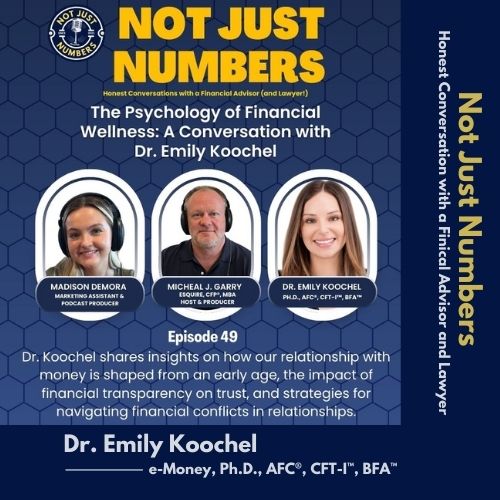
Episode 49: The Psychology of Financial Wellness: A Conversation with Dr. Emily Koochel

Hosts: Madison Demora and Mike Garry

Special Guests: Dr. Emily Koochel, e-Money

Episode Overview

In this episode of Not Just Numbers, hosts Mike Garry and Madison DeMora sit down with Dr. Emily Koochel, a leading expert in financial wellness, behavioral finance, and financial psychology. As the Manager of Financial Wellness at eMoney Advisor, Dr. Koochel shares insights on how our relationship with money is shaped from an early age, the impact of financial transparency on trust, and strategies for navigating financial conflicts in relationships. She also discusses the psychological challenges of retirement and the importance of connecting with one’s future self. Whether you’re a financial professional or someone looking to improve your financial mindset, this conversation is packed with valuable takeaways.

Listen to Our Podcast On:

TIMESTAMPS

00:08 – 07:54 – Introduction & Dr. Koochel’s Career Journey

07:55 – 14:42 – Understanding the Psychology of Financial Planning

14:43 – 20:05– The Foundations of Financial Wellness

20:26– 27:01 – Managing Financial Conflict in Relationships

27:02 – 30:10 – The Role of Financial Transparency and Trust

30:11 – 33:42 – Navigating Financial Anxiety & Market Uncertainty

33:43 – 43:01 – The Psychological Shift in Retirement

Connect with our Special Guest

LinkedIn

Follow Us on Social Media

Stay updated with the latest episodes and news by following us on social media:
 

Episode Glossary

  • Behavioral Finance: A field that explores how psychological factors influence financial decision-making.
  • Behavioral Financial Advisor (BFA): A professional designation that integrates psychology and financial planning to improve client decision-making.
  • Financial Wellness: A positive state of being resulting from a healthy relationship with money, and then the impact that that has on other aspects of our life.

Key Takeaways

  • Financial socialization shapes money habits early: Our relationship with money starts in childhood through explicit lessons and implicit observations, influencing lifelong values and behaviors.
  • Understand clients’ unique money dynamics: Advisors must recognize clients’ individual experiences with money to tailor financial plans, as only 20% are ready to change initially.
  • Financial wellness goes beyond wealth: It’s a positive state from a healthy money relationship, impacting mental, emotional, and physical well-being, not tied to a specific income level.
  • Collaboration resolves financial conflict: Help couples find common ground by modeling scenarios that address both partners’ goals, like saving for retirement and education, without compromise.
  • Financial secrets erode trust deeply: Transparency and safe communication are key to rebuilding trust after financial infidelity, which can be more impactful than other conflicts.
  • Reassure clients during uncertainty: Use stress-tested financial plans to ease clients’ fears post-election or economic shifts, showing resilience for long-term goals.
  • Ease retirement’s psychological shift: Connect clients to their future selves through vivid visualization (e.g., time with grandchildren), helping them embrace the next chapter beyond work identity.

Transcript

Episode 49: Dr. Emily Koochel on Financial Wellness and Psychology

Introduction

Madison: Hello, everyone, and welcome to Not Just Numbers, Honest Conversations with a Financial Advisor and Lawyer. I am Madison Demora, and I’m here with Mike Garry. Mike is a financial advisor and a CFP practitioner and the founder and the CEO of Yardley Wealth Management. He is also an estate planning lawyer, and his law firm is Yardley Estate Planning. Today we are excited to welcome Dr. Emily Koochel, a leader in financial wellness, behavioral finance, and financial psychology. She is the Manager of Financial Wellness at eMoney Advisor, where she leads research and education initiatives to improve the financial planning experience. With a PhD in Applied Family Science and a Master’s in financial planning, Dr. Koochel brings deep expertise to the intersection of money, relationships and behavior. She is a Certified Financial Therapist, accredited Financial Counselor, and a Behavioral Financial Advisor. She is a co-author of “The Psychology of Financial Planning”. Dr. Emily, welcome to Not Just Numbers.

Dr. Koochel: Thank you so much. I am so excited to be here and to chat with y’all today.

Madison: Awesome. Awesome. So, we’ll get right into the questions.

What Inspired Dr. Koochel’s Career in Financial Wellness and Psychology

Madison: What inspired you to pursue a career at the intersection of financial wellness, psychology, and behavior?

Dr. Koochel: Yeah. So, I won’t give you my whole life story, but I will go back just a little bit to give some context to it. So, as you mentioned, some of my education is in financial planning and then applied family science. So back when I was studying financial planning, I had the incredible opportunity to study amongst some of the pioneers in the field. So folks like Dr. Sonja Luder, Dr. Christy Archuleta, who have created the Financial Therapy association and wrote books and all of these great things, and it was working with them that they start to kind of plant the seed, and I go off start working with some clients. And it is fascinating that there are, there’s some general truths in financial planning that most financial professionals agree to, but I think we can also agree to the fact that there is a unique relationship to money for each individual. And it just became a curiosity that I needed to know more. If I understand the financial kind of expertise and technicalities of it all, what about understanding who we’re giving that information to? So better understanding the dynamics of the individual, of the couples, of the families that we’re working with, and not only just their relationship with money, but the dynamics between the individuals themselves. And that’s really where financial planning gets a little more complex and a little more nuanced. And so went back and studied that more specifically, as you mentioned, in family science. From there, go to teach at a university, teaching in financial planning. And then this really great opportunity comes along with eMoney, which is a financial technology company. And this certainly hadn’t crossed my mind until seeing it, but if you value education, if you value and are passionate about making an impact in people’s lives, wow. eMoney has the opportunity because they serve over 100,000 advisors. Those advisors then serve millions of clients. And so if you can take this information and scale it to those advisors and the clients that they’re serving, you have a pretty incredible opportunity to make a true impact. And, you know, I’ll give credit where credit’s due. eMoney also, you know, had leadership in place that said we find this valuable. And, you know, serendipitously, at the time that I was joining eMoney, the CFP board was also saying that the psychology of financial planning is really important. They were adding it into their exam requirements. And so maybe it was a little less foreign to hear somebody like myself taking this perspective, but it worked out in a way that, you know, the regulatory bodies were talking about it, the support was there. I had done a little bit of education to kind of gear up to it. And there’s this, there’s just this really great intersection of financial technology and planning and financial psychology that can be really meaningful to advisors to understand, but then ultimately to the clients that they’re serving. So, it’s a little bit of a windy path, like I think most of us have in our careers, but eventually we get to kind of this cool place where we get to do really cool work.

Mike: That’s way better than my windy path, which included law school. So, that’s very interesting. And having practiced now for 25 or 26 years, you know, you learn things, right? And so I remember 25 years ago, like, delivering financial plans and thinking like, well, there’s like, certain ways for the clients to achieve their goals. And it didn’t take real long to understand that, that some people were just not going to do some things, some ways. And so it was really important to come up with like a B plan or a C plan that would work because it’s really easy to know, it’s easy to learn that if clients are on board with their suggestions, they’re way more likely for them to actually do them and not, like, sit on their hands or come up with reasons not. And so when you first meet people, sometimes it’s hard to know what they’re going to do. Right? The initial planning in the first couple months, when you’re working with somebody, you know them pretty well for a short amount of time, but you don’t know them as well as you’re going to get to know them after 5, 10, 20 years. And so it is interesting, like, sometimes we’ll look at initial

Request the Full Transcript as a PDF

The full transcript of this episode is available via email. Please fill out the form below to receive it: