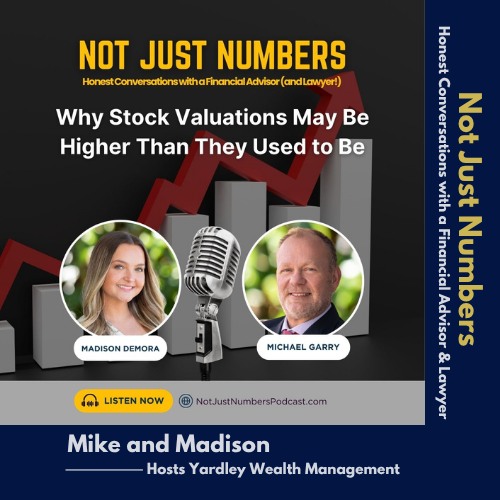
Episode 80: Why Stock Valuations May Be Higher Than They Used to Be

Hosts: Madison Demora and Mike Garry

Episode Overview

If stocks look expensive by historical standards, does that automatically mean they’re too expensive? In this episode of Not Just Numbers, Madison and Mike build on their last conversation about stocks, bonds, and cash and ask whether today’s stock valuations deserve some context. Mike walks through how different investing was 50 years ago, when commissions were fixed, mutual funds carried big sales charges, retirement accounts were scarce, and taxes on gains were steep. They also look at why diversification matters, including research showing that a small number of stocks have created most of the market’s wealth, and why valuations still matter. The big idea: stocks may be expensive by historical measures, but today’s investors are buying a cheaper, easier-to-own, and more diversified market than investors had decades ago.

Listen to Our Podcast On:

TIMESTAMPS

00:08 – 02:16 – Introduction

02:17 – 03:49 – Why Today’s Market Looks Different

03:50 – 08:05 – Why Buying Stocks Used to Be So Expensive

08:06 – 11:07 – Taxes, Retirement Accounts, and Why Fewer People Bought Stocks

11:08 – 13:33 – Mutual Funds Used to Be Expensive Too

13:34 – 16:18 – Why These Changes May Support Higher Valuations

16:19 – 27:20 – Diversification, Stock Picking, and Long-Term Market Returns

27:21 – 30:24 – Why Valuations Still Matter

30:24 – 32:14 – The Main Takeaways

32:15 – 33:28 – Closing

Follow Us on Social Media

Stay updated with the latest episodes and news by following us on social media:
 

Episode Glossary

  • Equity Risk Premium: The additional returns an investor can earn when investing in stocks over lower-risk investments.

Key Takeaways

  • Stocks looking expensive doesn’t automatically mean they’re too expensive. The market today is very different from the one behind long-term historical averages, so valuations deserve some context. That doesn’t make stocks risk-free or mean prices can’t fall.
  • Buying stocks used to cost a lot. Until May 1, 1975, commissions were fixed, often 1 to 2% of a trade, and investors generally had to buy 100-share “round lots,” with wider spreads and extra charges for smaller trades. Today, trades are low or no cost, and you can buy fractional shares.
  • Taxes and access were barriers too. Long-term capital gains taxes could run 30 to 40% for many investors, compared with 0% or 15% for most people today. IRAs began in 1975 but were limited at first, 401(k)s spread in the 1980s, and most workers had pensions rather than investment choices to make.
  • Mutual funds were expensive as well. Until the 1970s, almost all charged sales loads, and an 8.5% load meant only $9,150 of a $10,000 investment went to work. Yearly costs of 1 to 2% were common. Today many index funds cost under 0.20%, and ETFs didn’t exist.
  • Something that’s cheaper, easier, and more diversified may deserve a higher price. Mike noted that the S&P 500’s long-term average is around 15 times earnings, the past 20 years closer to 20, and recently around 25, which is historically high. Earnings have been strong, so it’s hard to say what’s right.
  • Owning 15 stocks isn’t real diversification. Mike cited research by Hendrik Bessembinder finding that 96% of the 20,000-plus stocks that have gone public didn’t beat Treasury bills, and that about a hundred stocks created most of the market’s wealth. A broad, globally diversified portfolio lets you own the winners without having to pick them.
  • Valuations still matter, and risk hasn’t gone away. Pay a high price and future returns are likely to be lower, and a diversified portfolio can still fall 30 to 50%. Low costs make it easier to capture market returns, not to avoid volatility, and your mix should still reflect your goals, time horizon, income needs, and risk tolerance.

Transcript

Not Just Numbers: Honest Conversations with a Financial Advisor and Lawyer
Episode 80 – Why Stock Valuations May Be Higher Than They Used to Be

Introduction & Hosts

Madison: Hello, everyone, and welcome to Not Just Numbers, Honest Conversations with a Financial Advisor and Lawyer. I am Madison Demora, and I’m here with Mike Garry. Mike is a financial advisor and a CFP practitioner and the founder and the CEO of Yardley Wealth Management. He is also an estate planning lawyer, and his law firm is Yardley Estate Planning. Hi, Mike.

Mike: Hey, Maddie. How are you today?

Madison: I’m good. How are you?

Mike: I’m good, I’m good. Are you ready to talk about something easy and not controversial at all, stock market valuations?

Building on Episode 78: Do Expensive Stocks Deserve Higher Valuations?

Madison: Exactly. So in one of our previous episodes, episode 78, we talked about stocks, bonds, cash, and the idea that stocks look expensive by some traditional measures. We also discuss the equity risk premium, which is the extra return investors expect for owning stocks instead of bonds. Today, we want to build on that conversation a little bit. Because one of the natural questions after that episode is, if stocks look expensive, does that automatically mean they are too expensive? Or is there a reason stocks may deserve to trade at higher valuations today than they did decades ago?

Mike: That’s the right question, Maddie. And I think the answer is maybe… Maybe. The thought for this came as I was walking the dogs at six o’ clock in the morning, listening to that podcast, and I thought of all these things, and I think it’s worth exploring and talking about a little bit. And, hopefully it’s entertaining for the listeners. So just because stocks are at a higher valuation doesn’t mean that they’re risk-free and they’ll always stay at that valuation. It doesn’t mean prices can’t fall. It doesn’t mean valuations don’t matter. But it may be true that the investing world today is a little different from the investing world of 50 years ago. And if the structure of the market for investing has changed, then maybe the way investors value stocks has changed or should have changed too.

Why Today’s Market Looks Different

Madison: All right, so let’s start there. When people say stocks are expensive today, they’re often comparing today’s valuations to historical averages. But are we really comparing apples to apples?

Mike: Not exactly. When we compare today’s stock market to the stock market of 50, 75, 100 years ago, we have to remember the experience of investing was very different back then. Today, investor can open an account at Schwab, Fidelity, Vanguard, or any other custodian, mutual fund company broker dealer, and buy a broadly diversified index fund or ETF with very low cost. They can own hundreds or thousands of companies around the world with one commission-free trade. That was not the normal experience for investors for most of market history.

Madison: So when we look at long-term stock market data, we’re looking at returns that theoretically existed, but that does not mean that most people could actually capture them easily.

Mike: Exactly. Jeremy Siegel’s book, Stocks for the Long Run, which everyone, including you, Madison, should read, looks at how baskets of stocks performed over very long periods of time, going back, about 200 years ago, book came out in the 90s. And that research is very useful. But for much of that period, the average investor could not easily buy and hold a diversified basket of stocks in a low-cost way. The returns may have existed in the data, but accessing those returns was much harder.

Madison: So the market return was there, but the ability for ordinary investors to actually capture that return has changed dramatically.

Mike: That’s right. And that’s a big deal.

Why Buying Stocks Used to Be So Expensive

Madison: All right. So one of the biggest changes you mentioned when we were preparing for this episode was the end of fixed stock commissions. Can you explain what that means and why it mattered so much?

Mike: Sure. So this is one of those things that sounds almost ancient to investors today, because now people can buy almost any number of shares, or even fractional shares, at little or no trading costs. But that’s not how it used to work. You know, until May 1, 1975, stock commissions were fixed. So any broker dealer you went to, they would have to charge the exact same amount. That meant investors could not really shop around for cheaper trading costs the way they can today. The commissions were set, and they were expensive. In many cases, or most cases, those fixed commissions generally equated to 1 to 2% of the total trade value. That’s a lot of money.

Madison: So if someone was buying or selling stocks often, the cost could really add up.

Mike: Yeah, absolutely. You couldn’t, not that it’s a good idea, but you could not day trade. Right. Because your commissions would eat up your money quickly. So doing many trades, or moving in and out of stocks, was expensive. And that made building a diversified portfolio much harder. Today we talk about diversification like it is easy because it is. You could buy an ETF or mutual fund and instantly own hundreds or thousands of companies. But back then, if you wanted to build your own stock portfolio, every purchase came with a meaningful transaction cost. And it was not just the commissions. Investors also generally had to buy what were called round lots.

Madison: And what’s that?

Mike: So a round lot meant 100 shares at a time. So if a stock was trading at $25 per share, buying 100 shares meant you needed $2,500 just to buy that one stock. And remember, that’s in 1975 dollars. That’s a lot of money. Then you add the commission on top of that. You know, one of the things I didn’t even think about when we were preparing this is there’s also the spread. So when you go to buy a stock or you look up a stock online, you’ll see, there’s a bid price and an ask price. And that’s the difference between what a buyer and seller are willing to trade for. Right. Well, those used to be much bigger differences than they are today. Now it now it’s fractions of a penny. You know, it used to be an eighth. So 12 and a half cents. And, you know, that’s in my lifetime. I don’t know what it was before. I didn’t research this. So that’s an added cost on top of the cost for the commission and then the cost for the round lots, which we’ll get to. But buying 100 shares of a $25 stock costs around $49 in commissions. That’s just under 2% in today’s dollars. That’d be roughly $350, to buy stock.

Madison: Yeah, that’s very different from someone today buying one share, five shares, or even a fractional share with almost no trading costs.

Mike: Right. And if, back then, if you wanted to buy fewer than 100 shares, you had to go through odd-lot dealers. So they would usually add an extra eighth to a quarter of a dollar per share. So smaller investors were penalized even more. And this is part of the reason companies used to split their stocks when the price got expensive. They wanted to keep the share price low enough that people could still buy round lots. That helped keep the average price of many stocks trading on exchanges, generally between 20 and $40. So stock would get up to $80 and they’d split it, or get up to $60 and they’d split it. But even then, buying 100 shares of an average stock still required several thousand dollars. And the cost to do it, add another 1 to 2%. Yeah, it adds up.

Madison: So when people compare today’s stock market to the stock market 50 years ago, they may not realize how different the actual investing experience was.

Mike: That’s right. And we’re just getting into it. There’s a lot more to unpack here. Like today, investing is cheaper, easier, and more accessible. Back then, buying stocks was expensive, trading was expensive, diversification was expensive, and smaller investors faced more barriers. So when we asked whether stocks deserve higher valuations today, this is part of the answer. The stock market became much easier for regular investors to access.

Taxes, Retirement Accounts, and Why Fewer People Bought Stocks

Madison: And commissions were not the only barrier, right? You also mentioned that taxes were more complicated and often higher.

Mike: Yes, they were. Capital gains taxes were more complicated to figure out, and for many people they were much higher than they are today. For a lot of investors, capital gains taxes could be 30 to 40%. Now we live in an area where a lot of people pay 0% or most people pay 15%. 30 to 40% for long-term capital gain is a lot. So think about the whole picture. It was expensive to buy and sell. Hard to diversify. And if you did make money, taxes take a big bite. So no wonder fewer people bought stocks.

Madison: And retirement accounts were also not as common as they are today.

Mike: That’s right. That’s another change. IRAs started on January 1, 1975, so a few months before, May Day, what they call the day when the fixed commissions went away. But at first they were only available to workers who didn’t have a pension. How crazy of a rule is that? They were not available to most people until the 1980s. And 401(k)s became legal in the late 70s, I think it was 78. But they didn’t become more widely available until the early 80s. There was a court case, in 81, I think. So even by 1983, nearly half of Fortune 500 companies had them, which sounds like a lot, but it also means that more than half didn’t. So IRAs and 401(k)s were just getting started. And of course, everybody should be able to invest in a low cost retirement plan, whether that work or not. And they should be more available today than they are. I wish there were more.

Madison: So before 401(k)s became common, many workers were not choosing investments the way they are now.

Mike: That’s right. So if, if people had workplace retirement plans through the 70s, they were usually pensions. That meant most employees were not logging into a retirement account, choosing funds, deciding between stocks and bonds, picking target date funds, or setting contribution percentages. You did that when you started working here, Right? You had to decide how much to save. We talked about whether it should be Pre-Tax or Roth. And so you had to make these decisions because if you didn’t, you’re giving up the match, right? So you’d be giving up free money. So it’d be really, really not a good idea not to do it. And so, that’s a choice you had to confront in your early 20s. And so if you didn’t have that at work, and stocks would cost hundreds of dollars to make a trade or a transaction, you could see why people wouldn’t do it, right? You were kind of forced to learn by investing through your workplace plan. And, when you combine all these things, commissions, taxes, limited retirement account access, pensions instead of participant director plans, it makes sense that fewer people had experience buying investments directly. And again, that matters when we compare valuations today to valuations in the past.

Mutual Funds Used to Be Expensive Too

Madison: So someone might hear this and say, okay, individual stocks were expensive and difficult to buy, but what about mutual funds? Were mutual funds an easier solution?

Mike: Maybe. They helped with diversification, but they were also expensive. Today, most mutual funds don’t have sales charges, except for the ones like that the large brokerage firms, they generally would charge, like C shares. But fund companies make money from their internal expenses, and they would use the sales charges to pay people to sell them. And those costs have come down a lot. But until the 1970s, almost all mutual funds charged sales loads. That means you had to pay commission just to buy the fund.

Madison: So even buying a diversified mutual fund came with big upfront costs.

Mike: Yeah, it was a big deal when Jack Bogle at Vanguard stopped charging 8.5% to buy a mutual fund. Think about that. So if you invested $10,000 and paid an 8.5% sales load, only $9,150 actually went to the fund. The rest was gone immediately. And if you had to pay 8.5% to get into the fund, you needed about a 9.3% return just to break even before you made any money. Like that would be a big impediment to doing something. Right.

Madison: Yeah, yeah, that’s a huge hurdle.

Mike: It is. And the internal costs were also much higher. It wasn’t uncommon for mutual funds to charge more than 1% or even 2% a year in internal expenses. Today, most actively managed funds charge under a percent, and many index funds cost less than 0.20%. There are plenty of index funds or ETFs that charge less than 0.05%. That’s a massive change.

Madison: So compared to the past, investors today have lower trading costs, lower fund cost, no sales loads in many cases, more retirement account access, and more ways to diversify.

Mike: And exchange traded funds didn’t, even exist back then. Today, ETFs are everywhere. Investors can buy broad market ETFs, bond ETFs, international, any kind you want really. And that kind of access was not available for most of stock market history. So when we look back at 100 or 200 years of stock market returns, we have to remember something important, the returns may have existed in the data, but most ordinary investors could not easily capture them in a low-cost, diversified, tax-efficient way. It’s just very different today.

Why These Changes May Support Higher Valuations

Madison: So let me bring this back to the main point of the episode. If stocks trade at higher valuations today, part of the reason may be that the investing experience itself has improved. Is that fair?

Mike: Yeah, I think it is fair. If you make something less expensive, you’re gonna sell more of it, right? If you take down all these barriers to investing in stocks, more people are going to invest in stocks and that’s going to bring up the valuation. Again, doesn’t mean stocks are risk-free. It does not mean valuations don’t matter. It does not mean stocks cannot go down. But the market investors have access to today is not the same market investors had access to 50 years ago. Today, investors can buy these great diversified portfolios at almost no cost. They have retirement accounts. They can automate contributions. They can reinvest dividends. They can buy fractional shares. They can rebalance without huge trading costs. And they can own thousands of companies with one fund. This is a much better product than when investors had decades ago.

Madison: So investors may be willing to pay more for stocks because they’re easier and cheaper to own.

Mike: Yep, something becomes easier to access, less expensive to hold, more diversified, demand increases, valuation goes higher. Doesn’t mean there’s no limit. It does not mean every valuation is justified either. But it does help explain why comparing today’s valuations to historical averages can be incomplete. The market has changed. If the S&P 500 historical price earnings valuations average around 15 times over the long term, like 100 years, The S&P is not that old but there’s precursors to it, and over the last 20 years have been more like 20 times earnings, that 20 times might make sense now. And valuations now are stretched more to around 25, which is historically very high. In the past, the few times it has gotten near that, the next few years weren’t great for investors. This time though, earnings are really, really good. So who’s to say what is right?

Madison: So the takeaway is not valuations do not matter. Its valuations need context.

Mike: Exactly. Valuations still matter. Price still matters. Future returns still depend on what you pay. But the investing world has changed dramatically. 50 years ago, buying stocks was expensive. Buying fewer than 100 shares was penalized. You know, all the other stuff we’ve talked about, all those costs and today the opposite is true. People are regularly Investing through their 401(k)s, IRAs, brokerage accounts. And they could do it at a cost that would seem impossible decades ago. So I think there’s big reasons today’s market may deserve to be viewed differently than the market of the past.

Diversification: Why 15 Stocks Isn’t Enough

Madison: That brings up another point you mentioned. When you were in college, professors used to teach that 15 stocks could give you a diversified portfolio. is that still how people think about diversification?

Mike: I hope not. That was a common idea for a long time. The thought was that once you own around 15 or 20 stocks, you should diversified away a lot of company specific risk. Mathematically, there is some truth to that. Owning 15 stocks is definitely more diversified than owning one stock. But now we understand that true diversification is much broader than that.

Madison: Because 15 stocks still leave you concentrated.

Mike: Very. Owning 15 stocks could leave you necessarily heavily exposed to a country, a sector, a style, a theme. And any one or more of those companies could go bankrupt. Today, investors can own hundreds or thousands of companies across different sectors, countries and market caps. It’s much better diversification than what most investors had access to decades ago. I can’t believe that this research I want to talk about isn’t more widely known. But there’s groundbreaking research by Arizona State University finance professor Hendrik Bessembinder that showed that 96% of the 20,000 plus stocks that have ever gone public were not in good investments, were not good investments, not even beating T-bills. The wealth in the stock market has been created by about a hundred stocks. So if you’re buying 15 stocks and only 4% of publicly traded stocks provide all the returns, what are the odds that you’re going to pick right? And you can’t do it after the fact either. You can’t now say, oh, I’m only going to own Amazon, Nvidia and Apple. I mean you could, but you aren’t going to get those returns from those stocks anymore. They are past that phase of their lives. Nvidia, these companies have 3,4 trillion dollar market cap. They can’t quintuple in size in the next couple years. It’s just there’s not enough human beings or money on earth. Another good example comes from the nifty fifty stocks of the 70s. They had high valuations and they were considered bulletproof investments. Some of them have been good performers over the last 50 years. Some of them are bankrupt and you probably never heard of two dozen of them. When I looked at the list, there were a good 10, 15 stocks that I never heard of right, among what was 50 years ago the Amazons, Apples, Nvidias. Stuff changes. You know, the capitalism is constant creative destruction. So things can look rock solid for a while and then all of a sudden they aren’t. More recently, like 25 years ago, we had WorldCom, Enron, Lucent and Arthur Andersen. At one point, Lucent was the most widely held stock in America. You Lucent was one of the stocks that spun off AT&T. And everybody had to have it. When I was starting at Merrill, everybody had it in their portfolio and you had to have it. More people lost billions of dollars from Lucent over the last 25 years like you can’t imagine. WorldCom and Enron on both Enron at one point was number seven on the Fortune 500. And WorldCom was one of the leading telecom companies. They both had massive accounting frauds. And Arthur Andersen, who was both of their accountants, was a big five accounting firm that have been in business for 70 years. And they went out of business in about nine months because of everything, the fallout from WorldCom and Enron. So you think you could buy a couple stocks of big names and they have all this rock-solid stuff behind them, and it doesn’t work. You can get lucky, people can get lucky. But it just, it’s a major difference between owning like 10 or 15 individual stocks and owning a globally diversified portfolio of thousands of companies. They are not the same risk.

Most Stocks Don’t Beat Treasury Bills

Madison: This is where I think the conversation gets really interesting. You mentioned that research shows most individual stocks have underperformed Treasury bills, and that a very small number of stocks have created most of the market’s long-term wealth. Can you explain that?

Mike: Yep. It’s one of the most important points for investors to understand. When people talk about the stock market’s long-term return, they often assume that most stocks contributed more or less equally to that return. People often mistake the meaning in Dr. Siegel’s book too, they think that owning any stock for a long time is going to be a good investment. That’s not what Dr. Siegel said at all. He said owning baskets of stocks, not having one stock. You know, it doesn’t work. A lot of individual stocks do not do very well over time. It is really hard. It’s hard enough to start a company and then to get it to be big enough. Of the millions of companies that start, it’s 20,000 have ever become big enough that they needed to access the capital markets and get listed on the stock exchange. Right. And so it’s really hard to get to that spot. And then it’s hard to stay there. And so most stocks, they get listed, they have their IPO. Maybe it goes well or it goes poorly, they’re out on the market for a while and then they don’t last. You know, what Dr. Bessembinder found was that, that most of them, you would have been better off buying a T-bill, which is essentially like a cash investment rather than buying 96% of individual stocks. They just underperform and some have long, bad performance and some fail completely. So they go bankrupt and you lose all your money. It’s a relatively small number of extraordinary companies have generated a huge portion of the stock market’s long-term wealth creation. Yeah, it’s a wild to think about, but it’s true. And you what, you don’t have to take the risk of owning like five companies. You don’t have to take the risk of owning one company. You could buy an ETF that has 10,000 companies in it. You have a globally diversified portfolio. Yeah, I don’t know. Maddie. How about that rant?

Madison: No, it’s awesome.

Mike: Finance guy all worked up and fired up today.

Madison: So if you’re picking individual stocks, you have to own the winners.

Mike: Yep. And that’s really hard to do in advance. Looking backward, it seems obvious which companies were the great investments. But at the time, it’s not obvious. That that is one of the strongest arguments for broad diversification indexing. You what, take Apple. Apple came public in the 70s. You know what, it was the lesser known operating system. They sold a handful of computers. They catered to like artists and creatives. And you what, Steve Jobs came back and they went on fire and then the iPhone, the iPod and all that stuff. It was not a great investment for probably a couple decades before this century. You just don’t ever know. You know, these are strong arguments for broad diversification and indexing. You don’t have to know ahead of time which companies will create most of the wealth. You just need to own the market broadly enough so you’ll participate when those winners emerge.

Madison: So indexing helps solve the problem of not knowing which companies will drive future returns.

Mike: That’s right. And you know we use indexing, when you talk about this, strictly speaking, we don’t buy index funds here. We do buy globally diversified portfolios that have most of the same holdings as the index funds, but they’re done a little bit differently. It’s just easier for us to say index rather than globally diversified over and over again. So for listeners that aren’t following along, that’s what that means. So you know, that might be another reason stocks deserve somewhat higher valuations today. Investors have better tools to capture market returns than they used to. The ability to own the winners without having to identify them in advance is really valuable.

Stocks for the Long Run: The Data vs. the Investor Experience

Madison: You mentioned Jeremy Siegel, Stocks for the long Run earlier, and I want to come back to that. Because a lot of investors have heard the basic idea that stocks have produced strong long-term returns over very long periods of time. But your point is that the data and the actual investor experience are not the same thing

Mike: Exactly. The data is useful. I don’t want to dismiss it. But looking at the long-term stock market history helps us understand why stocks have been such powerful wealth-building assets. But there’s a difference between studying a basket of stocks over 200 years and asking whether an ordinary investor could have actually bought and held that basket efficiently. And I’d say for the first 150 years or so of that type of long-term data, most people couldn’t do that. And we take it, take it for granted now. They could not buy a low-cost total market index fund. They couldn’t buy an ETF. They couldn’t easily own thousands of companies in one account. They couldn’t automate contributions into a 401(k). They couldn’t buy fractional shares without a commission.

Madison: So the idea of owning the broad market has existed in research for a long time, but it has only become common for regular investors more recently.

Mike: That’s right. It’s really only become commonplace over the last 25 years or so. It’s an important point. When we talk about stocks for the long run, today’s investors have a much better chance of actually capturing the broad market returns than an investor had decades ago. And that improvement may be part of why the market trades at higher valuations today.

Madison: So when we compare today’s valuations to the past, what should investors keep in mind?

Mike: Investors should keep in mind that the market of the past was not as easy to own. If you go back far enough, investors faced higher commissions, less transparency, fewer fund choices, more sales loads, less access to broad diversification, fewer retirement account options, and more friction in general. Today, the stock market is easier to access, cheaper to own, and easier to diversify across. That doesn’t make stocks cheap. It does not eliminate risk. But it may mean investors are willing to accept lower expected returns than they demanded in the past.

Madison: In other words, if the investment is easier to access, cheaper to hold, and better diversified, investors may be willing to pay more for it.

Mike: Think about it in simple terms. If you had two versions of stock investing, and one was expensive, hard to diversify, and full of friction, while the other was low cost, liquid, transparent, and broadly diversified, you’d probably be willing to pay more for the second version. That is basically what has happened over the last 50 years.

Why Valuations Still Matter

Madison: Now, I want to be careful here. Someone listening might hear this and say, okay, so valuations do not matter anymore. That is not what we’re saying, right?

Mike: No, definitely not. Valuations matter. If you pay a very high price for an investment, your future returns are likely to be lower. That basic relationship has not disappeared. The point isn’t that valuations are irrelevant. The point is that historical valuation averages may need context. A market with high cost, limited access, poor diversification options may deserve one valuation range. A market with low cost, broad participation, better regulation, more transparency, and easy diversification may deserve another.

Madison: So the phrase stocks are expensive may be true, but incomplete.

Mike: Exactly. Stocks can be expensive compared to their own history, but there may also be reasons why investors are willing to pay higher prices today. Both things can be true.

Madison: What risks remain, even with all these improvements?

Mike: All right, so the biggest one is still volatility. A diversified stock portfolio can still fall 30, 40, or even 50% during a severe bear market. I remember in the 2000 tech implosion, a lot of tech companies went down much more than that. Like the S&P 500 went down about 50%. But you know, there are a lot of companies went down a lot more. The difference is when you buy that globally diversified portfolio, it’s not going to go to zero. Right? Like if you buy, a fund that has thousands of companies all over the world in it, it might go down a lot and it might stay down for a while. It’s not going to go to zero. Maybe it’ll go down 50% and that will stink. Right? And you’d have to double your money to get even. But it’s not going to go to zero. You’re not going to run out of money. So they don’t eliminate risk. ETFs don’t eliminate risk. Low cost does not eliminate risk. They just make it easier to capture the market return over time. And the volatility is the, if all those other costs went away, volatility is the price that you still have to pay. There’s no way to really manage that other than deciding how much of the stock portfolio you can handle, how much of your portfolio you can handle in the stock market. All right, so you decide how much volatility you’re willing to measure and deal with. But then after that it’s pretty easy to invest.

Madison: So the risk has changed, but it has not disappeared.

Mike: Right. Decades ago, one of the big risks was that investor owned a few individual stocks and one or two bad outcomes could cause permanent damage. Zero. A company goes bankrupt, you don’t get anything back, you don’t get your money back. Today, a diversified investor is less exposed to that specific company risk. But they’re still exposed to market risk. Portfolio can decline. Could stay down for a while. Investors still need discipline, time and a plan.

The Main Takeaways

Madison: So what should long-term investors take away from this?

Mike: Yeah, I think the takeaway is that the stock market history is useful. I find it fascinating endlessly, but it has to be interpreted carefully. Long-term returns of stocks are powerful, but for much of history, those returns were harder for ordinary investors to capture. Today, the tools are much better. That makes long term investing more practical than it used to be.

Madison: But that still does not mean everyone should have the same stock allocation.

Mike: Correct. This ties directly back to what we talked about in the last episode. Your allocation should be based on your goals, your time horizon, your income needs, your risk tolerance, and your overall financial plan. Can never stress planning enough. Some people can tolerate a very high stock allocation. Others cannot. Some people need bonds. Some people need more cash. Some people need a mix. The fact that investing has improved does not mean that the answer is the same for everyone.

Madison: So if listeners take away one message from today’s full conversation, what would it be?

Mike: I’d say when you hear that stocks are expensive, don’t ignore it, but don’t stop there. Ask why valuations may be higher. The investing world has changed drastically over the last 50 years. You know, that may justify somewhat higher valuations, but it doesn’t remove risk, and it does not mean future returns will look like the past.

Madison: So it is really about balancing. Two ideas. Stocks may be expensive by historical standards, but the market investors are buying today is not exactly the same market investors had access to decades ago.

Mike: That’s right. It’s why context matters. Investing is not just about looking at one number, a chart, or a headline. It’s about understanding what the number means, what has changed, and how it fits into your own financial plan.

Closing & Contact Information

Madison: Mike, thank you for helping us expand on our past conversation and for explaining why today’s stock market may deserve a little more context when we talk about valuations.

Mike: That’s my pleasure, Maddie and I appreciate that this episode only built on one previous episode instead of three separate Wall Street Journal articles at the same time.

Madison: Me too. And thank you everyone, for listening. We hope today’s conversation helped explain why stock valuations may look different today than they did in the past and why changes like lower costs, better access index funds, ETFs, retirement accounts, and broader diversification have changed the investing experience. As always, the right investment strategy depends on your personal goals, your time horizon, your income needs, and your comfort with risk. For more information on Yardley Wealth Management or Yardley Estate Planning, you can visit our, websites at yardleywealth.net and yardleyestate.net. You can also follow us on socials at Yardley Wealth Management. Don’t forget to subscribe to our YouTube channel. This podcast has been produced by Madison Demora and Mike Garry, with technical and artistic help from Poe Productions.

Request the Full Transcript as a PDF

The full transcript of this episode is available via email. Please fill out the form below to receive it: