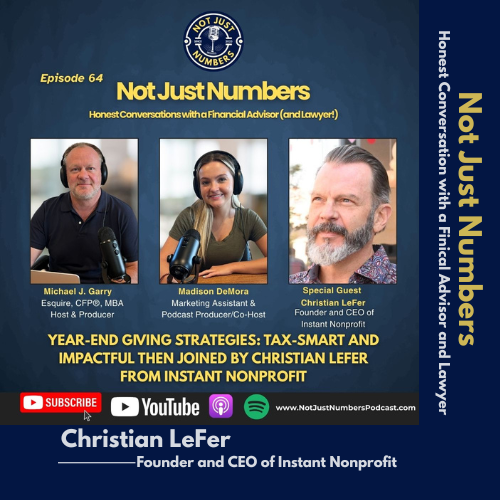
Episode 64: Year-End Giving Strategies: Tax-Smart and Impactful

Hosts: Madison Demora and Mike Garry
Special Guest: Christian LeFer, founder and CEO of Instant Nonprofit

Episode Overview

As the year draws to a close, charitable giving surges — and with thoughtful planning, those gifts can become even more meaningful. In this episode of Not Just Numbers, Mike and Madison explore how to make your generosity truly count, both for the causes you care about and for your long-term financial plan. They discuss why December is such a powerful month for charitable contributions, the emotional and cultural forces behind year-end generosity, and how new tax laws taking effect in 2026 may influence how donors approach giving in the years ahead. Whether you’re giving modestly or making substantial contributions, this episode offers guidance on how to plan ahead, avoid year-end pitfalls, and ensure your generosity supports both the missions you love and your financial wellbeing.
Then, Mike and Maddie sit down with Christian LeFer, founder and CEO of Instant Nonprofit, who has helped more than 5,000 people launch IRS-approved 501(c)(3) organizations. Christian shares how growing up in a nonprofit-driven family shaped his belief in “wealth with purpose,” and how his own frustrating experience trying to start a nonprofit led him to build a streamlined, done-for-you system that removes the bureaucracy and lets people focus on impact. Christian explains why a 501(c)(3) can be a powerful tool for tax strategy, legacy planning, and aligning wealth with personal values, often accessible to everyday families, not just the ultra-wealthy. He also breaks down how to know whether forming your own foundation or nonprofit is the right choice and why imperfect action is the key to creating meaningful change. If you’ve ever wondered how to turn a personal mission into a real vehicle for impact or build a legacy that lasts, this conversation offers clear guidance and inspiration. Christian also shares a free starter kit for listeners at instantnonprofit.com/podcast.

Listen to Our Podcast On:

TIMESTAMPS

00:08 – 01:38 – Intro

01:39 – 02:51 – Why Year-End Giving Matters

02:52 – 03:56 – America’s Culture of Giving

03:57 – 04:48 – Choosing Where and How to Give

04:49 – 06:05 – The Tax Landscape for Charitable Giving

06:06 – 10:04 – Giving Strategies That Multiply Impact

10:05 – 11:25 – Aligning Generosity with Financial Goals & Closing Thoughts

11:33 – 51:27 – Interview with Christian LeFer from Instant Nonprofit 

Follow Us on Social Media

Stay updated with the latest episodes and news by following us on social media:

Connect with Christian
Website

Facebook

LinkedIn

Episode Glossary

Qualified Charitable Distributions (QCDs): A tax-efficient way for people age 70½ or older to donate directly from their IRA to a qualified charity. The amount donated can count toward their Required Minimum Distribution (RMD) but is not included in taxable income, which may help lower Medicare premiums and reduce taxes on Social Security benefits.

Donor-Advised Funds (DAFs): A charitable giving account where you can donate money or appreciated assets now, receive the tax deduction immediately, and then decide over time which charities to support. 

Charitable Remainder Trust (CRT): A trust that provides income to you (or someone you choose) for life or a set term and then sends the remaining assets to charity. 


Key Takeaways

  • December captures 31% of all annual giving — the last week alone is nearly half
  • 2024 U.S. charitable total hit $590B+; $18 trillion expected to charity by 2048
  • 2026 tax changes: non-itemizers get $1k/$2k above-the-line; itemizers only deduct gifts >0.5% AGI and capped at 35% of value — give big before 2026
  • QCDs (70½+): up to $108k/person straight from IRA → counts as RMD, zero taxable income
  • Donating appreciated securities avoids capital gains + full fair-market-value deduction
  • Donor-Advised Funds + bundling = take deduction now, grant later (perfect for bunching 2–5 years of gifts)
  • Charitable trusts create income streams + slash estate taxes
  • Instant Nonprofit launches a 501(c)(3) in weeks for $1–2k (vs. 12–18 months and $10k+ with attorneys)
  • Family foundations are now realistic for non-billionaires — deductible gifts + the entity pays zero tax on growth
  • Two huge built-in perks: donations are deductible and the nonprofit itself is tax-exempt forever
  • Biggest lesson from 5,000+ nonprofits: execute imperfectly — start messy and refine later
  • Free starter kit & strategy call: instantnonprofit.com/podcast

Transcript

Episode 64 – Year-End Giving Strategies: Tax-Smart and Impactful

Episode Introduction & Year-End Giving Overview

Madison: Hello, everyone, and welcome to Not Just Numbers, Honest Conversations with a Financial Advisor and Lawyer. I am Madison Demora, and I’m here with Mike Garry. Mike is a financial advisor and a CFP practitioner and the founder and the CEO of Yardley Wealth Management. He is also an estate planning lawyer and his law firm is Yardley Estate Planning. Hey, Mike.

Mike: Hey, Maddie. How are you?

Madison: I’m good. I’m good. How are you doing today?

Mike: Good, Good. We have a green sweater day going on in the office.

Madison: Yep. Yep. Go birds. Right?

Mike: Go birds.

Madison: Go birds. All right. So, as the year winds down a lot of us start reflecting on what we’re grateful for. And that often inspires us to give back. Today we’re talking about how to make your generosity go even further for the organizations you care about and for your own financial plan.

Mike: That’s right, Madison. Charitable giving is first and foremost about generosity, about supporting causes that matter and creating positive change. With a little planning, you can make your dollar stretch further, supporting more good work while also being thoughtful about taxes and long-term goals.

Madison: Exactly. So today we’ll talk about why Queen December is such a powerful time to give and how new tax laws might shape charitable strategies and some of the ways you can structure your gifts, whether that’s through an IRA, donor advised fund, or charitable trust to make them as impactful as possible.

Why So Much Giving Happens in December

Mike: I think it’s a mix of emotion, tradition, and timing. December has become synonymous with giving, from Giving Tuesday to end-of-year appeals. It’s time when people feel grateful and reflective. In 2024, Giving Tuesday alone raised over $3.6 billion, up 16% from the year before. And people generally want to make a difference while they’re celebrating the year’s accomplishments.

2024 Charitable Giving Statistics & Wealth Transfer

Madison: Charitable giving is woven into the fabric of American life. In 2024, Americans donated over 590 billion, a 6.3% increase from the previous year.

Mike: Maddie, I think it shows how deeply generosity is woven into our culture. Individuals make up about two-thirds of all charitable contributions, and that generosity spans generations. Younger donors often focus on measurable outcomes, while older generations tend to think about legacy and continuity.

Madison: And we’re also seeing massive wealth transfers on the horizon, right?

Mike: That’s right. Cerulli Associates projects about $124 trillion, that’s trillion with a T, will transfer through 2048. And roughly 18 trillion of that is expected to go to charity.

How to Choose Where to Give

Mike: Start with your values. Identify the causes that reflect what matters most to you, whether that’s education, the environment, health care, the arts. Then research the organizations doing the best work in that space. Sites like Charity Navigator, Guidestar, and the BBB Wise Giving Alliance are great tools for assessing transparency, effectiveness, and financial health.

Upcoming 2026 Tax Law Changes (One Big Beautiful Bill Act)

Mike: So, the rules are designed to encourage broad participation while keeping the system balanced. Non-itemizers will be able to deduct up to $1,000 for individuals or $2,000 for married couples filing jointly. For those who do itemize, though, deductions will only apply to the portion of contributions that exceed a half percent of adjusted gross income. And for top earners, the deduction will be capped at 35 percent of the gift’s value, even if the marginal rate is higher.

Qualified Charitable Distributions (QCDs)

Mike: Qualified Charitable Distributions, for anyone age 70 and a half or older, a QCD lets you donate up to $108,000 per year directly from your IRA to charity, $216,000 per couple. It counts towards your Required Minimum Distribution but doesn’t increase your taxable income. That can really help reduce Medicare premiums and limit how much of your Social Security is taxed.

Donating Appreciated Securities

Mike: If you’ve held investments that have gone up in value, donating those instead of cash lets you avoid capital gains tax and still deduct a fair market value if you itemize.

Donor-Advised Funds (DAFs)

Mike: Donor Advised Funds allow you to make large contributions in one year, take the deduction immediately, and then distribute grants to charities over time. It’s great for people who want to be strategic but aren’t ready to pick specific organizations yet.

Charitable Remainder & Lead Trusts

Mike: A Charitable Remainder Trust provides income for life for a set term to an individual with the remainder going to charity. A Charitable Lead Trust does the reverse, it pays income to a charity for a certain number of years and then transfer the remaining assets to your heirs.

Bundling / Bunching Deductions

Mike: Bundling, or bunching, charitable deductions allows you to give two or more years worth of deductions in one year, helping you exceed the standard deduction threshold.

Main Segment Closing Thoughts

Madison: Generosity is one of the most meaningful expressions of gratitude, and when it’s paired with thoughtful planning, it can become one of the most powerful tools in your financial life.

Mike: Absolutely. By giving strategically, whether through QCDs, Appreciated Securities, DAFs or Trust, you can amplify the impact of your gifts while keeping your own financial house in order.

Guest Introduction – Christian LeFer (Instant Nonprofit)

Madison: Today we’re joined by Christian LeFer, founder and CEO of Instant Nonprofit, the highest rated service for launching IRS approved 501(c)(3) organizations. Christian and his team have helped start over 5,000 nonprofits, empowering founders, families and mission driven leaders to turn purpose into real world impact. All while maximizing tax efficiency and legacy potential. Drawing from his personal experience growing up in a nonprofit household and decades of work in fundraising and social enterprise, Christian brings a deeply strategic perspective on what he calls “wealth with purpose.” He believes nonprofit formation can be one of the most powerful tools for tax strategy, philanthropy, and creating family legacy that lasts for generations. Christian, welcome to the show.

Christian: Thanks so much. I’m excited to be here.

Christian’s Personal Story & Origin of Instant Nonprofit

Christian: Well, when I was about 8 years old, I was outside playing with my friends in the backyard in northern New Jersey, where of course now there’s a mall. And they paved over those woods. But I got called into the house. My mom had taken my little sister to the doctor. And while she appeared physically normal, there were no abnormalities or any indications—she wasn’t developing verbally at almost four years old. And so, she got her checked out and turns out my sister is developmentally disabled. You know, grew up around Special Olympics because of that, where she quickly became a track star. And she was famous for getting second place because she’s so good at relating to people, she would round the corner to get to the finish line and easily be winning. But then she’d run over and high five all her fans in the stands and they’d have to yell for her to get back on the track. So, I have a lot of second place podium pictures of my sister but just shows you the kind of human she is. And so, I grew up around people who want to make the world better or help people get to where they want to go and live a full life regardless of their disabilities or whatever. And I just thought that’s how things worked in the world. And I still do believe that. And fast forward, you know, we all have our sort of origin story, what makes us who we are. And then we later discover how we express that. And usually completely by accident. I went to start a nonprofit around 2009, 2010, and I just became morally outraged at how difficult it was. [continues exactly as original…]

Christian: …And lo and behold, I got a 38 or 42, one of the two, 38-day approval in the face of what would normally be a year. And that was astounding. I was just blown away. And it was because I had carefully placed everything that person could want, table of contents, etc. And now 5,000 later, you know, I went from blogger to businessman. And you know, it’s been wonderful to wake up and help people do this every day.

Why Starting a 501(c)(3) Is Normally So Difficult

Christian: …There are extra provisions and documents that you have to include besides that, like a conflict-of-interest policy. And there are just some special provisions that when Congress created 501(c)(3) or the 501 category in general, there are a few different types. They made it with two distinct advantages. … One is tax deductibility for donations. … And then the other thing is the entity itself isn’t taxed.

501(c)(3) as a “Tool of Titans” – Tax & Wealth Strategy

Christian: Yes. So, we all are— and it’s becoming more and more mainstream, right, for people to hear about how to use a trust, for example, to mitigate tax impact when you pass along your estate. … And a nonprofit can be controlled by a board that you can appoint, right? You can choose this board, and you can have that live on.

Family Foundations & Multi-Generational Legacy

Christian: Well, there are really three ways that I consider that this can be part of a wealth strategy. … Another thing that people can do is, you know, donating to charity, right, can keep things from being taxed at the estate level, which is, you know, 50% estate tax.

When to Start Your Own 501(c)(3) vs. Using DAFs

Christian: Yeah, I mean that’s much of that decision is very personal obviously … First of all, figuring out what it is brings us joy … Another decision point would be whether somebody else is doing exactly what you would think would be a service to the world in the way that you want to do it.

Biggest Lesson: Execute Imperfectly

Christian: I would say the biggest lesson that I’ve learned … is to learn to be comfortable executing imperfectly.

How to Connect with Instant Nonprofit & Free Starter Kit

Christian: Absolutely. They can go to www.instantnonprofit.com/podcast and there they can get a free boot camp, I’m sorry, it’s not a boot camp. That sounds like work. Right? A free starter kit. … And that is all at instanonprofit.com/podcast.

Final Closing & Contact Info

Madison: For more information on Yardley Wealth Management or Yardley Estate Planning, you can visit our websites at yardleywealth.net and yardleyestate.net. You can also follow us on socials at Yardley Wealth Management. Don’t forget to subscribe to our YouTube channel. This podcast has been produced by Madison Demora and Mike Garry with technical and artistic help from Poe Productions.

Request the Full Transcript as a PDF

The full transcript of this episode is available via email. Please fill out the form below to receive it: