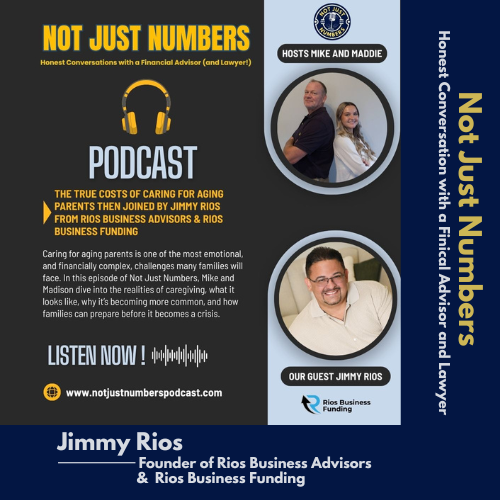
Episode 63: Caring for Aging Parents: The Real Costs | Featuring Jimmy Rios from Rios Business Advisors

Hosts: Madison Demora and Mike Garry
Special Guest: Jimmy Rios, Founder of Rios Business Advisors and Rios Business Funding

Episode Overview

Caring for aging parents is one of the most emotional, and financially complex, challenges many families will face. In this episode of Not Just Numbers, Mike and Madison dive into the realities of caregiving, what it looks like, why it’s becoming more common, and how families can prepare before it becomes a crisis. They discuss the growing prevalence of caregiving in America, the emotional and physical toll it can take, and the significant financial strain that often follows. From burnout and guilt to long-term care costs and Medicare misconceptions, Mike and Madison explore both the human and financial sides of this responsibility. Whether you’re already providing care or preparing for the future, this episode offers compassionate guidance and actionable steps to help you protect both your parents’ wellbeing and your own financial security.
Later in the episode, Mike and Madison sit down with Jimmy Rios, founder of Rios Business Advisors and Rios Business Funding. With more than 20 years of experience in financial services, Jimmy has dedicated his career to helping entrepreneurs understand and take control of their business finances. From practical steps for managing debt and improving credit to real-world examples of clients transforming their businesses, this episode offers valuable insights for anyone looking to grow, fund, or eventually sell their business the right way.

Listen to Our Podcast On:

TIMESTAMPS

00:08 – 01:25 -Introduction to episode topic: The True Costs of Caring for Aging Parents

01:26 – 02:34 -The Scope of the Challenge

02:35 – 03:28 -Who Are the Caregivers?

03:29 – 04:39 -Emotional & Physical Impact

04:40 – 05:38 -The Financial Realities

05:39 – 06:26 -Navigating Family Dynamics

06:27 – 07:13 -Planning Ahead & Professional Support

07:14 – 09:11 -Closing on: The True Costs of Caring for Aging Parents

09:18 – 38:48 – Interview with Jimmy Rios

Follow Us on Social Media

Stay updated with the latest episodes and news by following us on social media:

Connect with Jimmy Rios
Rios Business Funding website

Funding LinkedIn

Facebook

Episode Glossary

Stress Testing: A technique used to assess the stability of financial institutions and investment portfolios against possible future financial situations.

Key Takeaways

Caring for Aging Parents

  • 63 million U.S. caregivers (1 in 4 Americans) — up 45% in a decade
  • Most give 20–40+ hrs/week; 30% do it 5+ years
  • 61% are women, avg. age 51 — many in the “sandwich generation”
  • Huge emotional/physical toll + financial hit: ⅓ stop saving, 23% go into debt
  • 24/7 in-home care ≈ $290k/year; Medicare does NOT cover long-term care
  • One sibling usually does ~90% of the work → conflict common
  • Start conversations + update legal docs NOW (wills, POAs, beneficiaries)

Jimmy Rios Highlights

  • Don’t just give a loan — understand the full story first
  • Non-recourse funding = income that never has to be personally repaid
  • Biggest exit mistake: writing off all profit → kills business sale value
  • First step when debt feels out of control: list every single expense & debt on paper
  • Pro move: put cars under the business, hire your teens, take Section 179 deductions

Transcript

Not Just Numbers – Honest Conversations with a Financial Advisor and Lawyer

Episode Introduction – Caring for Aging Parents

Madison: Hello everyone, and welcome to Not Just Numbers, Honest Conversations with a Financial Advisor and Lawyer. I am Madison Demora and I’m here with Mike Garry. Mike is a financial advisor and a CFP practitioner and the founder and the CEO of Yardley Wealth Management. He is also an estate planning lawyer and his law firm is Yardley Estate Planning. Hey, Mike.

Mike: Hey, Maddie. How are you today?

Madison: I’m good. I’m good. How are you?

Mike: I’m good.

Madison: Today we’re diving into a topic that is both emotional and financial: Caring for aging parents. It’s something many of our clients are dealing with and increasingly something we’re seeing younger generations prepare for earlier.

Mike: That’s right, Maddie. You know, it’s a conversation that often comes up as families gather around the holidays. You know, when adult children start to notice changes in their parents’ health or abilities, it can be overwhelming to think about, let alone plan for. But having these conversations early can make all the difference.

Madison: Today we’ll talk about the growing prevalence of caregiving and what that looks like for families. The emotional, physical and financial toll it can take, and strategies to plan ahead, navigate family dynamics and protect your own financial future.

The Growing Prevalence of Caregiving

Madison: Let’s start with how common this is. There are now 63 million caregivers in the U.S. which is a 45% increase over the last decade. That means almost one in four Americans is providing care for someone else.

Mike: That’s so many. And I don’t know if you know a lot of them, but I’m starting to know more and more. And most of them aren’t doing this casually. You know, many live with the person they care for or within 20 minutes of them. Like, people move to get closer. The closer you are geographically, the more hours of care you’re likely providing. Sometimes 20, 30, even 40 or more hours per week.

Madison: Exactly. And almost 30% of caregivers have been providing care for five years or more. This isn’t a short-term commitment for most people. It’s something that can last a significant portion of your working years or retirement.

Mike: Yeah, sometimes, people call this the silent second job. Clients often don’t factor in how much time caregiving will require, so they’re already in it. And once you’re in the middle of it and trying to juggle work, kids, and their own health, it’s hard. It’s really hard.

Madison: The average caregiver is 51 years old and about 61% are women. Many are part of what’s called the sandwich generation, which they’re caring for both children and aging parents simultaneously.

Mike: And we’re seeing that especially among younger caregivers, like nearly half of those under 50 are looking after both an older adult and a child under 18. That’s a tremendous amount of pressure, emotional, physical, and often financial.

Madison: We should also note that caregiving doesn’t just mean running errands or check-in once in a while. Two thirds of caregivers help with at least one activity of daily living, things like bathing, dressing and feeding.

Mike: And more than half are doing medical or nursing tasks like administering injections, managing medications, or monitoring vital signs, often with little to no formal training.

Emotional & Physical Toll

Madison: All right, so let’s shift to the human side. Caregiving is rewarding, but it can also be exhausting. Two thirds of caregivers report moderate or high emotional stress, and nearly half experience physical strain.

Mike: Yeah, we see the toll it can take burnout, insomnia, anxiety, and even worsening health for the caregiver. And there’s often guilt, either from feeling like you’re not doing enough, or from neglecting your own family or career while you focus on your parents. This is why we encourage caregivers to think about support systems early. You know, support networks like friends, family, online caregiver groups, respite care, which means hiring help or arranging coverage to take breaks. And self-care. That self-care is something that we talk about a little bit more recently. And I’m glad, because people need it. You know, self-care could include things like exercise, tending to your hobbies, and even scheduling in your downtime. These aren’t luxuries, they’re necessities to stay healthy enough to continue providing care.

Madison: And it’s important to acknowledge that caregivers often need permission, sometimes from themselves, to accept help. Trying to do everything alone is rarely sustainable.

Financial Impact of Caregiving

Madison: Now let’s talk about the financial side, because this can be one of the most surprising and stressful parts.

Mike: One-third of caregivers have stopped savings to cover expenses, and 23% report going into debt. Some have tapped retirement accounts or college savings just to keep up.

Madison: And the cost of professional care keeps rising. A home health aide now costs about $33 per hour on average, nearly $290,000 a year for 24/7 care. That’s more than twice the annual cost of a nursing home room.

Mike: And unfortunately, Medicare doesn’t cover long term custodial care, just skilled nursing for up to 100 days after a hospital stay. Families are often shocked to learn they’ll need to self-fund most care. That’s why we stress planning ahead, looking at long term care insurance options, setting aside funds and exploring what resources might be available through community or employer programs.

Family Dynamics & Sibling Issues

Madison: One of the hardest parts can be managing siblings and other family members.

Mike: Yeah, it’s pretty common for conflict to arise over care decisions whether parents should move, who’s paying for what or who’s doing enough. You know, it seems like one caregiver in a family typically does like 90% of the work, at least from what we’ve seen. You know, we often suggest creating an open dialogue where everyone gets a chance to voice concerns, setting ground rules to keep focus on the parents’ best interests, clearly dividing responsibilities. Even if someone can’t provide hands-on care, they may be able to contribute financially or help coordinate appointments. Seeking mediation if needed. Sometimes having a neutral third party can help discussions be productive.

Planning Ahead & Closing Thoughts

Madison: So, what can families do before caregiving becomes urgent?

Mike: Start with conversations. As holidays come up, it’s a perfect time. Talk with parents about their wishes, including where they want to live, what type of care they prefer, and how they like their finances handled. Then get organized. Update legal documents like wills, powers of attorney and advance directives. Make sure accounts are titled correctly, beneficiaries are up to date, and someone knows where everything is.

Madison: And build caregiving into your financial plan. We can help model potential care costs and stress test your retirement plan to see how supporting parents might affect your long-term goals.

Mike: There are great tools out there, including cost of care calculators and senior living comparisons that we can walk through together so you know what to expect.

Madison: Caregiving is one of the most personal and challenging responsibilities many of us will face, but with preparation, you could approach it with clarity rather than crisis.

Mike: If you’re already a caregiver or expect to be one in the future, let’s start the conversation now. Together we can explore options, create a plan, and give you confidence that both your parents’ needs and your own financial future are supported.

Madison: Caring for aging parents can feel like stepping into uncharted territory emotionally, financially and even logistically. But the good news is you don’t have to navigate it alone.

Mike: Exactly. We’ve talked today about the scope of caregiving, the emotional and physical toll it can take, and the financial planning considerations that can make a big difference. Most important takeaway is that early open conversations and thoughtful planning can ease the burden for everyone involved.

Madison: If you’re already providing care, remember that support is out there, whether that’s respite care, caregiver support groups or financial guidance. And if you’re not there yet but see this responsibility on the horizon, now is the time to get prepared.

Mike: This is where we can help. We work with families to map out the potential cost of care, and stress test financial plans, review and update key legal and financial documents, and coordinate with your other professionals, like estate attorneys and CPAs to make sure everything is aligned.

Madison: Our goal is to give you clarity and confidence so you can focus on your parents and your family without sacrificing your own financial security.

Mike: If this conversation resonated with you, we’d love to connect one on one. We can walk through your specific situation, run what if scenarios, and help you put a plan in place before a crisis forces your hand.

Madison: Thank you for spending the time with us today. Caring for your parents can be one of the most meaningful and challenging chapters of your life. With the right planning and support, you can face it with less stress and more peace of mind.

Guest Introduction – Jimmy Rios

Madison: Today on Not Just Numbers, we’re joined by Jimmy Rios, founder of Rio’s Business Advisors and Rios Business funding. With over 20 years of experience, Jimmy has helped countless entrepreneurs navigate business financing, debt structuring, and exit planning. His approach centers on transparency, education, and personalized support, giving business owners the tools to take control of their financial future. Jimmy, welcome to the show.

Jimmy: Thank you so much. Glad to be here.

Madison: Awesome. Alright, Jimmy, you’ve been in the financial services industry for over 20 years. Can you share a bit about your journey? What inspired you to start Rio’s Business Advisors and Rio’s Business Funding?

Jimmy Rios’ Journey & Background

Jimmy: So, you know, my story is peculiar in the sense that I, as a kid, you know, you never really know what you want to do. Some people do, but I kind of stumbled upon it because my parents were first generation Colombian American immigrants. And they spoke the language, but they never felt comfortable, I guess, you know, in their delivery or, you know, their understanding. So as a kid, I remember more in my teens where it was always like, hey, Jimmy, can you help us with this? Can you call this place? Can you do this? And I was always like the middleman, right? And as I got older, they started putting me into more things. My dad was an entrepreneur. My mother was a teacher, but just really smart woman and always the finance person of the family. And it always seemed like I was in the middle of helping them with their mortgage or insurance or taxes. You know, something always came. As I got older, later in my 20s, now I’m going to ASU. I’m going, you know, trying to get my degree. I’m still not really knowing what I’m going to do. And I stumbled upon a job offering for a branch manager trainee for a finance company. And I thought, hey, that’d be cool, you know, maybe I could, you know, become a branch manager. Who knows, right? And I went in and I started working with about, I don’t know, 80%, 90% of my clients were the Hispanic, Latino, Spanish speaking clients. And all of a sudden, I was thrust into that role of what my parents, what I was doing for my parents. Where now is having to help them, maneuver a lot of the things and understand, you know, the contracts and, you know, what APR is and all these nuances in finances and actually led me to change my major to Spanish so I could get fine tuned in, in the Spanish side of it. But ultimately, I saw that there was a lot of things I couldn’t control in corporate America that I couldn’t do, that I wanted to do, but I couldn’t. So that kind of led me into forming the Rios Financial Group, to be able to help these individuals in more ways than one. And ultimately it led to the advisory firm and everything that we’re doing now.

Mike: Oh, it’s so interesting. And, you know, I guess in some ways it probably felt so, like, normal and natural for you, like helping people, like, navigate, you know, kind of a newer, you know, area. Right. And a lot of people aren’t familiar with a lot of the financial and legal things. And then you throw in, you know, not being a native English speaker. Must be hard.

Jimmy: I think, you know, you look at it from that perspective, right? And I always, I would ask my parents how it was, you know, when, you know, because they didn’t have my brother and I for 10 years after they came to the United States. And I asked them how difficult was it maneuvering that side of it, and they said it was really difficult. My dad for the first couple years he said it felt like all he could order was OJ and eggs because that’s like the only English he knew. But I mean, one thing I learned was in survival, there’s a lot that goes with just, you know, finding answers. Right? You’re never going to give up. You got to keep, you trudge along, and you keep finding ways to make it happen. And that was a very big part of what helped me. And seeing my parents overcome those struggles and really elevate themselves, right, to become financially literate, to be able to retire at an early age, to do the things that they did with travel and, enjoying life. Those were some of the attributes that I took at an early age I said I wanted. And if I have the tools that they didn’t and they could do it, why can’t I?

Mike: Right, right.

Jimmy: And it ultimately led me to start thinking outside the box because I said, well, what if I could help others achieve that in finding the ways to become more of a bridge in learning as opposed to just being transactional. Everything was always a transaction, like, alright, here’s your loan, here’s your insurance policy, or here’s your mortgage. But never a relational side of helping someone. Right. Like when you help your brother or a friend, you don’t expect anything really in return. It comes from reciprocity. And I felt that was missing in my repertoire of everything that I was doing. I was making money, I was young, I was making things happen, but I was missing something. And it came later in my trajectory and losing and, you know, learning from my mistakes that the missing link was that part was just giving it back and sharing and learning how to educate others so they can partake of it. And that’s when things opened up for me.

Mike: Oh, wow. Wow. That is really cool. Thanks for sharing that.

Jimmy: Yeah, definitely.

Initial Consultation to Success – The Rios Process

Madison: Alright. Can you walk us through your process from the initial consultation to celebrating success? What makes your approach unique compared to other advisory and funding firms?

Jimmy: Yeah, so one thing I realized before it became an advisory firm, was that in trying to solve for somebody’s problem, we were so quick to the punch in just giving them one piece of the puzzle. Right. We never really took the time to understand the whole picture of the puzzle. We just gave them one piece of it and pretended that that was the whole picture. And I figured that wasn’t the best way. And so, what I do that’s a little different is going back to finding, from our clients, what the big picture is. Right. What’s the real story behind what your problem is? Your problem today might be that you need $50,000, but is that really the problem? Is that really going to solve for everything or are you just getting a band aid for something that’s bigger? Because what I found in my trajectory was that I would lend people $50,000 and they’d come back two, three, four, five months later saying, I need more money. I was like, wait, what happened to the $50,000 I gave you a few months ago? Well, a pandemic happened. Oh, so you didn’t have a contingency plan? No. And so I started seeing that we needed to account for more than just the immediate solution. And that was a fiduciary that it took upon me to know more. I always heard it right, in finances and mortgages and, you know, get the full picture. But what really was that, because as a salesman, you’re going for the low hanging fruit, right? You want to get your commission, you know, and you lose sight of getting the full picture. And when you’re an owner of a business, it behooves you to get the full picture because you can offer way more solutions. The client feels more engaged that you help them, and they’re going to be more apt to tell others based on all the solutions that you provided because you weren’t thinking of just one thing. So, I just took a step back in my in my providing solutions. And, what I do is I really lay it down and I have them tell me their story, right. I want to find out what’s really going on. Because if I find out that you have problems at home, right? Even though I’m not a psychologist, but there’s things that are affecting the overall delivery of your business for whatever it is, then we got to address some of those things. And I found that through the credit building process, right? Because people are very shy about wanting to open up and the kimono and look under the hood and be like, hey, this is what’s happening in my life. Right. But the more true to themselves that they were, the better I was able to provide solutions because I started seeing that, you know, if we could start helping people budget better and start taking care of the holes that they have in their home, all of a sudden, they were producing better. They were able to get organized in their business. So, it started becoming a very close parallel, almost a mirror effect, of sorts. And that helped a lot as well because now they didn’t see some of the holes that were in their budget. They didn’t see where their money was going. And when we started opening their eyes to that, it was like night and day. And now they were more open to my suggestions. Now they were more engaged. Yeah. I wrote a book called Decoding the Mystery of Business Credit and it’s on Amazon. And you’d be amazed. People buy the book. How many people buy the book and they don’t open it, they don’t read it, it’s just sitting there? Right. And I find out because I asked them, “Did you read the book?” and they’re like, no. I said, what are you doing with it? Well, I’m going to read it. Right. Well, we find that a lot of people are like that and until you can actually get them doing certain things to go into action, they’ll just leave the book sitting there. And so, my book is good only as long as you read it and you put it.

Contact Information & Closing

Madison: If our listeners want to learn more about you and your strategies or connect with you, what’s the best way for them to reach out?

Jimmy: I think the best way is social media. On YouTube, we have a channel called Rios Business Funding. And you go on the channel and you can see all our videos. We have very good little instructional videos, our podcast, and a lot of the different things we do. And on there you can ask questions and you can inquire and we’re always checking that out. You know, Obviously our website, Riosbusinessfunding.com and riosbusinessadvisors.com, any one of those are really good. But yeah, social media right now has become kind of the go to with everything and, and we’re in all the channels.

Mike: Excellent.

Madison: Thank you so much for your time today, Jimmy.

Mike: All right, thanks so much.

Jimmy: Thanks so much, Michael. I appreciate it.

Mike: Have a good one.

Madison: For more information on Yardley Wealth Management or Yardley Estate Planning, you can visit our websites at yardleywealth.net and yardleyestate.net. You can also follow us on socials at Yardley Wealth Management. Don’t forget to subscribe to our YouTube channel. This podcast has been produced by Madison Demora and Mike Garry with technical and artistic help from Poe Productions.

Request the Full Transcript as a PDF

The full transcript of this episode is available via email. Please fill out the form below to receive it: