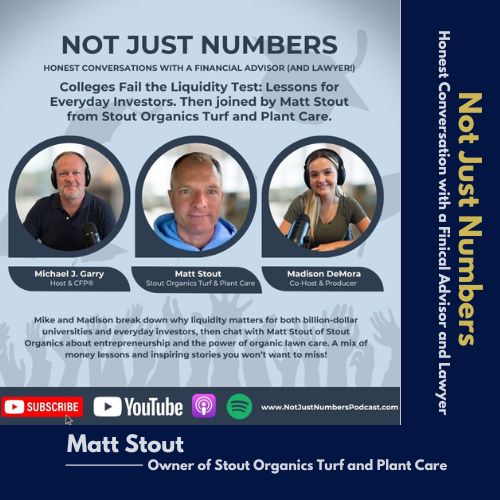
Episode 60: Colleges Fail the Liquidity Test: Lessons for Everyday Investors Then joined by Matt Stout from Stout Organics Turf and Plant Care

Hosts: Madison Demora and Mike Garry
Special Guest: Matt Stout from Stout Organics Turf and Plant Care

Episode Overview

 In this episode of Not Just Numbers: Honest Conversations with a Financial Advisor and Lawyer, Mike and Madison unpack Jason Zweig’s Wall Street Journal article, “Colleges Fail This Basic Test”. They explore how some of the nation’s wealthiest universities, with billions in endowments, still find themselves scrambling for cash during downturns. Mike explains why liquidity is essential, even for billion-dollar institutions, and how the same principle applies to individual investors. From the dangers of illiquid alternatives to the timeless importance of balance and discipline, this conversation highlights lessons that can help anyone build a more resilient financial future.
Later in the episode, Mike and Maddie sit down with Matt Stout, owner of Stout Organics Turf and Plant Care. Matt shares his journey from golf course superintendent to business owner, why organic applications often outperform traditional chemical-heavy methods, and how healthy soil leads to healthier lawns. Whether you’re curious about organic lawn care, entrepreneurship, or simply want to hear an inspiring story about following your passion, this episode has something for you.Click here for the link to WSJ article mentioned in the show

Listen to Our Podcast On:

TIMESTAMPS

00:08 – 01: 02 – Introduction and Background on episode topic

01:03 – 02:14 – Colleges Repeating Past Mistakes

02:15 – 04:02 – Alternative & Why Billion-Dollar Endowments Borrow Money

04:03 – 07:05 – Investor Amnesia & Examples from Yale and Harvard

07:06 – 08:54 – Lessons for Individual Investors & Closing Takeaways 

09:02 – 23:37 – Interview with Matt Stout from Stout Organics Turf and Plant Care

Follow Us on Social Media

Stay updated with the latest episodes and news by following us on social media:

Connect with Matt Stout

Matt’s Email

Phone number: 215-534-2765

Instagram 

Facebook 


Episode Glossary

Alternative Assets (alternatives): Investments outside traditional stocks and bonds, such as private equity, hedge funds, and venture capital.  

Endowment: A pool of invested funds held by an institution (like a university), often with donor-imposed limits on how the money can be used. 

Key Takeaways

  • Illiquid assets trap endowments: University endowments with heavy alternative investments (e.g., private equity, hedge funds) can’t sell quickly during crises, despite billions in value, leading to borrowing needs.
  • Balance over chase for returns: A 60/40 stock/bond portfolio provides growth and liquidity; endowments’ low cash (2%) and bonds (6%) ignore this, risking access to funds in downturns.
  • Restrictions limit flexibility: Even with massive endowments, restricted funds for specific purposes (e.g., scholarships) prevent broad use, forcing ironic borrowing for operations.
  • Human nature causes repeats: Investor amnesia and hubris lead to repeating 2008-09 mistakes, chasing exciting alternatives in good times while forgetting liquidity’s importance.
  • Alternatives suit only the wealthy: For individuals with $1-3 million, avoid illiquid assets; use ETFs/mutual funds for easy cash access during emergencies.
  • Liquidity is priceless: Keep healthy cash buffers and liquid investments to handle curveballs like job loss or market drops, unlike endowments selling at discounts.

Transcript

Podcast Transcript: Ep. 60 – Colleges Fail This Basic Test

Introduction

Madison: Hello everyone, and welcome to Not Just Numbers, Honest Conversations with a Financial Advisor and Lawyer. I am Madison Demora and I’m here with Mike Garry. Mike is a financial advisor and a CFP practitioner and the founder and the CEO of Yardley Wealth Management. He is also an estate planning lawyer and his law firm is Yardley Estate Planning. Today we’re diving into a recent article from the Wall Street Journal written by Jason Zweig, called “Colleges Fail This Basic Test”. It’s all about how some of the smartest institutions in the world, major colleges and universities, are making big mistakes with their money. And to help us unpack this, I’m joined, as always, by Mike Garry, financial advisor and estate planning lawyer. Mike, thanks for being here.

Mike: Maddie, It’s always great to be here podcasting with you.

Madison: Awesome. Thanks, Mike. Same here. So, Mike, the article points out that during the 08 and 09 financial crisis, a lot of big investors, including universities, got caught off guard because they had too much money in assets they couldn’t sell easily. And now it looks like they’ve repeated the same mistake. Can you explain what’s going on here?

Liquidity Crisis in 2008-09

Mike: Absolutely. What’s happening is that many university endowments have shifted into alternative assets. Things like private equity, hedge funds, venture capital, they aren’t publicly traded, so you can’t just sell them off quickly if you need cash. You know, like a lot of times those types of funds have restrictions on when you could take money out. So they’re not just like stocks or bonds or mutual funds or ETFs, where you could sell at any time as long as there’s a willing buyer. And for most of those, there’s always a willing buyer, even if it’s at a lower price. So you can’t just do that with these assets. The problem is when crises hit, cash is king. If you don’t have liquidity, meaning money that’s available right away, like by selling a stock or a bond, you end up scrambling, even if on paper, you look wealthy and you have a huge endowment.

Risky Endowment Asset Mix

Madison: The article highlights some shocking numbers. For example, many of these large endowments are holding only about 2% in cash and 6% in bonds and just 8% in U.S. stocks. The rest is tied up in alternatives. Why is that such a risky mix?

Mike: Well, it’s risky, number one, because it ignores balance. You know, for decades, investors looked at a 60% stock and 40% bond portfolio as a benchmark. And you know, that balance gives you growth, but also safety and liquidity. And you know, there are times when, when it makes a lot of sense to move away from that allocation. Maybe you want to be a little bit more or less aggressive, but when you blow totally away from that and load up on illiquid investments, you lose the ability to adjust quickly in a downturn. It doesn’t matter if you’ve got billions in assets if you can’t access them, it’s like being rich on paper but broke in real life.

Borrowing Despite Billions in Endowments

Madison: And we’ve seen the consequences. The article mentioned universities like Brown, Northwestern and Harvard borrowing hundreds of millions even though their endowments are worth billions. How does that happen?

Mike: Sure, it happens because they can’t access those billions because they’re all locked up in illiquid assets. And a lot of endowment money is also restricted. It can only be used for very specific purposes. You know, if you endow some chair of a university or some scholarship or research fund, you know, while that’s part of your overall endowment in the billions that they have, they can’t be used for anything else. So even if the university has those billions, they can’t just spend it however they want. And if cash is short, they have to borrow to meet operating expenses, which is really ironic given their massive endowments.

Investor Amnesia and Déjà Vu

Madison: Zweig makes a really important point that this is déjà vu. Universities had this same problem in 08 and 09, and yet we’re here again. Why don’t investors, whether institutions or individuals, learn more from the past mistakes?

Mike: Honestly, it comes down to human nature, you know, in good times, we stop worrying about liquidity and risk. Everyone’s chasing higher returns and alternatives look exciting, you know, and I think some of it’s, a little bit hubris. You know, they don’t want to go talk to their, oh, you’re a manager of some giant, endowment, what are you guys buying? They don’t want to say, oh, we have a well globally diversified 60/40 portfolio. They want to say, well, we have these alternatives, and they look exciting, But when bad times happen, which they do from time to time, suddenly cash is the only thing that matters. And the problem is memory is short. People forget how bad the last crisis was and double down on the same strategies. Zweig put it very well, as he always does. He’s one of my favorite writers there. Investor amnesia is deadly.

Yale & Harvard Selling at Discounts

Madison: One example in the article was Yale, which has been trying to sell billions in private equity funds but can’t get full value. Harvard had to sell 1 billion of private equity at 7% discount. What does that tell us about alternatives as a whole?

Mike: Well, one of the things that’s interesting is that this whole issue is because Yale’s endowment did so well. This guy, I think it was David Swenson, managed their endowment for years and years and had phenomenal returns. And a lot of it was because the alternatives he invested in. But you know, that was back when not everybody was investing in alternatives. And maybe he was able to find some good things and maybe he was just lucky. Maybe he was just lucky. You know, alternatives can work, you know, but only if you could afford to leave the money there for a very long time. If you suddenly need cash, you’re at the mercy of the market. You know, I see this issue a lot for individual investors too. And you know, and this is where this might tie in for our audience, which is not made up of endowment chiefs. You know, people want alternatives because they seem like they have a cachet, they’re not for everybody, you have to have certain amount of wealth to have them. But the reality is unless you have millions of dollars that you don’t need ready access to, you really shouldn’t be in alternatives. If you have one or two or $3 million, you don’t have enough to have alternatives and have like a safe life. If you have $10 or $15 million, sure, you could put a small part of that, a couple million dollars in alternatives because you don’t need the rest for your lifestyle. But barring that, like, you know, if you suddenly need cash, you’re at the mercy of the market. And in a downturn, buyers will only take those assets at a discount. So, you lock in losses just to get liquidity. It’s a classic case really of knowing your risk tolerance and time horizon.

Lessons for Individual Investors

Madison: All right, well I know you, just brought up individual investors, so let’s bring it back to them. Most of us don’t have multi-billion dollar endowments. What lessons should everyday people take from this?

Mike: Yeah, liquidity is priceless. It’s really simple. Don’t put money into investments you can’t touch unless you’re absolutely sure you won’t need it for years. It’s okay to own some alternatives or less liquid investments, but they should never dominate your portfolio. And like, you know, we have portfolios and people are taking money from their investments on a regular basis. But we have exchange traded funds and mutual funds that are easy to turn into cash, that you get cash the next day at the market price. It’s not the price that someone is like deciding somewhere else. It’s like the competitive market to get those funds. So always keep the healthy cash buffer and liquid assets because when life throws you a curveball, whether it’s a job loss, medical emergency, or market downturn, you’ll be glad to have easy access to money.

Zweig’s “Don’t Be a Monkey” Quote

Madison: Zweig ends the article with a pretty blunt line, “Don’t be a monkey, don’t put a penny into alternatives that you can’t afford to have locked up when you suddenly need cash”, do you agree?

Mike: I do. It’s a little harsh, but it drives the point home. Too many investors think they’re being sophisticated or rich chasing like these exotic strategies, when really the basics, balance, liquidity and discipline are what keep you financially secure.

Madison: That’s a great note to end on, liquidity, may not sound exciting, but as we’ve seen, even the smartest money can get into trouble without it. Mike, thank you for breaking this down for us.

Mike: Maddie, it’s always my pleasure.

Guest Introduction: Matt Stout

Madison: Today we’re excited to welcome Matt Stout, the owner of Stout Organics Turf and Plant Care. After years of working in the golf course industry, Matt saw a real need for a different approach to lawn care. One that delivers lasting results without relying on harsh chemicals. The vision led him to create Stout Organics, a company built on sustainability, science, and soil first philosophy. Serving Bucks County and beyond, Matt brings a deep commitment to healthy lawns, thriving soil, and exceptional service. Matt, welcome to Not Just Numbers.

Matt: Thank you for having me.

Mike: Matt, it’s great to see you.

Matt: Yeah, you too.

Matt’s Golf Course Background

Madison: All right, Matt, can you share a bit about your background in the golf course industry and how that shaped your expertise in turf and plant care?

Matt: Sure. Well, I mean, my background is, you know, when I was in high school, as a part time job, I started working with a landscape company and kind of learning the outdoor workload. And that eventually led me into working at a golf course. I really enjoyed it thoroughly, so I actually ended up going to school for that and getting a degree, from SUNY Delhi in upstate New York. And, actually worked on a golf course for over 25 years, starting at the age of, I was probably only maybe 19, 20 years old.

Mike: Wow. Any golf courses around here? Are you from New York?

Matt: Yeah. So, I grew up in South Jersey. So, I worked at, you know, the number one ranked golf course in the world, as a matter of fact, Pine Valley Golf Club. I actually built one of Donald Trump’s golf courses in South Jersey, which used to be called Pine Hill, and it’s now called Trump Philly.

Mike: Okay.

Matt: Yeah, plenty of courses down in South Jersey. And what actually moved me up to this area, to Newtown, was my first head superintendent position, which is when you’re responsible for running the whole property was over in Hopewell, New Jersey.

Mike: Okay.

Matt: So local courses here were Hopewell and Lulu Country Club. So, I ended up working at, yeah, about six different properties.

Mike: Okay.

Matt: Yeah.

Mike: Pine Valley is a very cool one to have on your resume.

Matt: It is, it is. And it was a great experience. You know, for me I was fortunate because I lived 10 minutes from that area. So, it was really, really, really neat. Great experience. Still have wonderful connections and friends from those time periods. And that really helped shape, who I am today in doing what I do.

Mike: Okay. And, what made you decide to leave that to work..

Matt: For such a long time, I felt like there was a knack to get into starting my own business. You know, it’s something that I’ve always wanted to do. It’s something my grandparents used to talk to me about. You know, they just encouraged you to do this to grow, you know, more organically, if you will. No pun intended.

Mike: There you go.

Matt: And so I wanted to do something on my own. The golf course industry is a grind. It, you know, it’s a seven day a week type of job and I just needed to change. You know, I did it for a very, very, very long time and I just wanted to do something different. And that’s sort of what led me into this.

Mike: Yeah, I’d have to think golf course management would be a terrible grind, like really early times, all the time. And you know, it’s just, it’s so much you look at, you know, we play over at Yardley, and you know, there’s always work being done, there’s always crews somewhere. But in the morning, I drive past there on the way to pick up my daughter from the train and you see guys like on every hole because, you know, it’s not a lot of people playing yet at 8:30. And yeah.

Why Choose Organic Lawn Care

Madison: Why did you choose to focus on organic based lawn applications instead of traditional chemical heavy methods?

Matt: Well, you know, first and foremost is because it works better. And I think that’s the basis of it all, is to, you know, make sure you provide a quality product. So that was really the first thing. I have a lot of experience with it, in the golf course world. Meaning, you know, having these different certifications, the Audubon Society, so we went through a bunch of different tactics, but, you know, one of the main fertilizers that I used almost my entire career was organic. And it worked so well. I noticed that I was using less pesticides than my friends were using because it was balancing the soil, feeding the soil microbes, and really giving it a good earthy texture which allowed the turf plants to grow and thrive better. So I felt like, you know, in doing what we do for homeowners, you know, you have a lot of people that have kids, dogs, pets, you know, and they want something different than the competitors and they want to see something different. Not using so many chemicals, trying to use less. And people really, really, really like that. I mean, I think it’s a changing industry. I mean, and you have some companies that call themselves natural, if you will, but it’s, they’re not really doing it. So I’ve felt like that’s the main reason I did it, was to set myself apart and to do it, you know, which I feel is the right way.

Mike: Yeah. Like, well, so natural is one of those terms like they use for food too, that doesn’t have like a real defined meaning. And, it looks nice on a package, but it doesn’t necessarily mean anything.

Matt: Right.

Mike: And I’ll go out here and say, we’ve been working with Matt for a couple years now, and a big part is we have two dogs who are outside all the time. And yeah, we didn’t want them to be ingesting all sorts of chemicals as they’re nosing around our yard for hours every day. Yeah, I totally get that as a homeowner.

Matt: Yeah.

Mike: Now the kids, if they were still home, they could have been out there all the time.

Matt: But the dogs, that’s a whole different world. Yeah.

Seasonal Turf Care Plan

Madison: Could you walk us through what a seasonal turf plan looks like for a typical client?

Matt: So, a typical plan usually consists of between five and, let’s say, seven applications. And that will be weed prevention, pre-emergence to stop most weeds from germinating. That’s our goal. We also then will add an application or two of lime, depending upon what the soil tests are. I think that’s extremely important. In addition to that, when we do do any type of pesticide treatment, herbicide treatment for broadleaf weeds or grassy weeds, we always spot treat. Instead of just blanket spraying. Now these other companies really can’t do that because they’re sending guys out in the field that aren’t really agronomists. They’re more employees. Not to knock them, but that’s just how it is. For me, I do all the treatments myself. So therefore, when I’m doing these things, I know exactly what’s needed for that specific spray. I can change up on the fly. So that does definitely make a big difference. We also do two applications of organic slow-release fertilizer that feeds for at least 12 weeks. And actually, the more you use the products, the more it gets built up into the soil and will actually last all winter long. And come spring when the temperatures wake up or warm up, and the microbes, the soil microbes wake up that fertilizer will start working again. So that’s the main program. It’s usually five to seven. Some of my customers I have, I’m treating over 6, 7, 8, 9, 10 acres. So, they have these huge properties. Others, 5,000, you know, 10,000 square feet. So, they can be a little bit, treated a little bit differently.

Advice for Homeowners

Madison: What advice would you give homeowners who want a healthy lawn but don’t know where to start?

Matt: Well, first I would say call me. That’s one step where, you know, I can educate you. And again, I think that’s what sets me apart too, is I’m sort of like always being a consultant. I’m always answering my phone. I have my personal cell phone on my truck. You know, you can go online, and you can do some research, but it’s really difficult to do these things on your own. It really is. A lot of them are just marketing towards, you know, you purchasing the products. But be able to get down the right rates, the right timing. All these things are so important. So, for a homeowner to really start thinking about this, I would recommend them emailing me or calling me.

Mike: That makes sense. Like, there’s so much information out there and people that don’t know anything about it, like, how would they even get started? Right? Like, you know, it would just be like, oh, this product seems to make sense because it says these buzzwords and people spend 30 seconds on it, like, they could be getting something totally wrong for their situation.

Matt: Yes.

Mike: I would think that somebody would need to know, like, how their grass and soil actually are before knowing what to apply. And how would they know? Like, I could look at it and see if it looks okay in my untrained eye, but I don’t know, like, what is stressing it out or why their cues are, why it’s thriving. Like, I don’t know.

Matt: And that’s a great point that you said, actually, you know, not knowing what type of turf grass you have.

Mike: Right.

Matt: So one of the, you know, first things that I like to do when I have a new customer, like we’ve done at your house, is core airify to loosen up the soil and overseed with these, really, really, really good quality turf types, which is turf grass, that have been tested at Rutgers University that is really grown to suit our area and our location and our humidity. And these new turf plants are designed to be more drought tolerant. Right. So you don’t have to use a little bit less water, more disease tolerant. And these things are really a great way to get it established and get the program started so you can start off with a good base and a good foundation.

Mike: Yeah, it makes so much sense.

Contact Stout Organics

Madison: Where can our listeners learn more about you and Stout Organics Turf and Plant Care?

Matt: Well, they can email me at, stoutorganics@gmail.com. Or they can call me 215-534-2765. I’m building the website now as we speak. So that’s not 100% completed, almost. You know, it’s been a process to start essentially your own business during the middle of the season. There’s just so much going on.

Mike: You busy in the summer and in the fall?

Matt: I’m not busy at all right now, so, you know, just trying to get the work done while getting the word out. And, building the website is, it’s going very well, but soon I will have that website up and running. You can find me on, Instagram, Stout Organics and you can also find me on Facebook. And I can fill them in on any information. I can create plans for them, custom plans. You know, in addition to this, we also do organic tick and mosquito control, which people really like. Again, you’re not using these harsh chemicals, that guys are spraying for mosquito control. These are all organic. We also do deer repellent and things of that nature. And one other unique thing that I’ve been doing a lot of lately are wildflower meadows. And what I’m doing is I’m converting, you know, some are 10,000 square feet up to 2 acres of grass that typically used to be fertilized and mowed. And now what we’re doing is we’re overseeding with a special fescue blend with a wildflower mix in there so that they can enjoy the visualization. Right. Of a pretty wildflower meadow, which is neat, and it attracts butterflies, bees, and provides a home for birds. And it’s really neat and it’s really taken off. So that’s something that I do as well.

Mike: I’ve seen articles about that in the papers the last few years. And it’s kind of neat, like, in addition to, like, the visual part, then, like, you’re spending less time like it’s not grass that’s being cut, and so you have less emissions from the lawnmowers, less gas use. And it’s pretty cool, you know, because, you know, before these houses were built around here, it wasn’t, there weren’t grass meadows here, you know?

Matt: Yes.

Mike: I’m guessing it was mostly trees and forests. So, I guess that’s partly why sometimes grass is hard to grow. Because it’s not the thing that was here.

Matt: Correct. Yeah. Yeah. And again, you know, like you’re saying about all these building and all these homes that are going in, you know, you got to remember, grass is taking carbon out of the air. Carbon dioxide. Right. And it’s cooling the Planet. It’s actually a really good thing for, for us to have. And everyone should, you know, think about that, when they have the opportunity, because it is important.

Mike: Okay. Matt, thanks so much for taking the time. As you said, I know this is a real busy time for you. It’s something that people talk about all the time. You know, you talk with your neighbors like, what’s the matter with your lawn over there? Or hey, your lawn looks great or whatever.

Matt: What is this guy doing. What’s that guy doing? Who are they using?

Mike: Yeah, you see all the trucks coming down the street and let’s see what’s going on. So, yeah, thanks for carving out the time. Really appreciate it.

Matt: Yeah, you bet. Thank you, guys.

Closing Remarks

Madison: For more information on Yardley Wealth Management or Yardley Estate Planning, you can visit our websites YardleyWealth.net and YardleyEstate.net. You can also follow us on socials at Yardley Wealth Management. Don’t forget to subscribe to our YouTube Channel. This podcast has been produced by Madison DeMora and Mike Garry with technical and artistic help from Poe Productions

Request the Full Transcript as a PDF

The full transcript of this episode is available via email. Please fill out the form below to receive it: