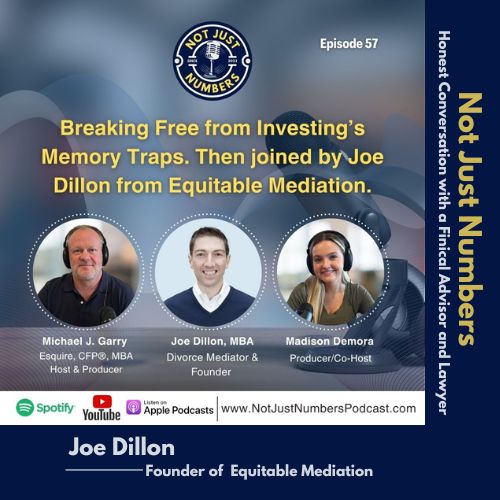
Episode 57: Breaking Free from Investing’s Memory Traps Then joined by Joe Dillon from Equitable Mediation

Hosts: Madison Demora and Mike Garry
Guest: Joe Dillon, Founder of Equitable Mediation

Episode Overview

In this episode of Not Just Numbers, Madison and Mike explore how our personal financial memories, whether shaped by market crashes, bull runs, or housing booms, can cloud judgment and influence investing decisions. Inspired by Jason Zweig’s Wall Street Journal article, they unpack the dangers of recency bias, the evolving role of cash in portfolios, and the importance of balancing historical perspective with real-time adaptability. Learn how to avoid overreacting to market noise, keep emotions in check, and build a strategy that stands the test of time. Then Mike and Maddie were joined by Joe Dillon, a nationally recognized divorce mediator and founder of Equitable Mediation. Drawing from his personal experience as a child of divorce and nearly two decades of professional expertise, Joe explains how mediation can save couples time, money, and emotional turmoil compared to traditional litigation. He shares real-life examples, common financial pitfalls, and practical tools for navigating complex decisions, especially when children are involved. Whether you’re facing divorce yourself or supporting someone who is, this conversation offers a candid look at why a fair, informed, and child-focused approach can lead to better long-term outcomes. Link to WSJ article: https://www.wsj.com/finance/investing/the-mistake-youre-making-in-todays-stock-marketwithout-even-knowing-it-8549894e

Listen to Our Podcast On:

TIMESTAMPS

00:08 – 00:51 – Introduction to episode topic: Breaking Free from Investing’s Memory Traps
01:07 – 04:40 – How Experience Shapes Investing
04:41 – 07:24 – Avoiding Memory Traps & Overcorrecting
07:25 – 09:24 – Striking a Balance & closing remarks
09:31 – 58:56 – Interview with Joe Dillon from Equitable Mediation
Follow Us on Social Media

Stay updated with the latest episodes and news by following us on social media:

Connect with our Special Guest

Equitable Mediation website

Episode Glossary

  • Recency Bias (behavioral economics): The tendency for people to overweight new information or events without considering the objective probabilities of those events over the long run. 
  • Noise (in investing): Refers to misleading information or activity that obscures genuine trends, making it difficult for investors to accurately assess market movements and underlying value.

Key Takeaways

  • Recency bias can trap investors into expecting past market performance to predict future outcomes, leading to flawed decisions; instead, rely on broad historical market data to maintain perspective.
  • Cash is now a viable asset class with high-yield savings accounts and treasuries offering 4% or more, making it a valuable component for liquidity and risk management in a diversified portfolio.
  • Divorce mediation, unlike attorney-led litigation, uses a neutral third party to facilitate direct, data-driven negotiations, often resolving disputes faster and at a lower cost (e.g., $25,000–$50,000 for litigation vs. mediation for the cost of one retainer).
  • Common divorce financial mistakes include ignoring tax implications (e.g., withdrawing from a 401k without accounting for taxes) or prioritizing illiquid assets like a house over liquid assets needed for living expenses.
  • Mediation’s structured process, including discovery, budgeting, and balance sheets, helps couples make informed decisions, with a 98% success rate when both parties engage fully, compared to a 70% average for general mediation.

Transcript

Breaking Free from Investing’s Memory Traps

Introduction

Madison: Hello everyone, and welcome to Not Just Numbers, Honest Conversations with a Financial Advisor and Lawyer. I am Madison Demora and I’m here with Mike Garry. Mike is a financial advisor and a CFP practitioner and the founder and the CEO of Yardley Wealth Management. He is also an estate planning lawyer, and his law firm is Yardley Estate Planning. Hey, Mike.

Mike: Hey, Maddie. How are you?

Madison: Good, I’m good. How are you doing today?

Mike: I’m good.

Madison: All right, so today we’re talking about a mistake a lot of investors are making without even realizing it. It’s all inspired by an article in the Wall Street Journal by Jason Zweig titled “The Mistake You’re Making in Today’s Stock Market, Without Even Knowing It.” So let’s start with the central idea of the article. Zweig talks about how personal investing experience, or what he calls memory banks, can skew the way we view the markets. Have you seen this play out with clients?

Memory Traps in Investing

Mike: Absolutely. All the time. You know, we all have this tendency to think that, like, how we have experienced things in the past, is a reliable predictor of the future. There’s something called recency bias. It’s that, in behavioral economics they talk about a lot, that what everything has been going on is going to continue going on. And that’s really not how the world works, you know, and so if someone lived through the dot com crash or 2008 great financial crisis, they may always view the stock market as like fragile. On the flip side, someone who’s invested in like the magnificent seven the last ten years, just think like, well, I should always get 100% returns. But you know, markets evolve, adapt, change and clinging too tightly to past patterns can set us up for missteps, you know, have to be careful.

The New Value of Cash

Madison: The article points out how cash, which many investors used to call “trash”, is now actually a valuable asset class thanks to higher interest rates. How should that affect the way we think about portfolio allocation today?

Mike: Sure, it is a big difference. And for a long time, people get zero returns from cash. It’s still not the same as stocks or bonds, so it’s still not generally a long-term investment. But it doesn’t yield zero anymore. And so, with high yield savings accounts or short-term treasuries, you can get 4% or more. And so, I don’t know that has a role in a diversified portfolio like stocks and bonds. But now it’s okay to have your liquid cash, and your emergency and necessary cash and get to the amounts that are reasonable for you as part of your liquidity and risk management. Because you can’t just have all stuff invested. You need to have stuff in case of emergencies.

Generational Differences in Investing

Madison: That brings me to another angle Zweig explorers, how generational experiences shape views on investing. How do you see that generational divide play out?

Mike: Yeah, it is interesting, right? So, like some people, so young investors who started after 2009 have seen bull markets basically for 15 years. Other than that, COVID 19, the quick Covid and occasional down year or two. Meanwhile, older generations who started, you know, in the 70s, and 80s when markets weren’t gangbusters, might not have that same view. And those different experiences might change how different investors view success. You know, and then outside of the markets, there’s the whole thing with how, people’s experiences. Right. Like some people bought houses and saw them appreciate quickly. Right. Like Maureen, she’s been in her house less than five years, and it’s appreciated a lot. We bought our house in July of 05, and I don’t know if it was worth as much as what we paid for it 10 years later. Right. And so, people have different experiences, and so that leads to different perspectives that people have about all sorts of financial things. Right. And so we need to work with clients to make sure that their perspectives are like, reasonable. Right. And that they don’t cling too hard on some either good or bad experiences they’ve had with money.

Avoiding Memory Traps

Madison: All right, let’s talk about memory traps. Zweig warns investors about becoming prisoners of their memory banks. What are some ways we can avoid that?

Mike: Yeah, one of the best things that we use, is historical perspective. Right. And instead of relying solely on personal experience, look at the broad market data, you know, going back decades, or we have a century of good stock market returns. And use that context to inform your decisions and stay humble. Right. Like the markets don’t follow our personal scripts. You know, my old boss used to say, you know, unfortunately, you know, people would buy individual stocks a lot more often than. Right. And so, because they wanted to and advisors were okay with it, we don’t ever really do that anymore. But, you know, sometimes people would buy a stock, and it didn’t turn out the way they liked and it would go down. And they said, well, I’m just, I’m just waiting for it to go back to even before I sell. And my old boss would say, well, unfortunately, the market doesn’t know where you bought it, and it can’t go back up to what you need to sell for. Right. So, you know, you need to be flexible, you need to plan, you need to check in with your advisor. And all that hopefully will help you avoid anchoring to like, outdated assumptions and give you like, you know, the best, mindset going forward.

Risks of Overcorrecting

Madison: All right. On the flip side, is there a danger in overcorrecting? Like, if people suddenly move heavily into cash or gold because of recent headlines, can that backfire?

Mike: Definitely. Definitely. Right. Overreacting or reacting strongly to the market generally is not a good idea. Right. You know, there are going to be short-term shifts or trends in the market. Most of that is noise. Right. Somebody should have, you know, like the whole idea, you know, and it sells a lot of newspapers I guess, or people talk about it like, oh, this is the asset class to have, you know, emerging market or growth or value or something, you know, like, yeah, you should have a lot of different things and you should have them in the proportion and allocation that makes sense to you. You know, don’t get carried away in the short-term noise of the market. You know, look at how things work for the long term and set up your portfolio for that. And you know, if something happens that’s like, interesting in the market and like, you want to talk to your neighbor about it over the fence or, you know, when you have your family over for a barbecue, that’s totally fine, but don’t invest that way. You know, stay in your globally diversified portfolio.

Balancing Long-Term and Short-Term Strategies

Madison: All right, so how do you strike that balance between staying grounded in history and still being nimble enough to adjust to what’s happening in real time?

Mike: Sure. You know, that’s a great question, Madison. Like, you have your core strategy, right. And that’s rooted in market data, and science and things of, you know, all the experience that we’ve accumulated over the years. But it’s okay to have a small amount of money set aside for like, the interesting things. Like if you really think some sector or some stock is going to be good and if you can limit yourself to a small percentage of your net worth because you’d really like to follow that, that’s perfectly fine. We’ve had people do that a lot over the years and generally what we find out what happens is maybe it’ll have that stock, or that sector fund or whatever. Maybe they’ll keep it long-term and maybe after a couple years, like, I don’t know why I got this, can we sell it? Oftentimes it’s for a loss because, you know, it was something that was real popular and a lot of people bought it and bit it up and then it didn’t go anywhere. But, you know, the big thing is to make sure, like, you can kind of keep your emotions in check and be grounded, you know, and have like, the long-term strategy with the occasional small amount of, you know, what people like to refer as fun money.

Madison: That’s a great note to end on. Just because we’ve seen it before doesn’t mean it’ll play out the same way again. And that’s why a thoughtful, well-rounded strategy matters now more than ever. Mike, thanks for helping us see how memory and market behavior are more connected than we think.

Mike: Anytime, Madison. It’s always a pleasure discussing this stuff with you.

Madison: And remember, smart investing isn’t about predicting the future, it’s about preparing for it. Today’s guest is Joe Dillon, a nationally recognized divorce mediator with over 17 years of experience helping couples navigate one of life’s toughest transitions. With an MBA in finance and advanced training in negotiation and mediation, Joe brings both expertise and a deeply personal perspective to the table. As a child of divorce, he saw firsthand the emotional and financial damage traditional litigation can cause, and it’s what led him to create a better way forward. Whether you’re going through a divorce supporting someone who is or, want to understand the financial side of major life transitions, Joe’s insights are ones you do not want to miss. Joe, welcome to the show.

Joe: Hey, thanks for having me.

Joe’s Journey to Mediation

Madison: So, Joe, thank you for joining us today. To start, can you tell us a bit about your personal journey and what ultimately inspired you to become a diverse mediator?

Joe: Sure. So, I would probably say, my parents litigated their divorce, right. So, this is back before mediation was really a thing. And I am like the walking stereotype of everything you should not do in a divorce, right. So, my parents, you know, kind of pitted me against each other. You know, each of them, I sat in the back of the courtroom watching them argue. This is a great way to spend your teenage years, right? You’d rather be out playing sports or, you know, going out, hanging out with your friends and doing things. And unfortunately, it dragged on for a really long time. And so, my mom, it was really ultimately my mom, who I lived with full time, and they fought and yelled and screamed so much that the last time I saw my dad was in the courthouse when I was 15. And I never really heard from him again. I got a letter once or twice, maybe once, I think, telling me he was getting remarried. And then the other letter I got was in 2019, saying he had died, right. From his lawyer, from his estate. So those are the only two communications I had with him once my parents divorced. So that’s a span of about, oh, I’d say 35 years. And so, you know, for me, it’s like, hey guys, this didn’t have to go down like this, right? There is a better way to do this. And a lot of folks, unfortunately, what happened is they think, oh, no, no, no, that’s not going to happen to us. That’s not going to happen to me, right? We’re going to, we’re going to be friendly and all this. And then somebody says something or a lawyer gets involved and, you know, before you know it, you’re off to the races like my parents were. And so, it really just bankrupted them emotionally, probably my mom almost financially, right. She still worked well into her, what should have been retirement years. And so, I just kind of looked at that and I said, you know, I kind of do this to help people avoid what happened to me, right? So, I’m sort of the walking wounded, but also a walking warning sign. And so, you know, I think that lends some credibility to it, right? When you say to people like, you don’t think this can happen, you’re talking to a guy as a kid of divorce that has happened. So really, I think that’s what kind of brought me into it.

Mike: Joe, so what you said there about how people go into it, like, okay, when they realize it’s going to happen, they think, oh, it’s not going to be bad. It’s not going to happen to me. It’s not going to be the worst. I remember, when I was in law school, I had a friend who got divorced. And so, you know, and he said, look, we’re in our 20s, we don’t have any kids, we don’t really own anything. This should be easy. And then like a year later, he said, you know what if she wants this fork, I’m going to fight her over it now.

Joe: Right.

Mike: And he’s like the most reasonable, easygoing guy. And, you know, unfortunately people go through a process, and the situation really takes a toll on their humanity, I think. You know, and really, doesn’t have to be as bad. When you said that, I thought, I’ve heard that so many times, like, oh, this isn’t going to be that bad. And then it more often than not, it is.

Mediation vs. Attorney-Led Divorce

Joe: Yeah. And I think a lot of it has to do with communication, right? When you’re working with a mediator, there’s direct negotiation. And, like, think about all of us with, like, our friends or our family, right? Think about a friend you’ve had where you just sent a text, like, offhanded or some message or something, and then they write back, like, what do you mean by that? And you’re like, whoa, you know, nothing. Like it was just an offhand remark, right? Like, you know, and people get crazed when they don’t have the ability of correcting that communication right away. You know, it takes time to go through the channels, right? From one lawyer to the other. And, you know, attorneys are busy folks. And so, you know, these communications can sometimes fester for days or weeks. And, you know, it could have been a simple offhand comment that got resolved right away when working in mediation where you’re directly resolving conflict right there in real time, you know.

Madison: All right, Joe, so for listeners unfamiliar with mediation, how would you explain the key differences between, mediated and attorney led-divorces?

Joe: Sure. So, with a mediator, you’re working with one professional like myself, right. So, as I say to clients, I don’t represent either of you, but I advocate for both of you and your kids when applicable. Right. So, we’re all working together in real time to resolve all the issues you need to resolve in a divorce. Now I’m going to create options. I’m going to share with you my experience. I’m going to take you through a number of financial processes because, you know, Mike, you and I have that in common, right? We say the numbers don’t lie, right. Here’s whether you want to know the reality of your financial situation or not. I’m going to share it with you. And that’s how we’re going to craft these settlements, right. So, we’re really trying to use reality-based settlements, negotiating from a position of information, of data, of discovery, and trying to get both people to understand that you have to give to get, right? So, as I like to joke with my clients, I’m like, if both of you are slightly unhappy with me at the end of this process, I’ve done my job, right, because it means somebody’s gotten something, but they also have had to give something. Now, if you’re working with an attorney, it’s what, you know, your attorney represents you and only you, just like your ex or soon to be ex-spouse, would represent them and only them. And so, they’re advocating for their clients as they are trained and paid to do. And so, their concern is not what the other side gets, right. Their concern is to make sure that their client and their side get as much as possible. And as you know, those of us in this profession, right, we know there are attorneys who are cooperative and there are attorneys who are scorched earth, right? And they will go to the ends of the earth and burn the house to the ground just to make sure they get the proverbial fork like Mike was sharing, right? So that’s really something. That’s a big difference. Now, granted, there are times where mediation may not be appropriate, right? Where say, there’s domestic violence or there might be, someone’s hiding assets, you know, those kinds of things. But now we always say, look, when you try mediation, mediation isn’t binding until you make it so. So, when you go through mediation, right, the agreement that you come out the other side with, you’re not making it binding until you enter that formal, you know, legal filing process. So why not try mediation? In our case, you know, our rate is about 98% of our clients reach agreement. So, you’ve got a really good shot if you’re willing to engage in it. Right. But then again, like I said, there are times where you have to have both parties willing to engage. One party might not be. They think, oh, I’m going to just fold my arms and dig in my heels and then that’s unfortunately where you need to involve attorneys. So, I’d say those are kind of the big, big differences.

Mediator Neutrality

Mike: You know, I went to law school a long time ago, but I did go to law school. So, there’s that little bit of cynicism that comes from it. One of the things I was thinking was, did you ever have problems where, like, one soon to be ex-spouse, like, sees your website or gets your info and says, oh, I think this would be a great idea? And the other one’s like, no, if you want that, it can’t be good for me.

Joe: Right, absolutely. This is your mediator. I hear that a lot. And it’s like, wait a minute, I’m not your mediator. I’m your mediator. Right. Collective. The collective. Right. But that’s it. And also, you know, you get people where, oh, he’s a guy, he’s not going to stick up for women. And then meanwhile, what they don’t know is I was raised by my Italian mother and my Italian nana. So, if anything, you know, I tend to lean in that direction. You know, not professionally, of course, but personally. Right. I know what it’s like for them. I grew up with a single mom. I’m an only child. But yeah, absolutely. And that’s part of it. That’s a part of the misunderstanding, is that we don’t take sides. Right. We want to get you collectively the best deal. Because I’ve seen it in my own family, I’ve seen it where my mom, for example, you know her, she ran out of money. Really what I think, really what happened in her divorce. And so finally she just gave up on my dad’s pension and, you know, she was still working into her 70s and early 80s. And you’re like, this doesn’t seem mathematically proper. Right? Like, this doesn’t seem right. But the numbers weren’t there for her. Right. It’s like, because she just gave up because she just couldn’t afford to continue the fight, which was unfortunate. Right. Because at the time she was 45, but it impacted her 40 years down the road. Right. So, yeah, we do get that, unfortunately.

Mike: And do you, I feel like just from talking to you, the little bit that I have, that, you seem to me like you’d be a very fair and reasonable person. Do you think that mediators have similar personalities? And you think it’s something like, to be a good mediator, I think you have to be pretty even handed. I would say most people probably couldn’t do that. Not for a living, anyway.

Joe: Yeah, no, I appreciate the nice remark. And I do think, you know, and I say this jokingly to my friends who are attorneys. Right. As you would imagine my line of work, I have a lot of friends and colleagues who are attorneys.

Mike: Sure.

Joe: And I always ask them, I say, how do you go from advocate hat, right, where today I’m lawyer, and then I also want to be a mediator, and then now I’m neutral. Right. And I find that attorneys have a lot of difficulty being neutral because that’s not what they’re professionally trained to do. Right. And so, as a finance person, right, I’m looking at everything pretty analytically from the kids perspective, from the family’s perspective. Right. And I’m just saying, look, you two, like this, here are the numbers. Here’s your budgets. Here’s your budget. Here’s your retirement. Here’s your retirement. Right. And then I ask clients, like, well, explain to me, like, do you guys think this is fair? And if not, explain to me why. Right. And then that’s part of the conversation. So, yeah, I think it is difficult for people to be neutral. And also, you know, make no mistake, right, we’re all human beings. We all have our own biases. So, at the end of the day, you know, somebody like me, I work really hard to say, look, just because perhaps that person’s not my cup of tea, it doesn’t mean they shouldn’t have a fair outcome. Right. Everyone deserves to live their life. It’s not my settlement. I don’t have a horse in the race or whatever, you know, other euphemism you want to use for it. But, yeah, I think that’s a fair point. Mediation is a skill in itself. Being neutral is a skill in itself.

Mike: Yeah, I would think so.

Joe: Yeah.

Child-Focused Mediation Outcomes

Madison: So, Joe, you’ve seen firsthand how courtroom battles can leave both parties worse off emotionally and financially. How does a mediation approach, especially when it’s child focused, help couples reach better long-term outcomes?

Joe: Yeah. So, I think the first thing, that is the financial aspect, right? You know, when you think about, we say you can mediate your entire divorce for the cost of like one attorney retainer, right? And so, when you think about that and you say, do I want to put my kids through college or do I want to put the attorney’s kids through college? Right? And you say that to people and they think like we were just talking about before. Yeah, yeah, yeah, sure, no problem. But you know, the Wall Street Journal, if you believe them as a source, say a friendly attorney driven divorce is between $25,000 and $50,000, right? And so, when you say, okay, well, you know, hey, if you want to spend that money on it, good, good on you. Right? But if it goes sideways, you’re probably looking at closer to $200,000. And that’s probably about the cost of a four-year public university right about now. Could be a little higher, actually. I’m a Drexel grad from Philadelphia, so, you know, I know Drexel probably about that per year right now. But in all sincerity, you know, you look at that financial toll, right. You say, listen, you guys could save a lot of financial resources for you and for your family and for your kids. And the other thing is too, which another point of emphasis like around child focused is you say, look, I get that you’re not going to be spouses anymore, right? But you’re still mom and dad. And that’s what happened personally for me is that my dad wasn’t at my high school graduation because he was so mad at my mom. He wasn’t at my wedding, he wasn’t, right? And you remind people. And having that neutral third party in that forum with both of them present allows you to kind of, in a way, sort of parent them and say, listen, you two, you know, your kids don’t care that you don’t want to be married anymore. When there’s a soccer game or a dance recital, they want to see both your faces in the audience next to each other, right? And so, we kind of use that to kind of say, not only you have a financial cost, you have an emotional toll, and you don’t want to go through this long, arduous process. And the last thing I would say is that, you know, you can mediate a divorce in like, two to three months. Right. My parents, I think it took close to three years for everything to be final. And that’s a long time to not be focused on your kids. Especially, like, during my teenage years, right. It’s like, you know, kids can get in a lot of trouble if left unsupervised. I was an only child, right? Good thing I was a relatively good kid. But, you know, you want to spend that time. Do you really want to give up those precious years with your kids to go spend them in a courtroom or in this litigious, you know, circle of battle? Let’s get this resolved, let’s get you moving and healing and moving forward. You know, so we try to use all the, you know, aspects of it, financial, emotional, legal, technical, and hopefully one of them resonates, right, to help them moving forward.

Factors in Mediation Success

Mike: So I think a few questions back, you said like, maybe like 90, some 98% of the time mediation works. And I know there are some parts where, like, they just don’t make any sense for mediation. If there’s some violence or, some other things. And the 2% where mediation doesn’t work, are there commonalities or it’s just like, different random things come up that make it just not possible for them to conclude the mediation?

Joe: Yeah, good question. So, our case resolution rate is 98%. The average is about 70% for mediation in general. And to answer that question, Mike, is that there are different styles of mediators, right. So, when you talk about neutrality, my style tends to be what we call directive, right. The opposite being facilitative. When you get, so as you guys probably saw, you know, I have taught mediation, right. So, I teach other mediators to be mediators. And I was a facilitator at Northwestern University in Chicago, where I’d lived for five years. And there it was a lot of attorneys and a lot of therapists, you know, mental health professionals, because you think about it, marriage counsel see a lot of couples breaking up, and they think, hey, I’ll be a divorce mediator. So, their style tends to be more like, well, how does this make you feel? How does the conflict make you feel? You know, can you share with me what you’re thinking? You know, and that’s fine, but that doesn’t necessarily, in my experience, move you closer to resolution. So being more directive doesn’t necessarily mean I’m telling you what to do. I think my style combined with our process. And I think this is really important. One of the things that gets divorces off track is that one day you’re arguing about this, then you’re over here, then you’re over there, and it’s like you’re letting, you know. When we were, before we got on, we were joking about our dogs and how, like, when we take them for walks, if you don’t have a real tight hold on those leashes, right, those dogs will chase that bird and you find yourself face down on the pavement. Right. If you don’t act as the strong guiding hand, keeping people on track, keeping them focused on the issues, keeping them talking about the things they need to talk about in the order they need to talk about them, that’s when things go awry. And so, our experience shows that if you follow our, you know, this is our own proprietary process, all of our own forms, worksheets, experience, if you follow us and you stay on our track, you’ve got an excellent shot. The 2% are the folks who either know better or who don’t want to follow the process. And as we know, right, from our professions, I can’t help you until you provide me information. Right. Like you as a financial advisor, you go, well, great, what are you currently invested in? What are your goals? You know, what’s your savings rate? Right. And people, I’m not telling you that. You’re like, well, how am I supposed to help you? You know? Right? So that’s usually what happens. The worst thing you can say to me is, and I send this to a warning to anybody out there who’s listening. And even if you’re going through with a mediator or a lawyer is if you say, why do you need a copy of that? That’s an immediate red flag to me. Right. That’s a ut-oh, you know. Well, I kind of need to know how much you make if we’re going to talk about child support, you know. Right. So, all kidding aside, that’s really what it is. So that’s really what I think the commonality is, unwillingness to fully embrace and engage in the process.

Mike: Gotcha. Yeah. So those people need to be litigated against.

Joe: Yeah, unfortunately. Which stinks because at the end of the day, right. People don’t get it. You can either tell me, or you can have a judge compel you to give this item, right. It’s coming out. You’re not that clever. Judges are smart people. They got to that place because they’ve shown time and time again. Right. The ability to be fair and thorough and intelligent. Right. So, good luck to you. Right. That’s what I say. I’m going to sleep at night. I wish you well. Right. Sadly.

Mike: You know, it’s funny, you think of the people like that, you know, that think they’re going to be smarter than the mediator or the judge or something and hide out. Like, they’re not the one millionth guy to think that. Right.

Joe: Yeah. My favorite story is, you know, of course, anonymizing is I’m having a negotiation of child support with a client couple in New Jersey. And this gentleman, without missing a beat, leans back in the chair, big old grin, you know, got the arms on his chest. I remember to the day, to this day, he had a Philadelphia Phillies hat, you know, on. It was like, clear as a bell. He’s like, I don’t have to pay child support. And I’m like, really? He goes, I’m going to walk into the courtroom, and the judge is going to love me. And I’m just going to say, your honor, don’t worry about it. I’m not going to pay child support. And the judge is going to agree with me. And I’m like. And I looked at him, I said, do you look good in orange? Because you’re probably going to be in a jumpsuit somewhere in a county jail, right. And these guys, these people are just so, they’re so diluted to this. I’m like, how do you think your kids are going to eat or a roof over their head or whatever, you know? And I don’t know what planet he lived on, but, you know, this is in Somerset county in New Jersey. And I’m like, well, good luck to you. And that’s one of those cases where I said, well, here’s your agreement. If you decide to pay it, this is, this is what you guys have agreed, that you’ll pay. And we did get them to an agreement, but then it becomes a function of enforceability. And I shared with the wife in this case that you may want to look into the New Jersey Payment Support center, right, and have this doctrine, paychecks and things like that. Because this is going to be a battle royale. I think their kid was like, 12 or 13 at the time. And you don’t want to spend the next five or six years, you know, trying to chase this guy down for a weekly or monthly check, you know, so.

The Mediation Process

Madison: So, Joe, I know you touched on the process. Can you walk us through what a typical mediation process looks like with you and your team?

Joe: Yeah, sure. So we first, so, the way we kick things off, right, we always want to meet together, me with the client, potential client couple, to make sure we’re a good fit, right. And part of it is I’m engaging with them to see if they are willing to actively engage, if there’s any red flags. And for the most part, people tend to be self-selective, I hope when they want to mediate, right. Like Mike was saying, if you get one person who says yes and one who says no, then of course, you know, they’re not going to become clients. What we do is we kick them off with what we call a strategy session. And so, in this we say to them, look, we’re going to meet for an hour. We’re not going to negotiate anything. We’re going to just put all the issues on the table, right. I want to know what we’re up against. I want to know what your hot buttons are. What are the things you really want to make sure you resolve. Of course, besides all the obvious, parenting plan, child support, alimony, property division. That’s not what we’re talking about. But it’s all the little landmines, of all the little stuff that crop up in the middle of a negotiation that can really throw you off. Then from there, we also educate them on our process, our discovery process, our forms, our worksheets, our data, you know, data collection. And I have a saying I say to clients, don’t do the deciding before the discovery. And I mean that. A lot of folks will come in and they’ll say, you know what, Joe, we got it all figured out. We talked about it X, Y and Z. And I’m like, this is going to be one of the worst cases, right. As soon as they say it’s the easiest, like we were just talking about, right? It’s one of the most difficult. And to that point, what winds up happening is they’ve made decisions in a vacuum without information. So, Maddie, if I said to you, hey, where do you want to go to eat today? What’s the first question you’d probably ask me? It’s like, what’s around here? What’s good? Like, say you were visiting me in California, right? And you weren’t, you never been there before. You’d be like, well, where do you go? What’s good around here? And I’d be like, come on, Maddie, tell me, where do you want to go to dinner? And you’d be like, Joe, I don’t know what the choices are, right? How are you supposed to pick this? Right? So by going through that information gathering process and putting that all out on the table, we now know what we have to work with, right? So, we do that. That sets our foundation. From there, we get into negotiation. So, as we’re going, right, we’re doing exercises, we’re filling out forms, we’re completing worksheets, we’re drawing in different data that you guys have collected and using that in our process that we decided, the three of us in our initial meeting, right? In that first strategy, if you guys said you want to put your house on the market right away because, school coming, you know, we got to get the house on the market before the school year is over, we’ll start with property division, right. So, in other words, I’ve got buy in from the client that we’re going to do things in the order they want to do them in. And so, I get to also call them out if they don’t follow their own choices, right? Which is a good way of keeping them on track. Well, guys, help me understand here, you told me you need to get your house for sale quick, and we’re arguing a lot about what color we’re going to paint the spare bedroom here. That’s not going to help us get this house on the market that you told me needs to be on the market by August 15th, you know? So, those are the kinds of things you can do. And as we go back and forth, I think of mediation like a funnel, right. You start at the top of the funnel, right, think it’s real wide. Eventually you get down to the bottom, where, okay, folks, we only have a few issues we have to resolve. It gets narrower and narrower, right. And that’s where we can usually get people to say, look, you can see the finish line, even if there’s conflict, guys, you just have this one last thing to resolve. Come on, we can do it, right? So, I’m kind of part cheerleader. Then once we get them there, I go away, draft their agreement. They can have a chance to review it. It looks locked and tight. And then really, at that point, you know, once they’ve got everything agreed to, filing is administrative, right. It just becomes really the court, the paperwork, the waiting period in Pennsylvania, there’s no waiting in New Jersey, for example. And so really, what we try to do is, as you can see, do a lot of the heavy lifting up front. So, we all have the data, we all have the information. We’re sharing everything in a transparent way. We use bots as our file sharing. Right. And we have this whole sharing system where everybody can see everything. And I think by doing that, that’s what really helps people understand, he’s neutral, he’s transparent, I understand why we’re making these decisions, I see the information in front of me, as much as I might not be happy about this outcome, I understand it to be reasonable or fair. Because you’re telling me your budget, you need $5,000 a month and you only earn $2,000 a month. Yeah. You’re gonna need some help. Right. So, it’s all those kinds of things that we’re doing along the way and reinforcing those messages and making progress incrementally so that people can actually see. And this is a big issue in divorce because you think divorce is a conflict. These folks have not been getting along for years, most likely. Now you show them that, hey, guess what? Look at you too. Right? You never thought you could do this. You’ve made all these great decisions. You’ve agreed on a parenting, on your child support, when you’re going to sell your house, great work. And I think they get that momentum from someone like me, that energy from somebody like me, and that really helps them move forward. So that’s really kind of the process in a nutshell. And it really does help, right, because they start seeing the progress. They stay on track. And then before they know it, they’re done. And they’re like, usually the last things people say to me really is, it’s over. I’m like, yeah. That was a lot better than I thought it would be. It’s like, good, you know. Right. Because that’s what we want. Right? So, I hope that answer made sense.

Madison: Yeah. It’s funny, towards the end, you answered a question that I had in my head when you were talking. I was going to ask, does it get, you know, you said it’s like a funnel. So, when you get towards the end, like, does it seem to get easier for the, you know, soon to be ex-couples? You know, they see all the progress that they’ve made and they’re like, wow, we really did this.

Joe: Yeah. Yeah, it does. I think most of them it does. And the ones where it doesn’t, it actually also helps because there’s usually one person in a negotiation that if you’re reaching that point, right, where it’s like we have an impasse, we call it. There’s usually one person who’s throwing all kinds of offers on the table and the other person is just saying no. It’s like, you know, trying to get a five-year-old to like, you do something, right? Cross their arms, no, no, no, I’m not doing that. Right? And so, one party who’s trying to give and give and give is like, well, they’re being unreasonable, I’ve offered X, Y, Z. And then usually the benefit of time, right, eventually that other person, when I think they just enjoy the saying no. When the person who’s doing all the giving says, well, you know what, I give up. I’m going to get a lawyer. That’s usually what gets their attention. And that’s the moment where it’s like, fine, okay, we’ll put the house up for sale August 15th. Meanwhile, that’s what they had told me they wanted to do the whole time, right? We sometimes as a mediator, you also have to know when to wait people out, right? We all talk about when we negotiate. A good negotiator also knows to use silence as a tool. Now, not on our podcast here, because that would be awkward for the listeners. But part of me is just being on a Zoom with people and just staring at them and it makes people uncomfortable, which is kind of the point, right? Is that somebody finally just speaks up, right? And it’s like, that’s when we can get things moving along again, right? So, I’d say to your question, Maddie, more often than not, yeah, people are like, you know what, I got this, I got more, you were really generous giving me some of your 401k. You know what, you can stay in the house an extra year. We’ll put it up for sale next spring. Don’t worry about it. Right? It’s like those are the moments as a mediator you live for, right? Yay, we got something. Right?

Financial Mistakes in Divorce

Madison: Can you share an example of a financial mistake you’ve seen couples make during divorce negotiations that had long term consequences?

Joe: Oh, yeah. I, you know, boy, there’s so many of them. But one of my favorite favorites, really bad way to put it is, forgetting about the tax implications on negotiated agreements. Right? Literally yesterday I had a client who said, well, I’ll just give, you know, my wife, she needs $40,000, she wants to go put it down on a condo, and so I’ll just write her, you know, give her money out of my 401k. You’re like, okay, you realize those are pretax dollars, right? And that if you do that, you know, you’re probably going to get whacked with 40% roughly. Right? Because, you know, Uncle Sam and the governors of various states love to take the big lump and then make you wait until April 15th to get it back. Right? Stuff like that. Or when they look at the settlement and they say, well, gee, you know, we bought this house, and, you know, this is current tax law, so it depends on when somebody’s listening to it, I’m not a tax accountant by any means, by the way, but, you know, we bought this house, you know, 25 years ago for $200,000, and now we can sell it for a million dollars. And, you know, if I take it over and I have a $250,000 capital gains exemption on the sale, and I’m counting on, you know, this to be my bank, my retirement, and suddenly, you know, I’m going to now start owing taxes because I never kept any receipts of any capital improvements. You know, it’s like all of a sudden, that profit that I exchanged, thinking I was going to be pocketing $800,000. Because I let you keep $800,000 of your 401k, I’m not walking away with $800,000. And suddenly I have a real problem on my hands, right? And so, as someone, as a mediator with a, MBA in finance, I’m kind of acutely aware of that. Like I said, I’m not a tax advisor or CPA, but that’s the stuff that really hangs people up. All dollars are not created equal, right? You sell a stock, you can- I had a client, he was in love with Apple. He was, as they say, a fanboy, right? He had an Apple T-shirt every time he came to mediation, his iPhone, his ear buds, right? And he traded basically everything for all the Apple stock. You know, at that time, the stock had really gone up and up and up. And I’ll call him Bob, just as a fake name. Bob, you realize the gains you have on these stocks and what, you know, and the risk, by the way? That, you know, if this thing goes down, right, the house isn’t going to drop 43% overnight, hopefully, right? That stock might do that. Right? And it has up and down over the years. So, it’s those kinds of financial mistakes that people make, and then you can hopefully talk them off the ledge to say, look, I know you love apple, I see your T-shirt, that’s awesome. But this is probably not the greatest approach. But I can’t tell you what to do. Right. But I just want to, as a neutral, say, perhaps you want to speak to your financial advisor about this and see if they think this is a good idea. And that’s what’s also nice about me having folks, you know, like, for folks, for example, like you, Mike, is to be able to say, look, I’m not going to tell you what to do, but do me a favor, before we meet again, go see Mike and ask him what he thinks. Here’s a copy of what you think you want to settle on. Ask him what he thinks about exchanging, you know, a savings account for this much in stock that probably has somewhere close to $500,000 of capital gains in it. Right. You know, so.

Mike: Maddie, when you asked Joe that question, I was thinking about the people who, like, are dying to keep their family home. And so, they will take the home and the value, include it and give up the 401k. And then, like, the home isn’t going to provide money every month for you to eat with. Like, you need financial resources, too. I get to fall in love with the house where you raised your kids or whatever. But you need to be able to move forward. And okay, great, you have this beautiful house, but you might have to work till you’re 80 for money to stay in that house.

Joe: Exactly.

Mike: It’s just the value of something you can’t liquidate easily or piecemeal. Right. Like your 401k, you sell 5,000 or 10,000 a month to take over your living expenses. But yeah, it’s complicated, you know, and I think in this area, I think mediation could be a really big advantage to people compared to, you know, litigating with attorneys, because the mediator is going to try to draft something that’s fair and palatable to both sides, and we’ll keep that in mind. And not like, oh, yeah, well, let her get the house, you take the financial assets and, you know, and then, like, she’ll realize 10 years from now that she really made a bad mistake or a mistake that she can’t live with.

Joe: Houses are a great example, Mike, because, you know, anybody who owns a house can tell you, when does the hot water heater explode and leak all over your basement? Does it do it two in the afternoon on a Saturday? No, it does it four in the morning on a Tuesday. Right. Where you wake up to a flood, you can’t take a shower, you can’t go to work the next day, and you’ve got a mess to clean up. Right. And so those are also the things that you ask people when you get an asset. Is it an asset? Or is it a liability? You know, and houses are kind of both, right. You know, they go both ways, you know.

Mike: You know, like in the past, /people would talk about, like, the appreciation in their house. You know, be excited about it. And the reality is that we put much more money into our house than generations did before. Like my grandparents house, like, they built the house in the 40s, and that’s basically what it was like until they were old, and my uncle started doing stuff, you know. Now people put a lot of money in their houses every year. I mean, so it is, it is both an asset and a liability. You know, it’s a use item more than anything, you know? Yeah, just think, yeah, people put so much money into their houses and they’re nice, but it’s expensive and, you know, there has to be some way of paying for that. Yeah. So, it really is important to take a look at your overall situation. Right? Like, not just, we like this house.

Joe: And it’s funny you say that, when I explain this to clients, I say, okay, have you ever been to a restaurant, or a salad bar, right? Like, just even, right? If you walked up to a salad bar and you saw lettuce and tomatoes and cucumbers and, you know, this whole long line of stuff, right? I don’t know about you guys, but I don’t just go up and put tomatoes on my plate and then go back to my booth, right? It’s just a plate of tomatoes. I’m going down the line and I’m taking a little of this, a little of this, a little that. Divorce settlements. I try to get people to think of it the same way. You don’t want to be asset rich and cash poor, or you don’t want to have all tomatoes, right? You want to have a portfolio that just like I say to people, if you had a portfolio and you had a 401k and you were, you know, saving for retirement, would you do, like my friend there with all Apple stock, nothing but Apple stock, would you base your entire retirement on one company? No. Right. I mean, unless if you did, I would have a real talking to you. Right? And so that’s the same with the settlements, right? You try to get people to understand that. And even if it’s not that, they’ve got a little of everything, at least they’ve got, if you’ve got a house, make sure you have enough liquid cash on hand if something goes wrong. Right. How are you going to repair that roof if it leaks. These are conversations we have. And that’s where I kind of come at it from that financial aspect to say, let’s think this through. I know that’s where your kids took their first steps, and it is a gorgeous house, and I know where you live. You know, I know your neighborhood. But let’s make sure you can also enjoy your life moving forward. And sometimes that’s a difficult question to pose to someone because they know it in their heart, but they’re really just not willing to kind of say, yeah, you’re right, we need to sell this house. They sometimes need time to, you know, go away and think about it, and sometimes they don’t. And that’s perfectly fine as well. Right.

Tools for Navigating Complex Decisions

Madison: All right. You talk about turning complexity into clarity. What tools or frameworks do you use to help couples navigate complex financial or emotional decisions?

Joe: Yeah, so we were talking a little bit about it before. Right. Discovery process. So, we had this like eight-page checklist of all these items we asked people to gather. Because a lot of times in a relationship, it’s been my experience that there’s a, what I’ll call a financial household financial manager. Right. Typically, there’s one person who does the budgeting or pays the bills or does that. Right. And so, the other person has no idea of what’s going on. And especially as situations get more complex, people don’t really fully know what they own and what they owe. And so, the first step that we talked about is that full discovery and we review all those items. We then have people do a budgeting exercise, which they really definitely kick and scream on. But we actually make them do three budgets, which is, you know, probably cruel and unusual, but it is part of the process. So, the first budget we have them do is a joint budget of what their marital spending looked like for the previous 12 months. You’d be surprised at how many people don’t realize how much they spend on common things. Like, I’ll give you an example. This is a perfect one. We were just talking about this before is streaming services, right. Now, we just went through this, my wife and I, because little by little, it creeped up with Spotify, Apple tv, Hulu, Netflix, HBO Max. And all of a sudden, like, why are we spending $183 on streaming? I could get cable at this point, right? And so, we went first through it, but because all that stuff just hit your credit card. So, when you do that, you show people, what are you spending? Is that attainable? Is it tenable? Are you living at below or above, you know, your means? Then we make them do budgets of what their life’s going to look like, separate, moving forward, and then they start realizing just how much it costs to live on your own, right? So that first process helps us set up conversations around child support and alimony. Because then they realize just how much I earn, right? Because I’ve got all your tax returns and pay stubs. And how much it’s going to cost us to live apart. We then have them do another piece, which is a balance sheet. So, we have this balance sheet that they list out all their assets, all their liabilities, and we show them everything in one spot. I’m sure, Mike, you probably do a similar exercise, right? Because everybody goes, hey, my house is worth a million dollars. Yeah, but you owe 750,000 on it. You always forget the mortgage. I have this new car worth X. Yeah, but it’s actually worth less than you owe based on loan, right? So, they, again, in their brains, they don’t understand, because they don’t look at it all in one place. And when you do it that way and you put all the financial reality out on the table, it helps people suddenly get a grasp on reality, which is, wow, we really need to talk about these things. And okay, Joe, we’re going to listen and we’re going to engage and we’re going to go through your process because we’re going to trust in you based on your track record. And by doing that, right, we tackle those issues, we show them the numbers, and then, like, for example, we’ll run, you know, every state. For example, the federal government requires every state to have a repeatable way to determine child support called a guideline, right? So, I bring out some software, I run the guideline, and I’m going to just make up a silly number, say it comes up to $500 a month, right? And then I look at a person’s budget, and you say, well, you have three teenage boys. My guess is you spend at least 500 a month on groceries for the kids, right? Just groceries, let alone streaming, $20 to Starbucks, entertainment clothes, you know. So let’s talk about this, right? We, we sort of, in a way, it’s like reality checking and always going up against that discovery, those worksheets, those budgets, those balance sheets. Right? Because then when you keep doing that and you’re chipping off an issue one at a time, one at a time, one at a time, it helps first, keep people focused, right? Because when it’s really complex, they can get distracted. And then it also helps them understand, like, wow, you know, yeah, this is a lot more challenging. Yes, we are spending more than we probably should. Yes, we do need to cut back, right? Those are arguments they’ve probably had for years, right? But now when somebody like me comes along and says, well, guys, you know, and I’ll say, I’m never going to tell you what to do, but credit card interest rates are probably in the 25 to 29% range right now. And if you execute this budget as you presented it to me, you’re about $3,000 a month short, which is probably going on a credit card at that rate, $36,000 a year, you’ll be bankrupt in about two to three years. Right. And I’m like, if you want to do that, that’s fine, but maybe we could talk about this, you know, and so that’s where you kind of get them, you know, get them back in and get them talking. And I think that all of that reality checking stuff really, to your question, Maddie, really helps is, showing them I’m not trying to be difficult or obtuse. Their spouse isn’t trying to be difficult. This is the reality of the situation and that’s what’s going to help us, you know, move this thing forward and come to agreement. So, yeah.

First Steps for Divorce Preparation

Madison: All right. For someone listening who might be headed for divorce, what’s the first step they should take emotionally or financially?

Joe: So, that’s a really interesting question because, you know, if you do a search online, right, for how to prepare for divorce, you’re going to find hundreds of checklists, right? It’s always, go get tax returns and pay stubs, really tactical stuff. As a professional negotiator, that’s going to come in the process, right? Whether you mediate or you litigate, somebody’s going to have some discovery process, right, to do all that. So, you know, if you go and do that, sure, that that might, you know, might be fine. But if your spouse is not aware that you, you want a divorce, that may actually trigger an unintended consequence. Right. Well, why do you need my pay stubs or tax returns? Right. Well, yeah, I didn’t tell you this, but I want a divorce and I need this information. Right. For me, I think the first step that someone should really sit down and think about is what is it if they go through this process, what is it that they are willing to give and what are their bright lines that they’re not willing to cross? Right. A lot of times people go into a negotiation and it’s just a shouting match and you’re not really sure, you know, what is it you want, what is it that you don’t want, what is it you’re willing to give up? Right. And really sit down and think about, like the house we’re just talking about. Why do I want to keep this house? Do I really want to keep this house? Am I being like, is it just because I have this emotional tether to it, or do I just love the feeling this house gives me? And you know, I have clients, for example, where the house they lived in as a married couple was their childhood home. Okay. Yeah. But then I also, on the other side of the equation, have to ask myself, well, if I’m going to keep this asset worth X, what am I willing to give up and is that okay? Right. Giving up someone’s 401k or pension. Right. So, I think instead of the tactical stuff, people really need to take a moment and say to themselves, knowing that this is a negotiation and knowing that we’re going to have to give and get what are my must haves, my nice to haves, and my don’t really care, you know. And I think sitting down and really, even if it’s something as simple as I really want to keep this car, but I don’t care about the other one, or I really want to make sure that I keep, I have at least a hundred thousand dollars in my retirement account as long as I can also do X, Y and Z. Those are the kinds of things that I think people really need to spend time thinking about. Right. And that goes to the emotional piece too, because when you’re in a state like a divorce, the conversations of course they’re emotional. Right. And when we’re emotional, we don’t make the most rational choices. And sometimes I have had people where just to get out of the pain of the conversation, they’ll be like, I don’t care, whatever you want. I’ll, be like, hey guys, you know, I can’t tell you what to do, but when you retire 20 years from now, you’re not going to necessarily most likely be happy about saying whatever you want and giving up all your retirement, all your pension, the house, right? Like, oh, you know, that’s where I get into this conversation. Right. Again, being able to send people places, I say, you know what? I don’t personally, so as a mediator, I don’t personally require people to retain attorneys throughout mediation, but there are times when I see something that I don’t like, it’s going in the direction I will say, listen, before our next session, I would like you to speak to an attorney. Here are some mediation friendly colleagues. Have them take a look at this. Right? So that’s what I would say is like a lot of it, people think about is tactical. I would say really take, take time to do the looking in work. What is it I really want to have happen at the end of this process? What are my goals? What are my interests? Rather than, hey, the first thing I should do is get copies of pay stubs and tax returns. So that would be my answer to that question.

Learning More About Equitable Mediation

Madison: Where can our listeners learn more about you and Equitable Mediation?

Joe: Oh, that’s an easy one. That’s a good one. I can answer that. Best place is our website, right, which is Equitablemediation.com. If you go on there, you can find out all kinds of information about me, my partner Cheryl, who is also my wife, she’s our divorce coach. So, our process is such that we kind of have this team approach. Again, going to your last question, right, about the tactical, the financial and the emotional aspects we try to help clients with there. There’s also a learning center of all sorts of resources, blog posts on a number of topics. We have state specific guides, you know, including ones for Pennsylvania, New Jersey. Right. We practice in New York, New Jersey, Pennsylvania. We also practice in other states, but I’m originally from, you know, the New Jersey, Central New Jersey. And so that’s kind of our wheelhouse where Equitable Mediation got started in Bridgewater, New Jersey 17 years ago. And that’s really a great place to start. There’s a button in the menu that says talk to us. So, when you’re ready, you can schedule a free call with Cheryl just for you, you know, just for one person to find out if mediation is even an option. And then if it is, you can certainly schedule an initial meeting with you and your spouse with me, right. So always a free call with Cheryl. Check it out, see if it makes sense. If not, you can go through all the resources, the guides, the videos, the blog posts. You know, we really feel strongly, that an educated client is a good client. Right. So that we can give them that, you know, that dose of honesty and that dose of reality. Right. Our bend has always been, you might not like what we’re sharing, but this is what our experience has shown us. Right. If you come in thinking you’re going to get everything and not have to give anything, you’re going to be disappointed. And no matter what process you take through the divorce, right? So that’s what we say. Read the website. Lots of FAQs, lots of questions answered. If you have questions, contact us there, and schedule the call. And that’s really the best way, I’d say, for people to get to know more.

Madison: This has been great. Thanks so much, Joe.

Mike: Yeah, I think this has been a great conversation. I learned a lot.

Joe: That’s good. Yeah, absolutely. Thank you for having me. I appreciate the opportunity to share because, like you just said, right. Mediation’s been around a while, but it’s not necessarily as widely known as you would think it should be. And so, I’ve always appreciate. And thank you so much to both of you for allowing me, the ability to kind of share that message. Right. That there’s a better way to go about this. Right. You don’t have to. Your divorce doesn’t have to be a disaster. Right. Like my folks and, you know, you want people to be able to move on with their lives and get remarried and be good parents to their kids. Right. So, thank you both. I appreciate your time.

Closing Remarks

Madison: Yeah. For more information on Yardley Wealth Management or Yardley Estate Planning, you can visit our websites at, yardleywealth.net and yardleyestate.net. You can also follow us on socials at Yardley Wealth Management. Don’t forget to subscribe to our YouTube channel. This podcast has been produced by Madison Demora and Mike Garry with technical and artistic help from Poe Productions.

Request the Full Transcript as a PDF

The full transcript of this episode is available via email. Please fill out the form below to receive it: